A Polaroid camera that instantly produces a photograph measuring about 50 by 60 centimeters. No enlarger, printer, or digital file—just an enormous physical photograph shortly after you press the shutter. The Polaroid 20×24 is one of the most remarkable cameras in the history of photography. In 2026, it will be exactly fifty years since the first working prototype was built.
Yet this is not the story of a forgotten camera that suddenly resurfaced after half a century. The Polaroid 20×24 remained in use over the years, and specially developed instant material is now being produced for it once again.
It Began as a Demonstration
The story begins in 1976. Polaroid was preparing to introduce Polacolor II film for professional photographers. Founder Edwin Land, however, wanted to show shareholders something more spectacular at a meeting.
So he commissioned a gigantic camera that could instantly produce a twenty-by-twenty-four-inch Polaroid. The prototype was used to take portraits during the meeting.
The response was so enthusiastic that in 1977 and 1978, Polaroid built five fully functional 20×24 cameras. A dedicated studio opened in Cambridge, Massachusetts, and cameras were also sent to places including Amsterdam and Tokyo.
No Ordinary Camera
The 20×24 was not simply an extremely expensive camera that anyone could order from a camera store. Polaroid treated it primarily as an experimental tool for artists.
Selected photographers and artists were allowed to use it and, in return, contributed images to the Polaroid Collection. This also let Polaroid discover what creative users could do with the technology.
It was used by major names including Andy Warhol, Chuck Close, Robert Rauschenberg, Robert Mapplethorpe, Mary Ellen Mark, Sally Mann, William Wegman, and Ansel Adams.
More Than One Hundred Kilograms
The name 20×24 refers to the photograph’s dimensions: twenty by twenty-four inches, or about 50 by 60 centimeters. The camera itself weighs more than one hundred kilograms, sits on a wheeled frame, and has an enormous bellows.
Essentially, it works like a gigantic view camera: focusing is done on ground glass, and the front standard can be shifted and tilted.
But something remarkable happens after the exposure. In the original system, negative and positive materials were fed together with developing chemicals through large rollers. The layers were then peeled apart, revealing the finished instant photograph. No subsequent enlargement. No printer. A photograph measuring about 50 by 60 centimeters emerged directly from the photographic process.
Every Exposure Counted
Photographing with the 20×24 is therefore completely different from using a digital camera. There are no dozens of variations to choose from later. The camera had to be positioned, the subject had to be arranged properly, the lighting had to be right, and the focus had to be precise. The result was one enormous physical photograph.
That is exactly what made the camera so appealing to artists. Large-format photography is slow and deliberate, but Polaroid added something special: the result was visible shortly after the exposure. It was not a preview. It was the photograph.
We still see that principle in modern instant cameras. Systems such as Fujifilm Instax continue to make the immediate, tangible nature of instant photography accessible, although naturally on a much smaller scale.
Film Became the Problem
The 20×24 never disappeared completely. Photographers such as Elsa Dorfman continued using it for years, and modified and new examples were built later as well. Ultimately, the biggest problem was not the camera but the material.
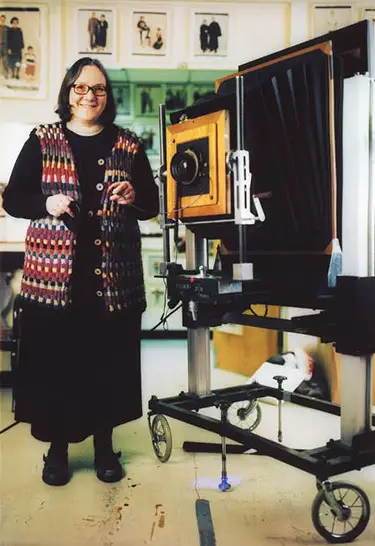
Photo: Photographer Elsa Dorfman with her Polaroid 20×24. Self-portrait: Elsa Dorfman / Wikimedia Commons, CC BY-SA 3.0. By Elsad at the English-language Wikipedia, CC BY-SA 3.0, https://commons.wikimedia.org/w/index.php?curid=29696254
When Polaroid discontinued the original peel-apart instant film, 20×24 Holdings acquired a large stockpile of the remaining film material in 2009. It was kept in cold storage, and the necessary chemicals were reformulated for as long as possible.
By 2016, it appeared that this supply, too, would soon run out. Improvements in chemistry and production procedures extended the life of the remaining stock somewhat, but it was clear that this could not be a permanent solution.
A Second Life
Yet the story did not end there. In 2022, Polaroid BV restored one of the historic 20×24 cameras and developed new instant material that allowed the enormous camera to be used again. This was not simply a restart of the old peel-apart film, but a modern solution for the 20×24. It truly gave the camera a second life.
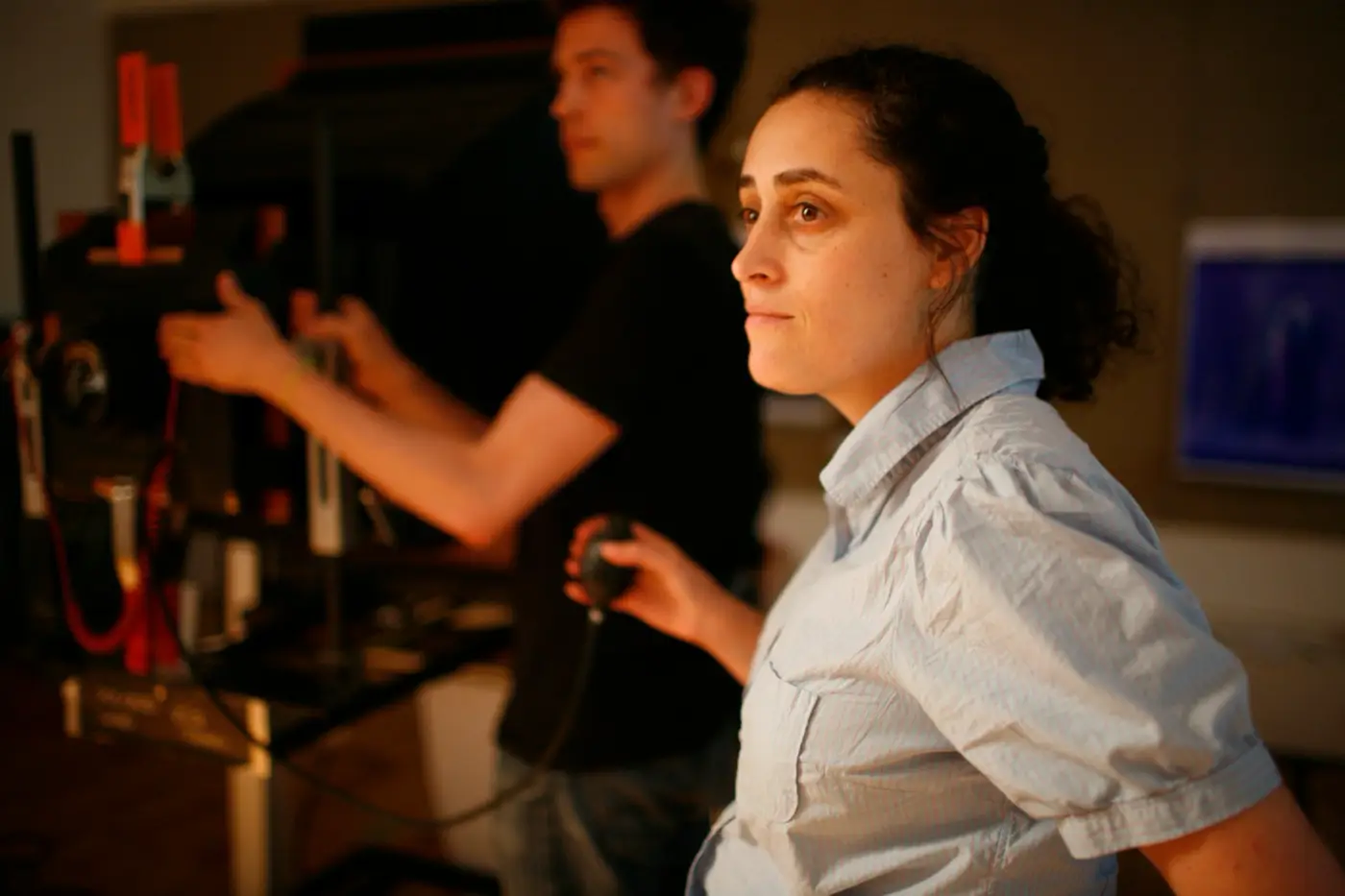
Photo: John Reuter, a photographic artist from the U.S., demonstrates a 20x24 Polaroid camera. He is shown here with a photograph of half an orange taken with the camera. May 21, 1985. (Photo by Victor Colin Sumner/Fairfax Media via Getty Images).
The Polaroid Foundation is once again using the 20×24 as an artistic tool. At the opening of Palazzo Diedo in Venice in 2024, eleven artists were invited to create new work with the camera. John Reuter, who has worked with the system since 1980, supervised the project.
Remarkably, the camera’s fiftieth anniversary coincides with a period in which the 20×24 is once again seeing extensive use. Through the Polaroid Foundation’s 20×24 Project, a new generation of artists is working with the restored camera.
Fifty Years Later
In 1976, the Polaroid 20×24 was primarily intended to demonstrate how impressive new instant photography could be. Fifty years later, the same camera tells almost the opposite story.
Today, we effortlessly take hundreds of digital images, view them immediately on a screen, and use software or AI to alter them almost without limit afterward.
In contrast, there is a camera weighing more than one hundred kilograms. An enormous bellows. A large sheet of ground glass. A photographer who has to make decisions in advance. And, ultimately, one physical photograph measuring about 50 by 60 centimeters.
Perhaps that is exactly why artists still want to work with it. The Polaroid 20×24 was never intended for the masses. Fifty years after the first prototype, it remains every bit as extraordinary. And thanks to newly developed instant material, its remarkable story can continue for the foreseeable future.