The winners of Ocean Photographer of the Year 2026 were announced on 9 September. The annual competition organised by Oceanographic and Blancpain presents the ocean in all its forms. Five of the winning images each reveal, in their own way, how space, light, timing and perspective shape a story.
French photographer Julien Anton was named Ocean Photographer of the Year 2026. His winning image shows an adult seahorse and two juveniles in the waters of French Polynesia. Awards were also presented in categories including wildlife, adventure, conservation, human connection and fine art.
The award-winning photographs differ greatly in subject and approach. Yet every image reflects a clear photographic choice. Ultimately, it is not the equipment, but the way the photographer observes and responds that determines what we see.
1. The meaning of negative space
In Julien Anton's winning photograph, the difference in scale is immediately apparent. The adult seahorse has structure and visual weight, while the two juveniles are little more than delicate marks in the dark water. The black space surrounding the animals is therefore more than a calm background. It emphasises just how small and vulnerable the juveniles are.
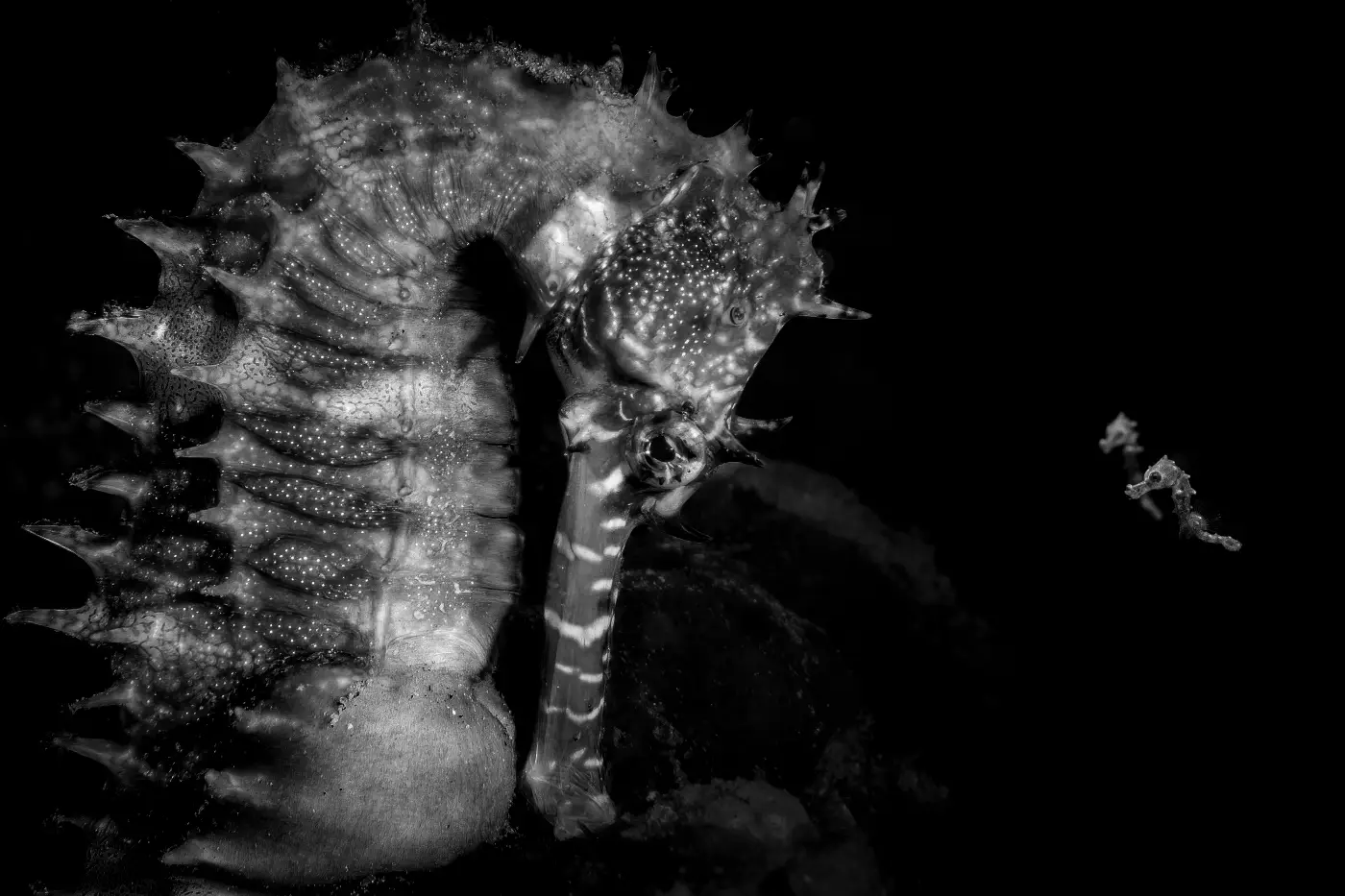
Their position in relation to the adult also adds to the image's impact. The young seahorses appear to turn towards it, creating the impression of a farewell. Whether the animals are actually related is unknown. The composition nevertheless evokes that idea and shows how readily the arrangement of subjects can suggest a story.
Negative space can also carry meaning outside underwater photography. A plain wall, an open sky or a dark shadow can reinforce distance, loneliness or vulnerability. Minimalist photography is therefore not simply about removing elements, but also about the relationship between the subject and its surroundings.
Anton photographed at 1/320 second, f/5.6 and ISO 400, using several video lights. This technique makes the animals clearly visible against the dark water. The photograph's special quality, however, lies mainly in the brief moment when the juveniles appear to turn towards the adult seahorse.
2. Creating order with light
Mitsuna Kawai won the new category The Ocean Unseen: Hidden Worlds with a ribbonfish photographed during a winter blackwater dive at Osezaki in Japan. Its long, silver body moves vertically through the dark water. Salps float around it, small translucent animals revealed as individual points of light by the flash.
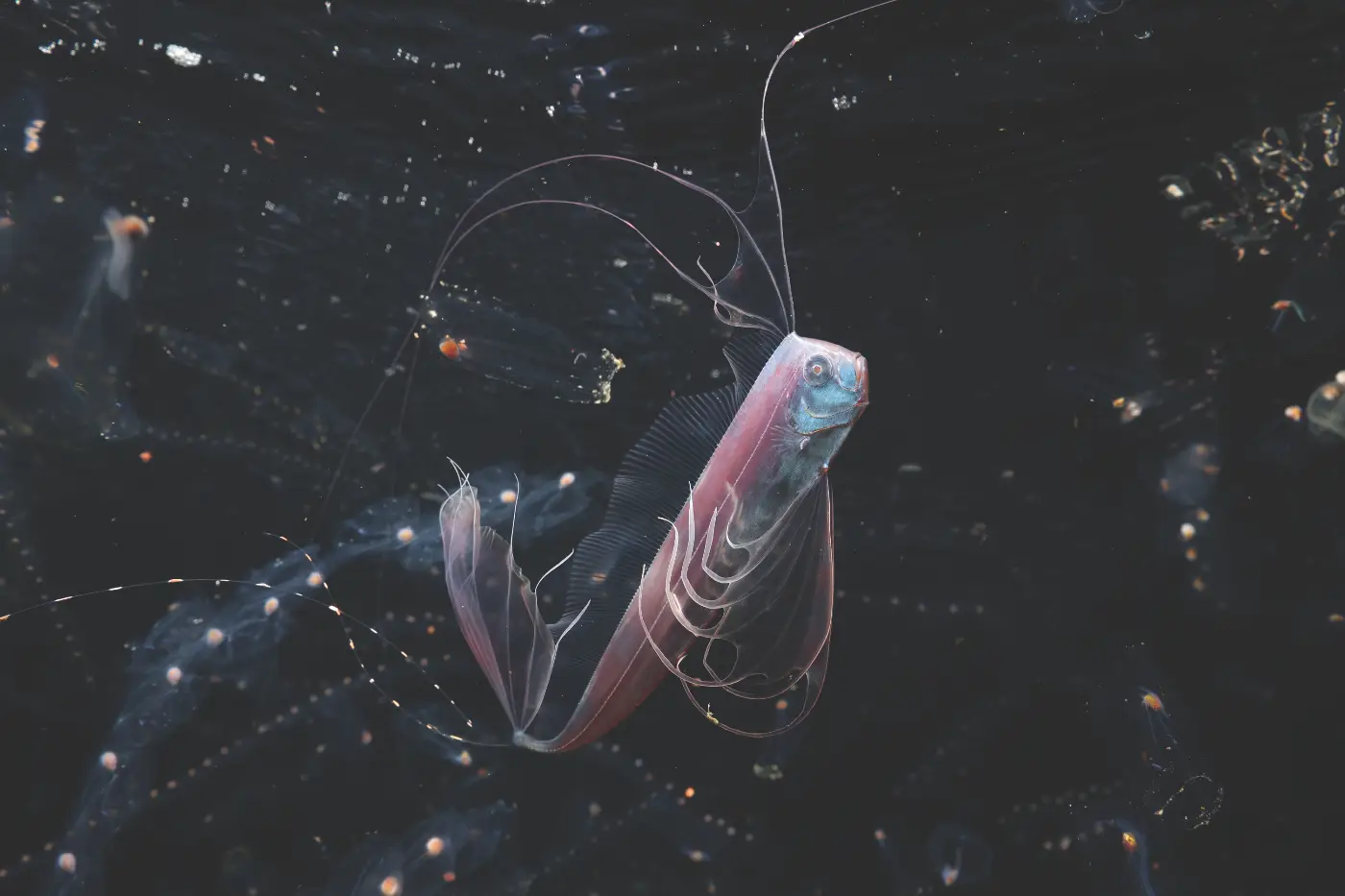
The artificial light creates order in an environment without a clear horizon or background. The ribbonfish attracts attention first. Only then do the smaller organisms become visible. They give the main subject a sense of scale while also revealing something of the world it inhabits.
Underwater, colour and contrast diminish as the distance between camera and subject increases. By working at close range and using carefully directed artificial light, a subject can be separated from its surroundings. The trade-off is that frontal light can also make suspended particles stand out strongly. You can read more about this technical consideration in our article on underwater photography.
Kawai used a single underwater flash at 1/160 second, f/9 and ISO 200. The light does not attempt to reveal the entire water column, but is limited to what matters for the image. Darkness therefore remains an essential part of the photograph.
3. The rhythm of movement
In Gergo Rugli's winning photograph, dolphins leap from a rising wave at Tamarama Beach in Sydney. Surfers move through the same water, while coastal buildings are partly visible through the haze behind the wave. Animals, people, sea and city form distinct layers within a single composition.
The image appears to depend entirely on a fraction of a second. Yet that moment was preceded by a much longer period of observation. According to the accompanying description, the dolphins continued moving among the surfers for more than an hour. This gave Rugli the opportunity to recognise their behaviour and wait until several shapes came together.
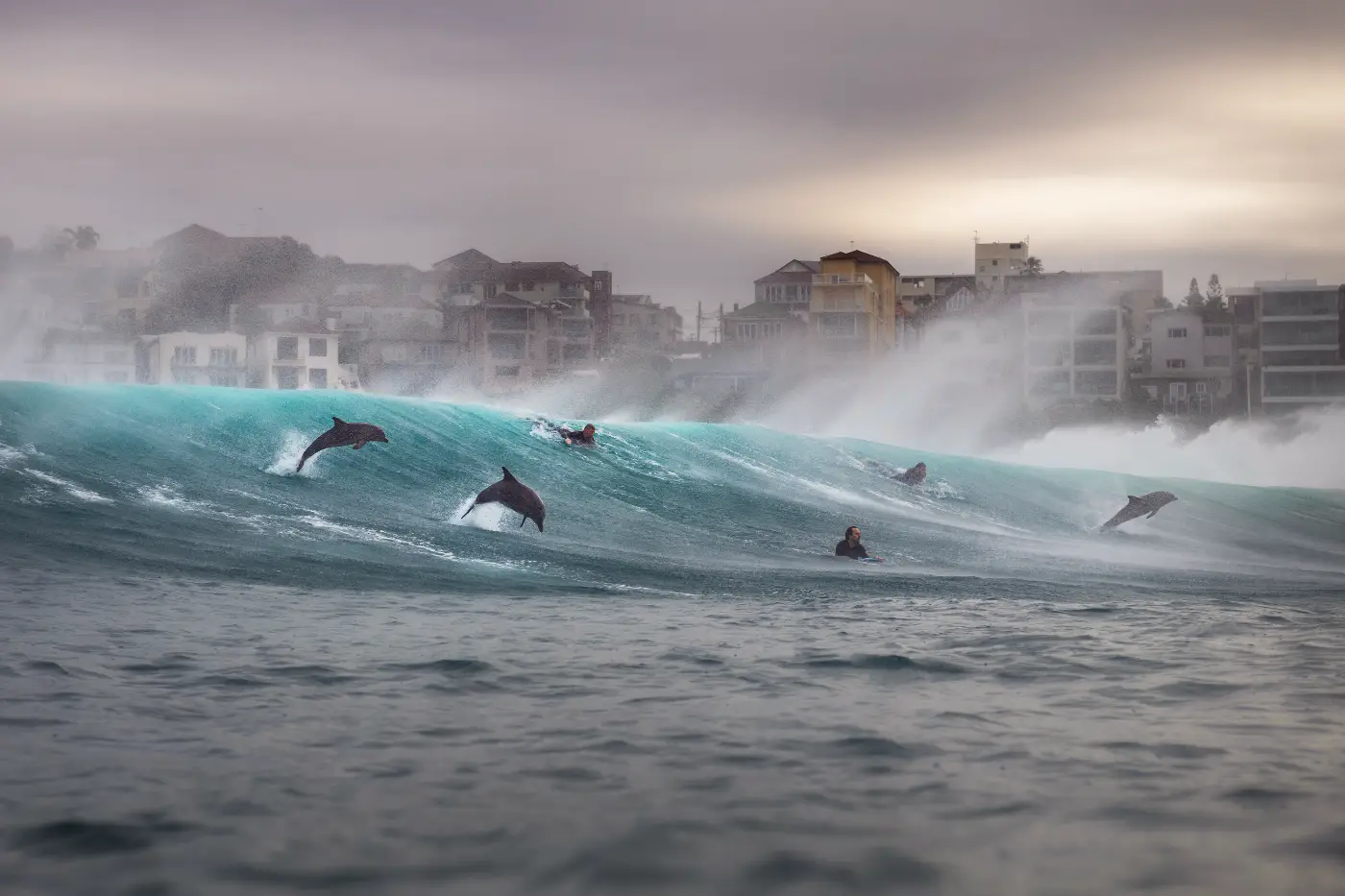
The line created by the leaping dolphins follows the curve of the wave. Meanwhile, the surfers reveal the scale and power of the water. The image is therefore not about one individual leap, but about the relationship between several movements.
The shutter speed of 1/60 second at f/5.6 and ISO 110 is striking. For fast-moving animals, that is relatively slow. The main shapes remain recognisable, while the water and haze retain a sense of motion. A much faster shutter speed would have frozen more detail, but might also have removed some of the dynamism.
The photograph shows that timing is not simply a matter of reacting quickly. It often helps to study the rhythm of a movement first. This applies to waves and animals, but just as much to sport or children at play.
4. When a busy composition is essential
When composing an image, photographers often try to keep distracting elements out of the frame. In his winning photograph in the Conservation (Impact) category, James Ferrara chose the opposite approach.
A whale shark swims among a large group of divers and snorkellers in the Maldives. One diver dominates the foreground, the enormous animal follows behind, and human silhouettes near the surface fill almost all the remaining space.
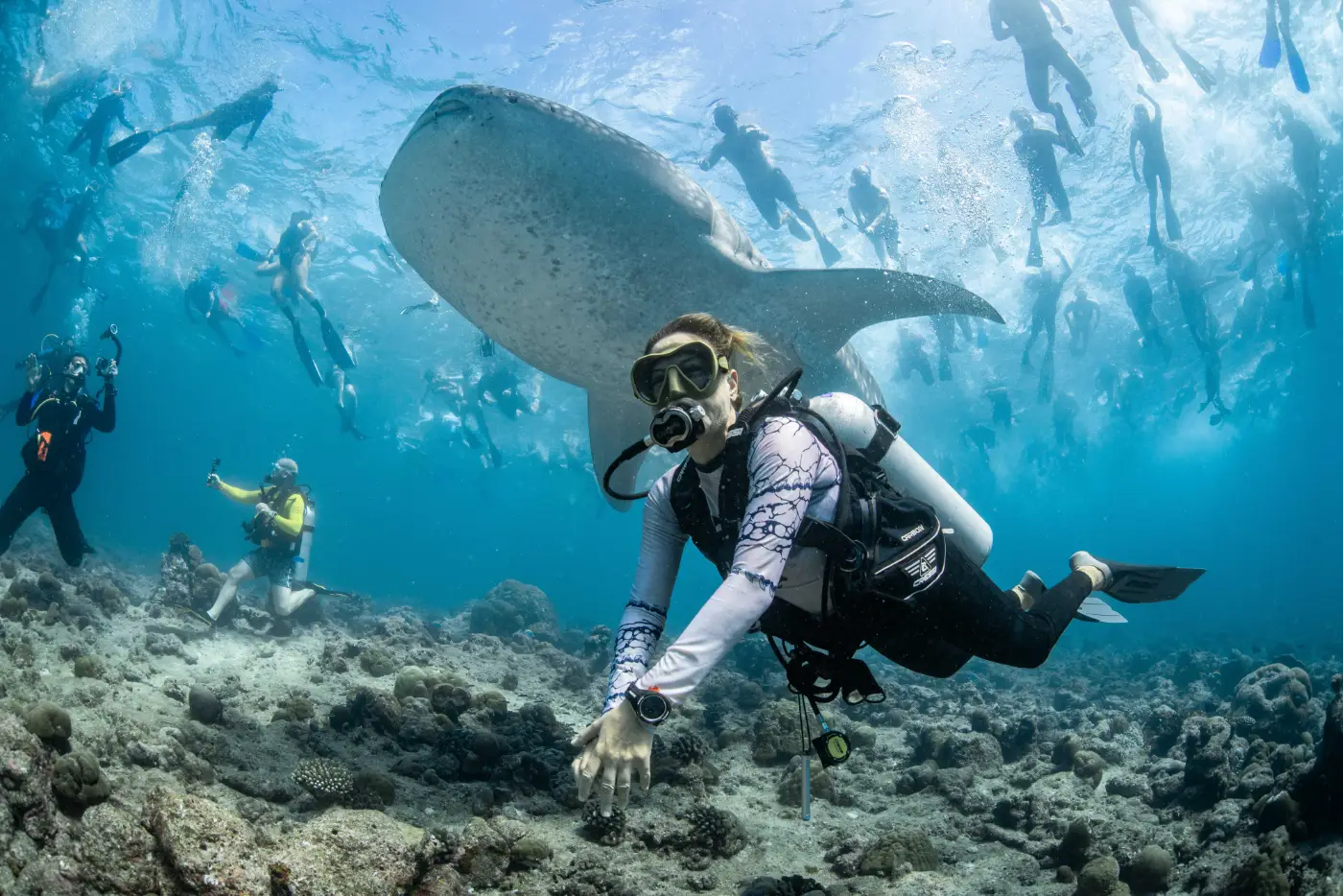
The crowded scene is not the result of careless composition, but the subject of the photograph. Almost fifty people are visible in the image. In this way, Ferrara makes the pressure that mass wildlife tourism can place on a single animal tangible.
The wide-angle perspective pulls the foreground towards the viewer while also showing that the swimmers continue deep into the background. The image offers no quiet position from which to observe the situation at a distance. As a viewer, you are effectively placed among the other people in the water.
Ferrara photographed with a fisheye lens at 1/400 second, f/10 and ISO 400. The fast shutter speed keeps many individual figures recognisable. Precisely because the people are visible and can more or less be counted, the scale of the situation becomes clear.
Not every busy scene needs to be simplified. Sometimes that complexity contains the information a photograph needs. In wildlife photography, this also brings a responsibility. Keeping your distance and approaching the subject with restraint are important when the presence of people may affect an animal's behaviour or welfare.
5. Form without colour
Matty Smith won the Ocean Fine Art category with a nurse shark moving in profile through dark water. Several remoras swim below and alongside the animal. The incoming light defines the shark's back, head and skin texture, while the surroundings largely disappear into darkness.
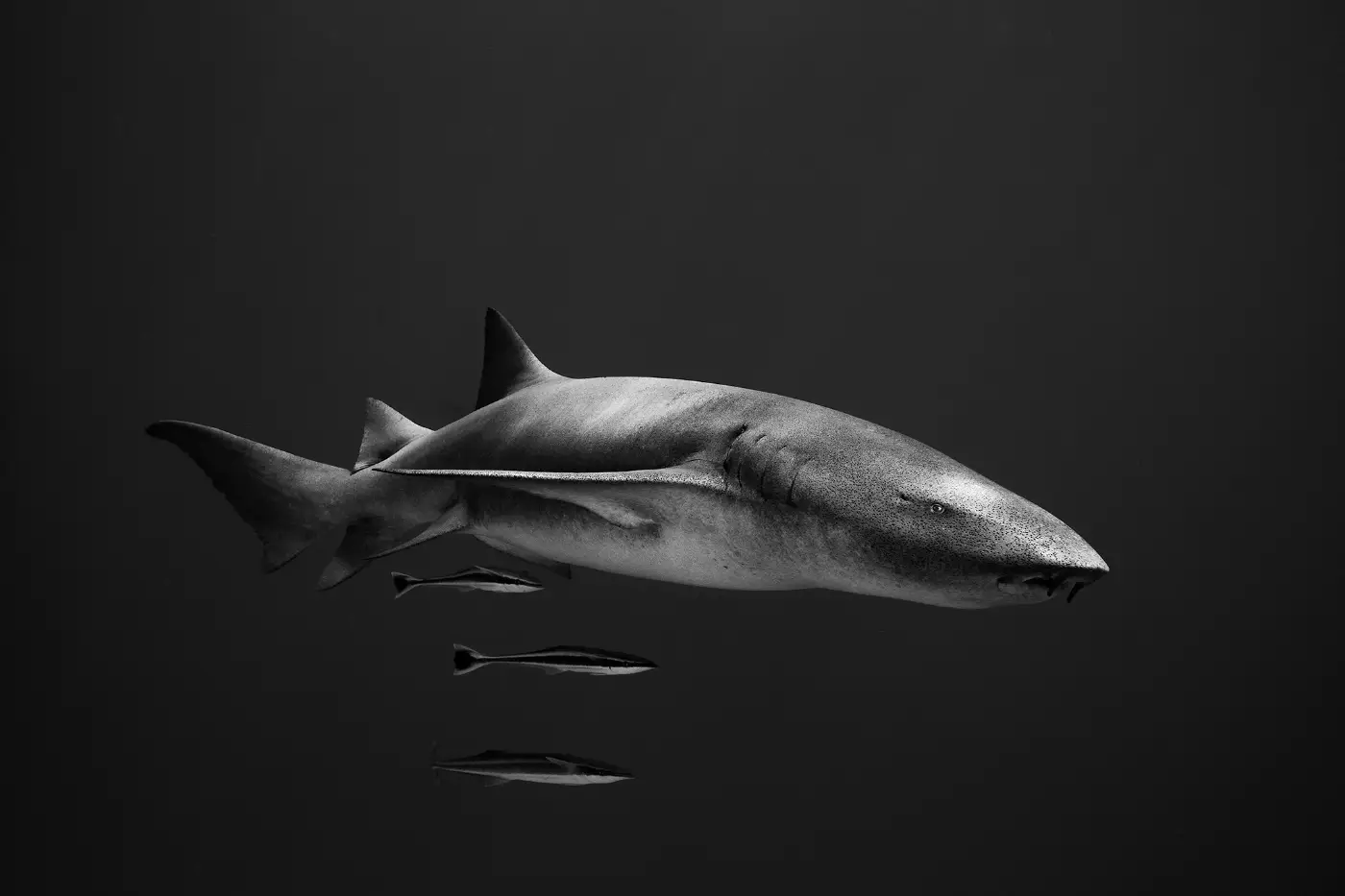
Without colour, the relationships within the image become clearer. The shark forms a long, weighty mass. The smaller fish reappear as lighter shapes beneath it. The composition is not completely symmetrical, but it does feel carefully balanced.
A narrow rim of light prevents the shark from blending into the background. The open space around the animals slows the image down and gives the forms room to come into their own. At the same time, the shark's gaze creates a degree of tension. The animal appears aware of the photographer's presence.
Smith worked in the light of the setting sun at 1/160 second, f/13 and ISO 200. In this image, black and white is more than a way to create atmosphere. Removing colour makes room for form, skin texture, light and the relationships between the subjects.
Five ways of seeing
The five photographs have few outward similarities. Anton works with negative space and scale, Kawai uses light to guide the eye, and Rugli brings several movements together in a single moment. Ferrara deliberately keeps the crowd in the frame, while Smith removes colour to give form and tone greater emphasis.
Above all, the winners show that a successful photograph is the result of choices. Sometimes it is about waiting, sometimes about leaving things out, and sometimes about accepting a complex scene. Technique supports those choices, but does not make them for the photographer.
The full results and the other award-winning photographs can be viewed in Oceanographic's official winners' gallery.