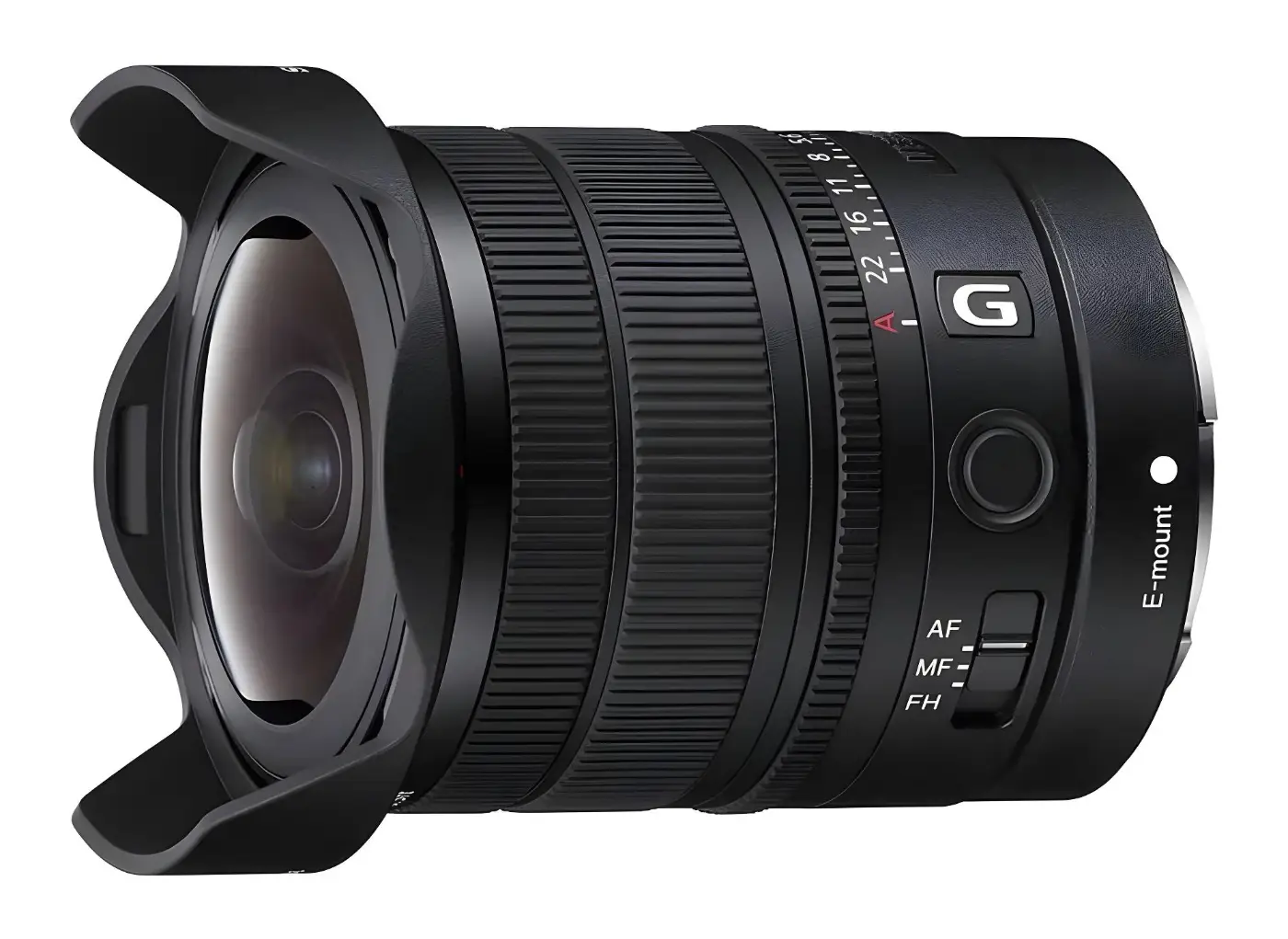
Sony is introducing its first fisheye zoom for full-frame E-mount cameras. At 8mm, the FE 8-14mm F3.5 Fisheye G produces a fully circular image; at 14mm, it fills the entire frame. So you are not merely zooming in—you can also decide how much fisheye effect you want to see.
You do not buy a fisheye to keep buildings perfectly straight. Straight lines curve, subjects near the edges become stretched and the world seems to fold around your image. That is exactly what this lens is designed for.
Fisheye lenses usually have a fixed focal length. Sony takes a different approach with the FE 8-14mm F3.5 Fisheye G. Its zoom lets you switch between a circular and a full-frame fisheye perspective using a single lens.
From circular to full-frame
At 8mm, the image appears as a circle on the rectangular full-frame sensor, surrounded by black. Within that circle, the lens captures a 180-degree angle of view. Take one step forward or point the camera slightly too far down and your own shoes can suddenly appear in the frame. Very little escapes such an expansive view.
%20Menno%20van%20der%20Veen%20-%20Festival%20Around%20the%20World.webp)
Zoom to 14mm and the photograph fills the entire frame. The diagonal angle of view is still 180 degrees, but the result looks less extreme than the standalone circle. The characteristic curvature naturally remains visible.
You are therefore doing more than bringing the subject closer. You also determine how much of the sensor is filled with the image and how prominently the fisheye effect appears. This makes the lens more versatile than a fixed-focal-length fisheye.
A conventional rectilinear ultra-wide-angle lens tries to render straight lines as straight. This Sony deliberately does not. If you want to photograph an interior with perfectly straight walls, you would be better off reaching for something else. If you want the space to curve, however, this is exactly the effect you are looking for.
Landscapes as worlds of their own
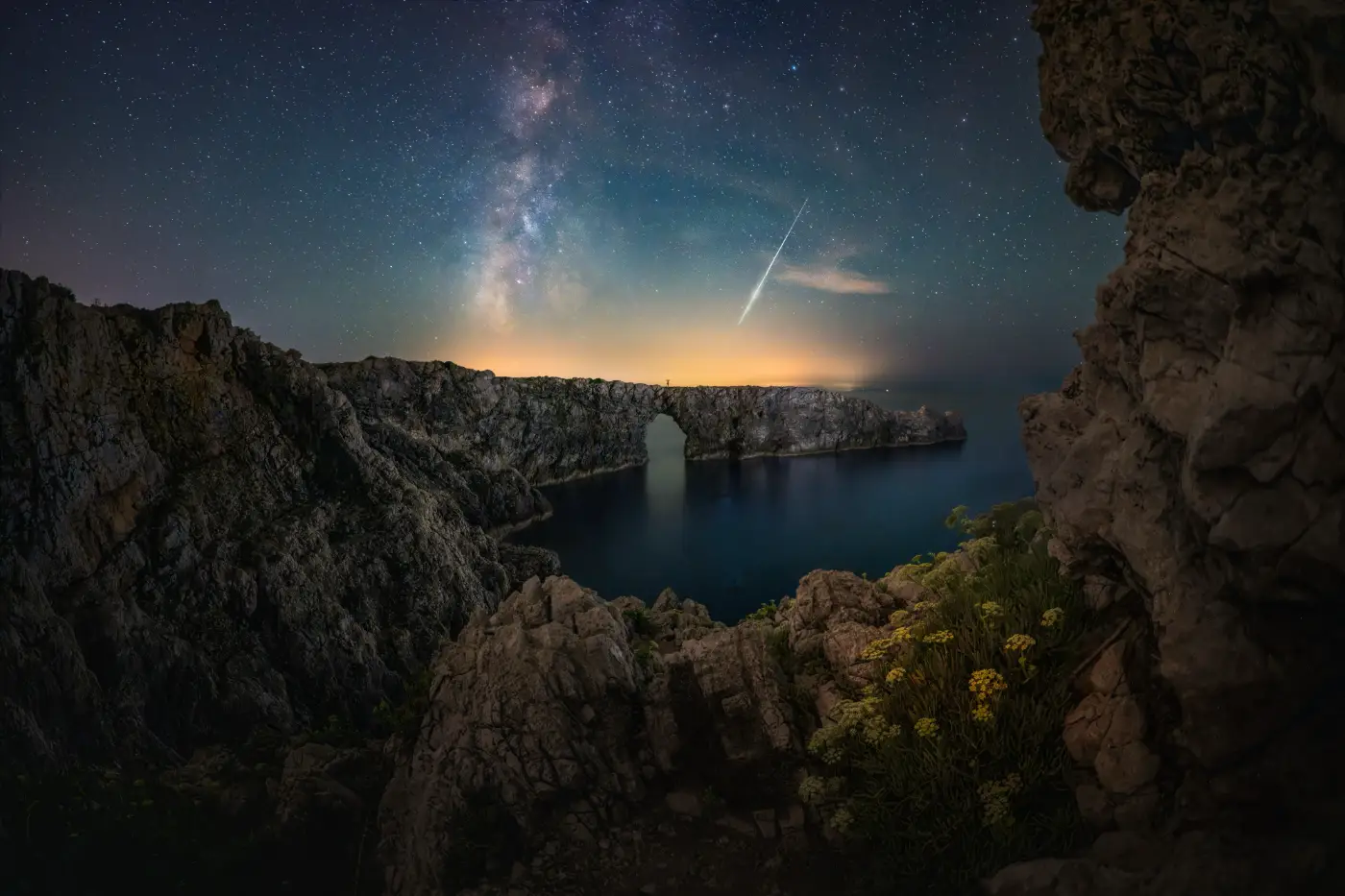
Albert Dros’s sample photographs clearly demonstrate the possibilities. A night sky bends like a dome over the landscape. In another image, the foreground and horizon curve along with it, making the landscape look almost like a world unto itself.
%20Menno%20van%20der%20Veen%20-%20DJ%20Stage%206.webp)
Menno van der Veen uses this perspective at festivals and events. A festival site becomes a small planet, while the stage, lighting and crowd all fit into a single curved image during a performance. You can stand close to the action and still include almost the entire setting.
That is precisely the strength of a fisheye. A conventional wide-angle lens mainly captures a lot of the scene. A fisheye turns that enormous angle of view into a visible part of the photograph itself.
Sony lists landscapes, architecture, sports, events and video among the possible applications. In architecture, the strong distortion remains a deliberate creative choice. For sports and festivals, the lens can be particularly interesting when you can get close and want the surroundings to become part of the story.
Close subjects become even larger
The minimum focusing distance is 15 centimetres. At the 14mm end, the lens reaches a maximum magnification of 0.22x. This allows you to place a subject prominently in the foreground while still showing a great deal of its surroundings.

This intensifies the characteristic fisheye look. A shoe, flower, skateboard or outstretched hand becomes enormous, while the background appears even farther away. As a result, a small change in camera position can transform the entire composition.
The optical design incorporates ED glass and aspherical elements to reduce chromatic aberrations and other optical flaws. Sony promises the high resolution expected of a G Lens throughout the zoom range. The first sample images look convincing, although a practical test will have to show how the lens performs at different apertures and in various lighting conditions.
Light enough to bring along
The FE 8-14mm F3.5 Fisheye G weighs approximately 314 grams. It is 82.8 millimetres long and has a maximum diameter of 63.1 millimetres. That is welcome for a lens that will not be an everyday choice for many photographers. It is easier to bring along just in case when it does not immediately take up half your camera bag.
For comparison, the Canon RF 7–14mm F2.8–3.5L Fisheye STM weighs 476 grams, making the Sony more than 160 grams lighter.
The zoom mechanism is internal. The lens does not extend while zooming and its centre of gravity barely shifts. This is useful when shooting handheld or working with a gimbal or rig.
%20Menno%20van%20der%20Veen%20-%20Sony%20FE%208-14mm%20F3.5%20Fisheye%20G.webp)
The maximum aperture remains F3.5 throughout the zoom range. That also benefits video work: the maximum aperture does not change while zooming.
Controls for stills and video
Autofocus is fast and quiet, while focus breathing is kept to a minimum. Manual focusing feels direct and predictable thanks to Linear Response MF.
The lens also features a focus-mode switch, zoom lock and aperture ring with click stops that can be disabled. This lets video creators adjust the aperture smoothly and silently.
Two fisheyes for spatial imaging
Sony also envisages a highly specialised application. Two FE 8-14mm lenses can be mounted side by side with two VENICE Extension System Mini units. This places the optical axes approximately 64 millimetres apart, close to the average distance between human eyes.
This makes it possible to capture stereoscopic footage for spatial productions and VR. For most Alpha photographers, this will not be the reason to buy the lens. For professional video creators working with spatial content, however, it is more than a footnote.
Who is this fisheye zoom for?
It is intended for photographers who make the fisheye perspective a genuine part of their visual language. Think of festival photographers standing in the middle of the crowd, sports photographers positioned close to the action or landscape photographers who want to capture the sky as a dome above the scene.
What makes this lens unusual is not only its extreme 8mm setting. A turn of the zoom ring takes you from a circular world to a full-frame fisheye perspective. Still curved and still unmistakable, but easier to tailor to the image you have in mind.
The Sony FE 8-14mm F3.5 Fisheye G will be available from late September 2026 for €1,699.