A northern gannet cuts diagonally through green water, with the sun behind it and a curved trail of bubbles in its wake. This underwater photograph taken near the Shetland Islands earns British photographer Henley Spiers the title Bird Photographer of the Year 2026 and £3,000.
From more than 24,000 entries, the jury also honoured a short-eared owl looking straight at the photographer, frigatebirds fighting over a fish and a greater sage-grouse in the first light of morning. The young photographer award goes to sixteen-year-old American Parham Pourahmad, with a great horned owl against the full moon.
A dive through the sunlight
Northern gannets begin their hunt high above the sea. They position themselves, turn into the wind and brake with their wings. Then they fold their wings tightly against their bodies and dive after their prey, reaching speeds of up to 86 kilometres per hour, Spiers explains.
Sunball Rocket, which also wins gold in Birds in the Environment, shows the moment just after that transition from air to water. The eye and long beak are clearly visible. The rest of the body gradually disappears into the turbulence. Behind the bird, the trail of bubbles leads to the surface, where the sunlight scatters.
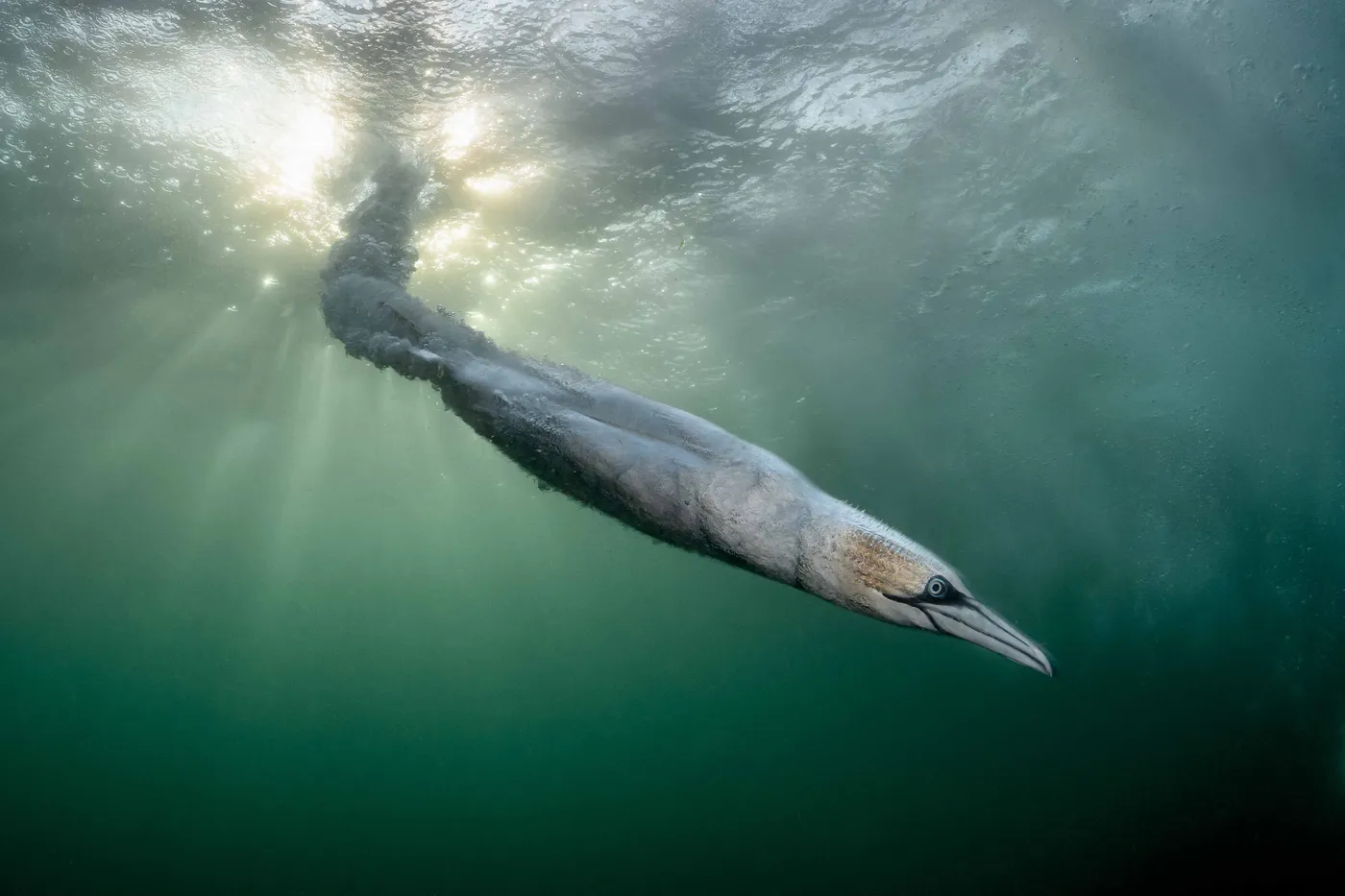
Spiers used a Nikon Z8 and an 8–15mm fisheye lens at 15 mm. That wide angle of view fits both the bird and the water’s surface into the frame. A shutter speed of 1/200 second does not freeze everything: the trail of bubbles retains a sense of speed. In a single image, you see both the bird’s streamlined shape and the force of its dive.
A glance in flight
In the Fraser River delta in British Columbia, five short-eared owls were hunting around Ivan Sjögren as dusk fell. He watched them fighting and later displaying courtship behaviour, clapping their wings together. By following their hunting routes, he was able to choose a spot, where he sat low in the grass.
As this owl flew past, it briefly turned its head towards him. That fleeting eye contact earns Sjögren gold in Birds in Flight. Both wings point downwards, with the feathers spread like fans. The brown and cream feathers blend into the soft landscape, until your eye reaches the bright yellow eyes.
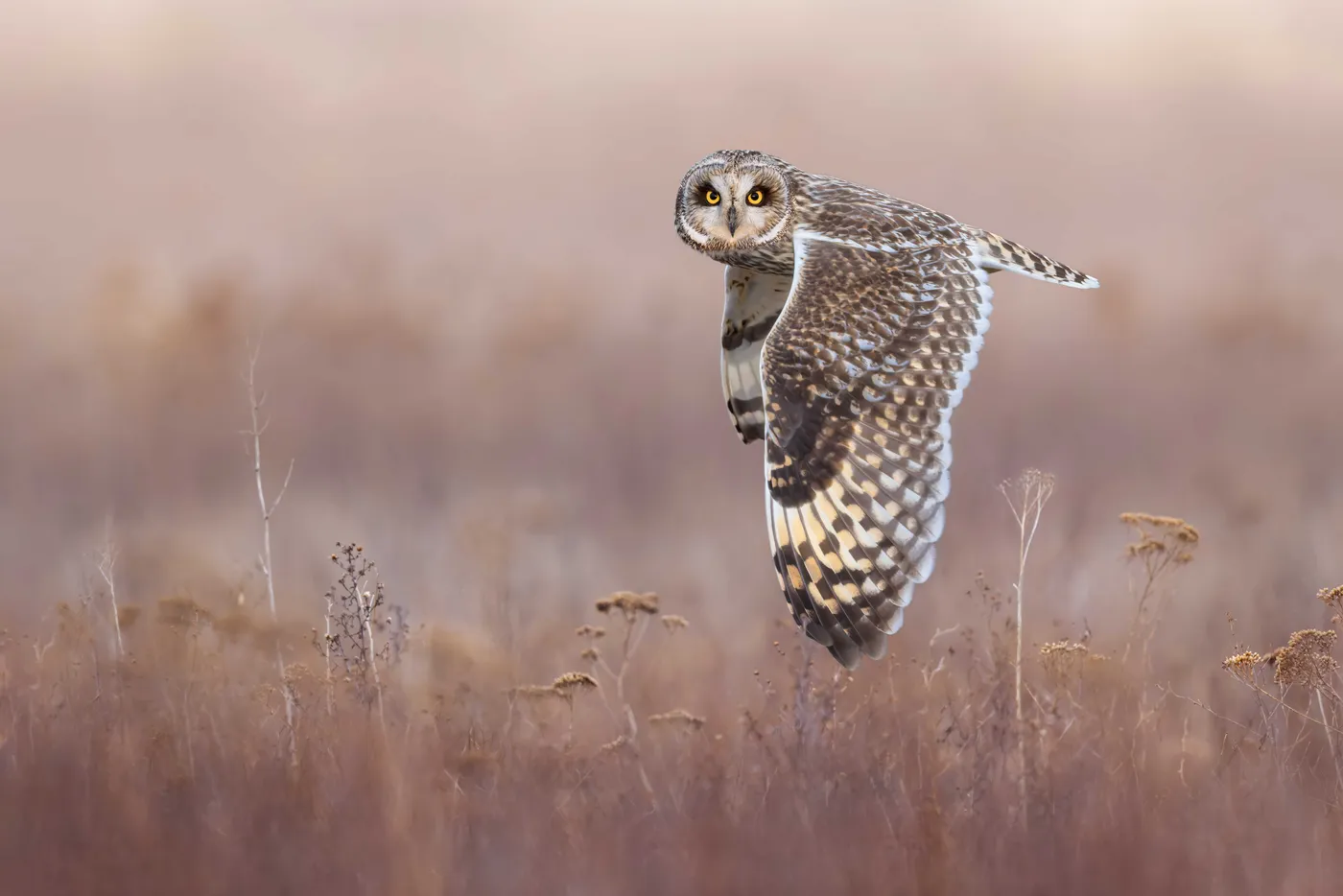
With a 500mm telephoto lens and a 1.4× teleconverter, he worked at 700 mm. To achieve 1/2500 second in the fading light, he had to raise the ISO to 5000. Individual wing feathers remain visible, while the background dissolves into soft areas of colour.
Feathers that seem to glow
Before sunrise, Thomas Deliberto crouched behind a few rocks at a display ground in Utah, where greater sage-grouse gather to mate. His camera pointed east. As the sun rose over the hill, this male was in full display.
In Radiant, which wins gold in Best Portrait, the bird faces the camera. Its white breast feathers form a broad mass, topped by a small head with yellow accents near the eyes. Behind its body, the pointed tail feathers fan out. The morning light shines through them, as if the bird were glowing from within. With the hillside behind it still in shadow, those feathers have room to stand out.
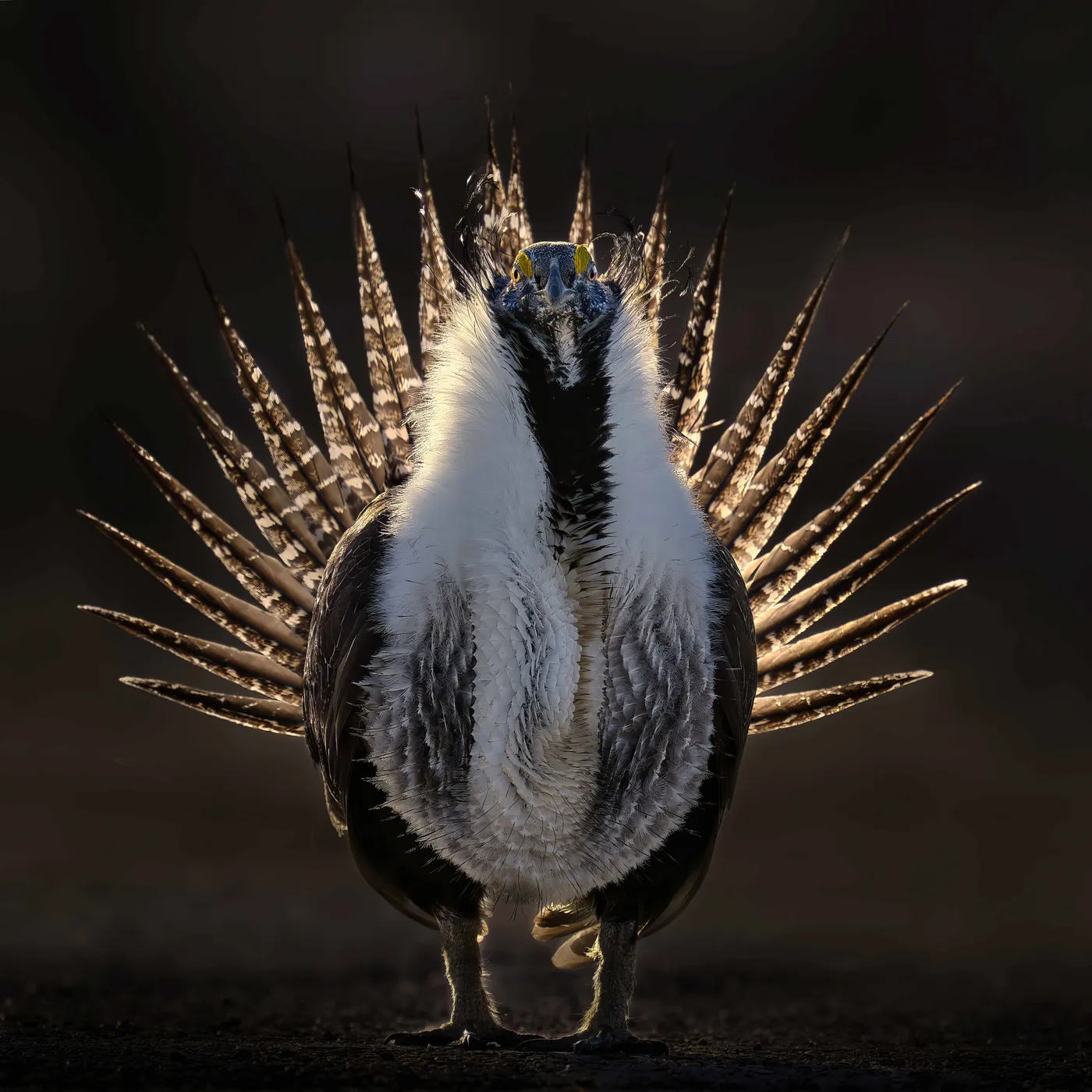
Deliberto photographed it with a Nikon Z9 at 1/160 second, f/5.6 and ISO 64. He highlights the vulnerability of the habitat. Greater sage-grouse are closely tied to the vast sagebrush steppe of the American West, and as that habitat disappears, their numbers have declined sharply.
The sea as a golden backdrop
In Sunset Puffin, silver in Best Portrait, the exuberance comes mainly from behind. Large golden circles of light fill the frame around a puffin. The bird itself remains mostly in shadow, with just a warm rim along its head and a little colour in its beak.
Volker Widmann spent several days on Skomer, off the coast of Wales. This allowed him to photograph early in the morning and late in the evening, when the day visitors had left and the colony was quieter. For this image, he waited until sunset. He then positioned the bird in front of the reflections on the sea.
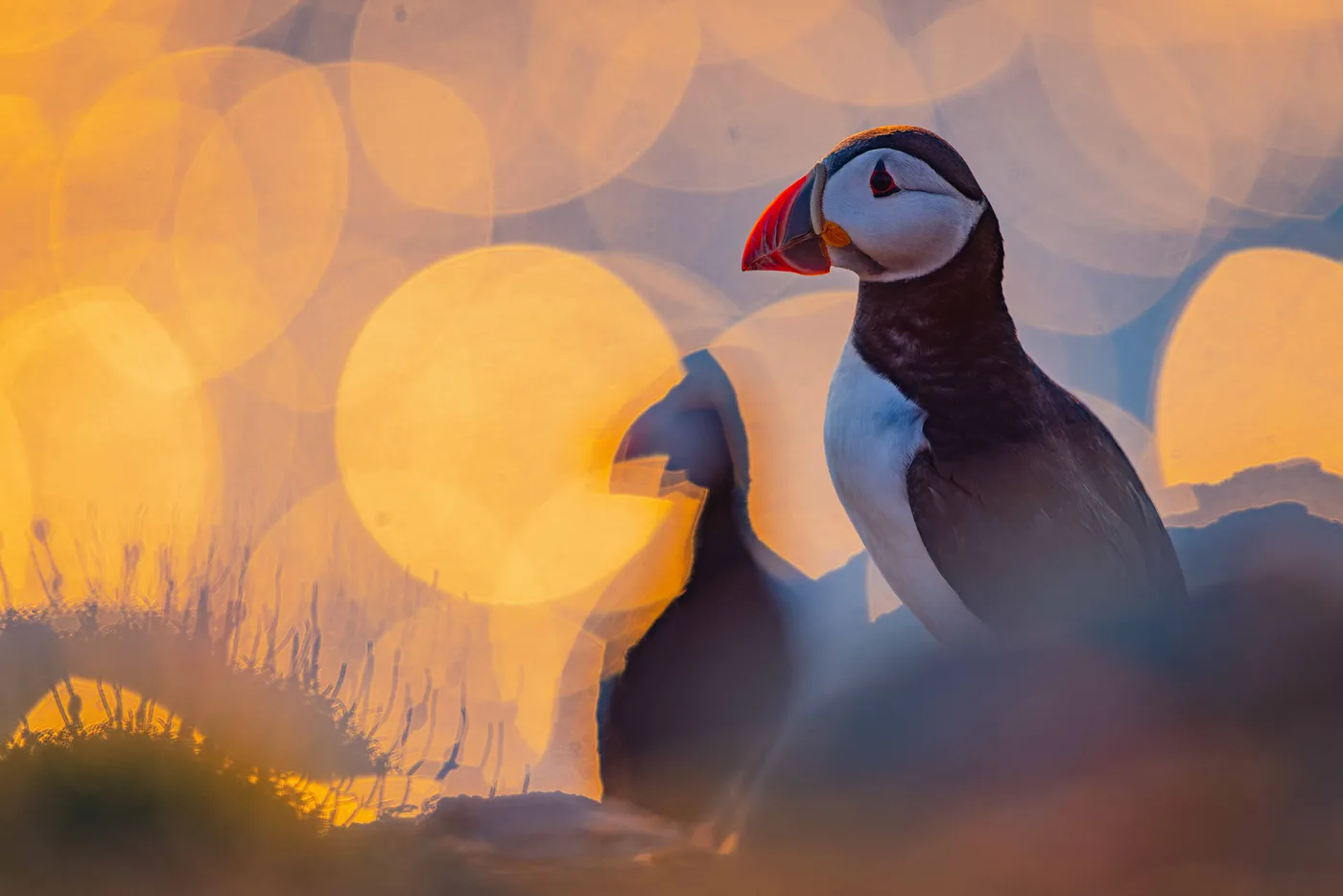
With a 500mm lens at f/4, those out-of-focus reflections become large, overlapping patches of light. The puffin remains sharp and recognisable, while the sea dissolves almost entirely into colour and light. A second, blurred bird at the bottom left keeps a hint of the colony in the frame.
A battle above the beach
On the beach at Tulum in Mexico, a fisherman was throwing unwanted catches into the air, each time triggering an aerial battle between frigatebirds. Bernhard Schubert stood beside the fisherman and followed a bird as it grabbed a fish and was immediately pursued.
Kleptoparasitism, the stealing of food caught by another animal, earns him bronze in Bird Behaviour. Two beaks almost touch, while long wings and forked tails point in every direction. Yet amid the tangle it remains clear what the struggle is about: the fish. In black and white, the scene becomes almost graphic. The dark wings stand out against the bright sky, and subtle differences in grey define the feathers.
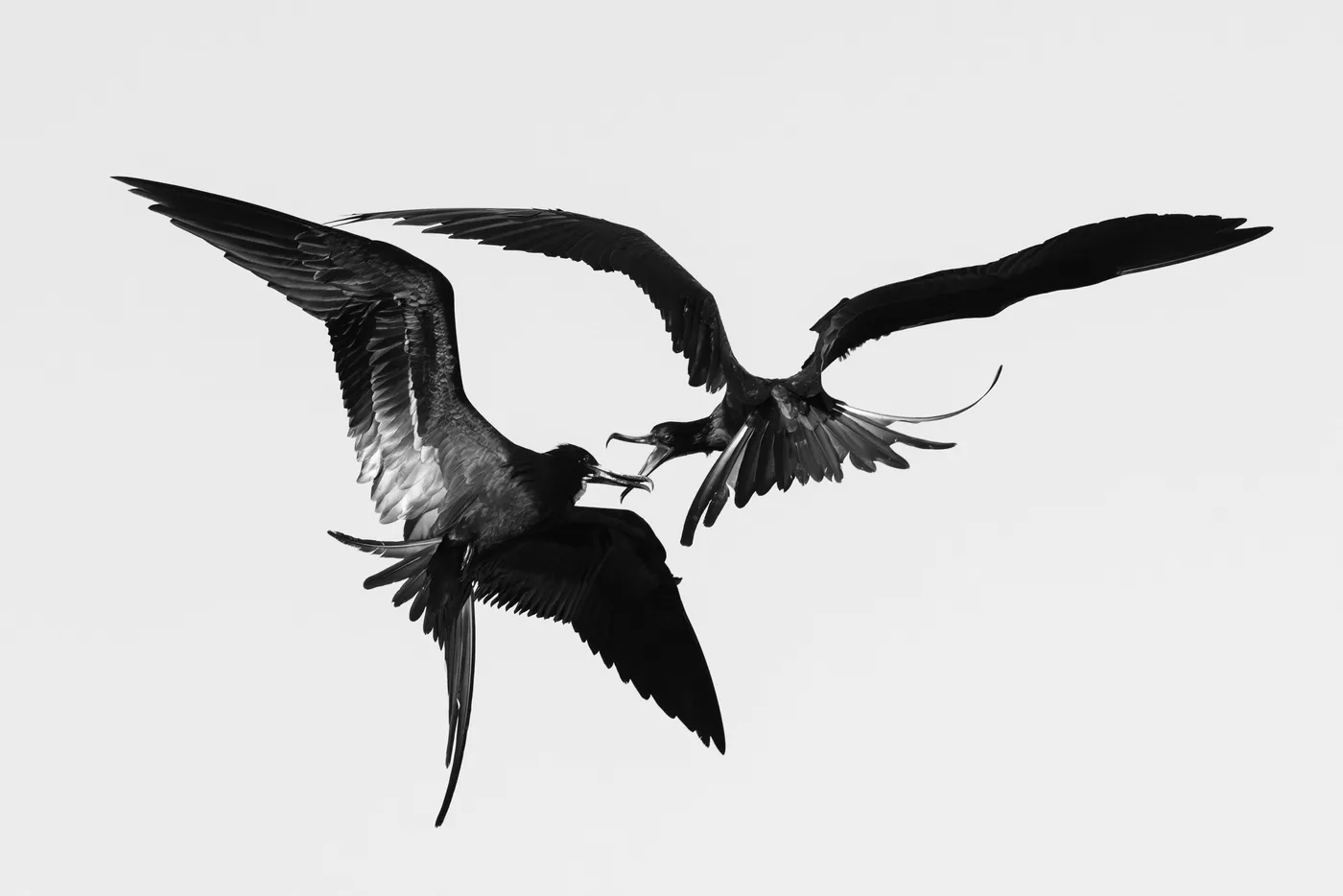
To keep up with the unpredictable changes of direction, Schubert used a large autofocus area. At 1/4000 second, he captured the clashing movements. The photograph looks carefully arranged, even though the situation was almost impossible to predict.
A different photograph than planned
Parham Pourahmad did not have to travel far. In a park next to his home in Los Gatos, California, he had found a breeding pair of great horned owls. He headed out at dusk with a portrait in mind, until the full moon rose above the horizon. When one of the owls flew to a pine tree, he quickly found a viewpoint that placed the bird directly in front of the moon.
With Moonlit Night, the sixteen-year-old becomes Young Bird Photographer of the Year 2026 and wins gold in the 15–17 age category. The image needs little colour: a deep blue sky, black branches and the bright disc of the moon. Within that circle, the owl is immediately recognisable by its posture and ear tufts. The dark tree fills much of the frame, giving the small figure at the top a natural place within it.
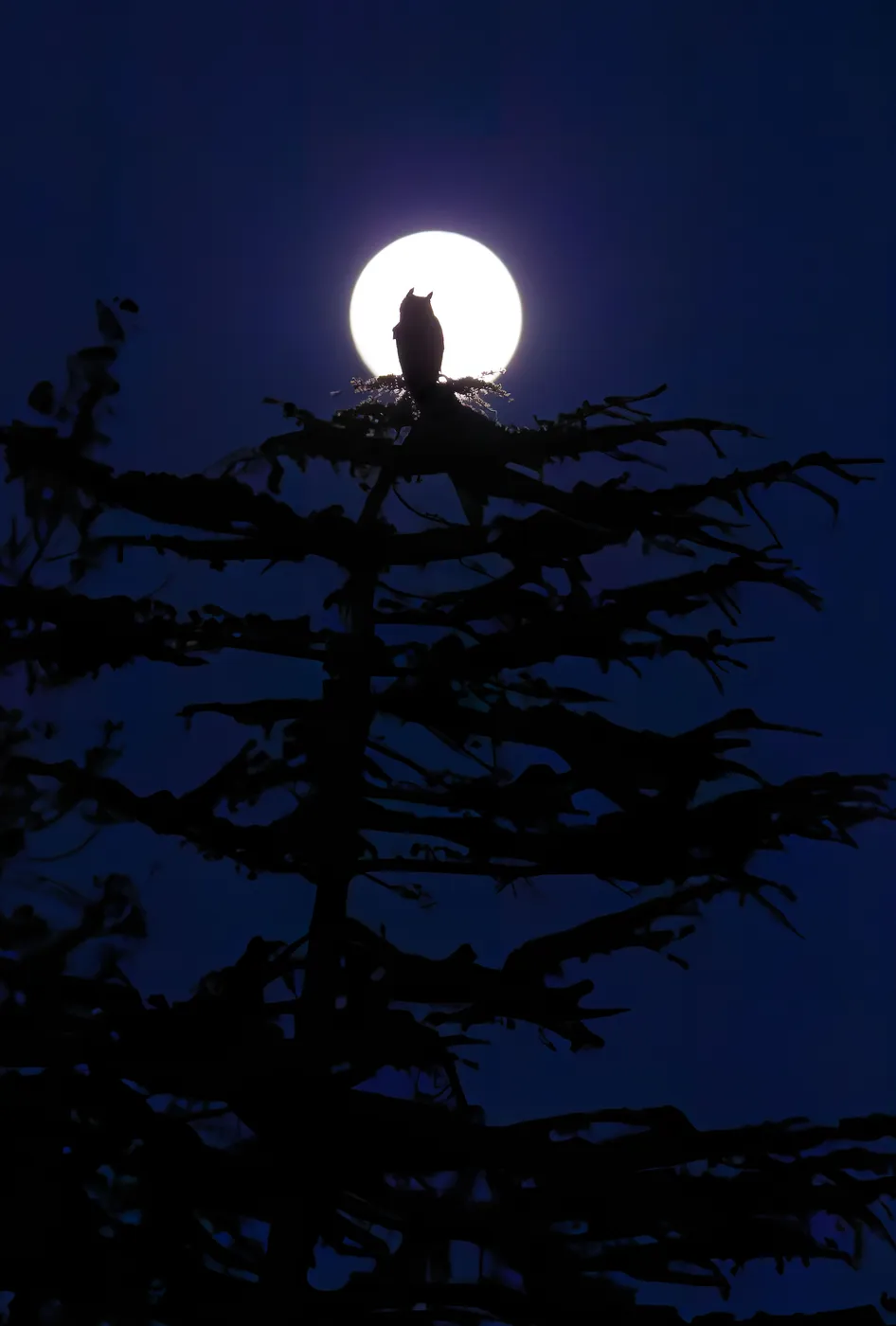
Pourahmad used a Canon EOS Rebel T5i with a Sigma 150–600mm lens at 275 mm, at 1/500 second, f/5.6 and ISO 6400. The image only emerged when he let go of his original plan and seized the moment the evening offered him.
The complete selection
What connects these photographs is the time that came before them: days on an island, hours low in the grass, a viewpoint that shifted at the last moment. All the award-winning images can be seen in the Bird Photographer of the Year winners’ gallery. This year, the competition donated more than £5,000 to Birds on the Brink, which supports local bird conservation projects.