A smartphone with focal lengths spanning 14 to 230mm, two 200-megapixel cameras and even a detachable teleconverter. The OPPO Find X9 Ultra was announced back in April, but is now back in the spotlight. EISA has named it Photo & Video Smartphone 2026-2027. With its extensive range, the phone comes closer to the capabilities of a superzoom camera.
Smartphones have become particularly good at replacing the camera you otherwise would not have with you. Wide-angle shots, portraits, night photography and video now all fit in a single pocket. Telephoto photography has remained more difficult. Longer focal lengths require physical space, and a phone offers very little of it.
OPPO tries to solve that problem in the Find X9 Ultra with no fewer than two telephoto cameras. This makes the device rather more interesting than yet another smartphone whose main selling points are more megapixels and bolder marketing claims.
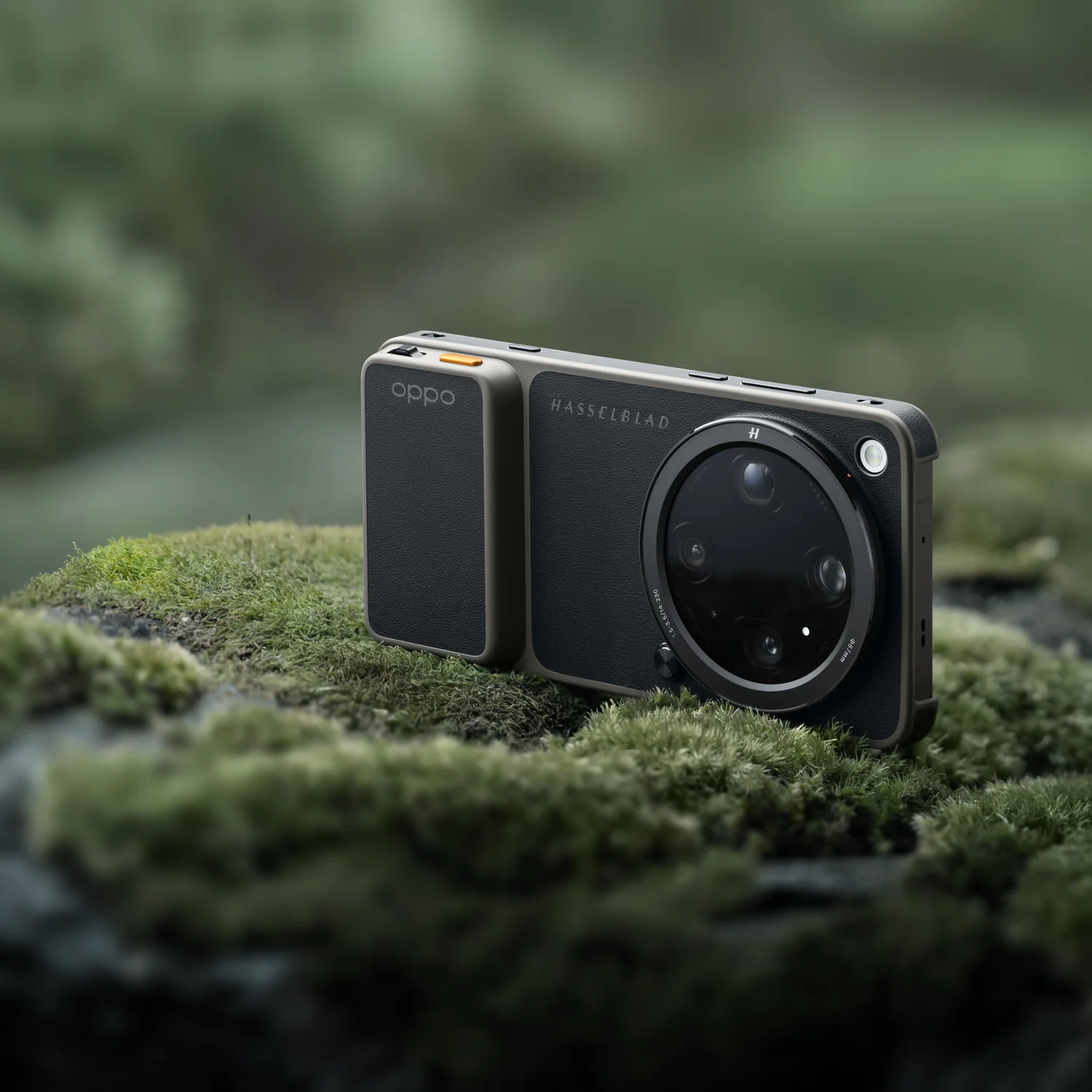
Most smartphone photographs start with a wide-angle view. That is useful for a town square, a group of people or a quick moment at the dinner table. But a long telephoto camera does more than increase magnification: above all, it changes what you notice.
From 14 to 230mm
The camera system was developed with Hasselblad and comprises four cameras that actually take photographs. It also has a separate multispectral sensor that measures colour temperature. OPPO therefore describes it as a five-camera system, although the fifth is not a camera you can use independently to take pictures.
The ultra-wide camera provides a field of view equivalent to 14mm on a full-frame camera. The 200MP main camera is equivalent to 23mm. It is joined by a 200MP telephoto camera at 70mm and a 50MP periscope camera at 230mm.
On a smartphone, 230mm does not mean that a 23-centimetre lens is literally fitted inside the body. It refers to the field of view produced by a 230mm lens on a full-frame camera. A design that reflects the light five times allows the required optical path to fit inside the slim phone.
It may sound as though you have a zoom lens covering 14 to 230mm, but that is not quite the case. These are four separate cameras with fixed fields of view. Intermediate settings such as 47 and 139mm are created by using the high resolution to crop part of the image. Software then combines information from multiple exposures.

This can produce excellent results, but it is not the same as a lens that zooms optically and continuously from 14 to 230mm.
A long telephoto camera also does more than increase magnification. Its narrow field of view forces you to look more deliberately. A façade becomes a rhythm of windows, while in a landscape you can isolate a single tree or one illuminated mountain peak. This also makes 230mm a compositional tool.
The standout camera is the 70mm unit
The 230mm camera naturally attracts attention, but the 70mm camera may be more useful for everyday photography. This telephoto lens is backed by a relatively large 1/1.28-inch, 200-megapixel sensor and has an aperture of f/2.2. Its minimum focusing distance is fifteen centimetres, allowing it to be used for close-ups as well.
The combination of a large sensor and many pixels also gives OPPO room to crop. The 139mm setting, for example, does not come from a separate lens but from the 70mm camera. This also explains why high resolution is more than just an impressive number in the brochure in this case.
A façade becomes a rhythm of windows, while in a landscape you can isolate a single tree or one illuminated mountain peak.
The built-in 230mm camera uses a smaller 1/2.75-inch sensor and has an aperture of f/3.5. In sufficient light, it can provide considerable reach. As conditions get darker or the subject moves, the limitations of such a small sensor are likely to become apparent sooner. Image stabilisation helps counter the photographer’s movement, but not a bird or performer who decides to move.
That long telephoto camera can nevertheless be particularly useful while travelling. Think of details high on a building, a lighthouse along the coast, a musician on stage or an animal you do not want to disturb. It is best to locate a moving subject at 1× or 3× first and then switch to 10×. At 230mm, the view is so narrow that otherwise you may spend more time searching than photographing.
Detachable 300mm teleconverter
For anyone who finds 230mm insufficient, there is the optional Hasselblad Earth Explorer Kit. It includes a case with a shutter button and zoom wheel, as well as a detachable teleconverter with sixteen glass elements.
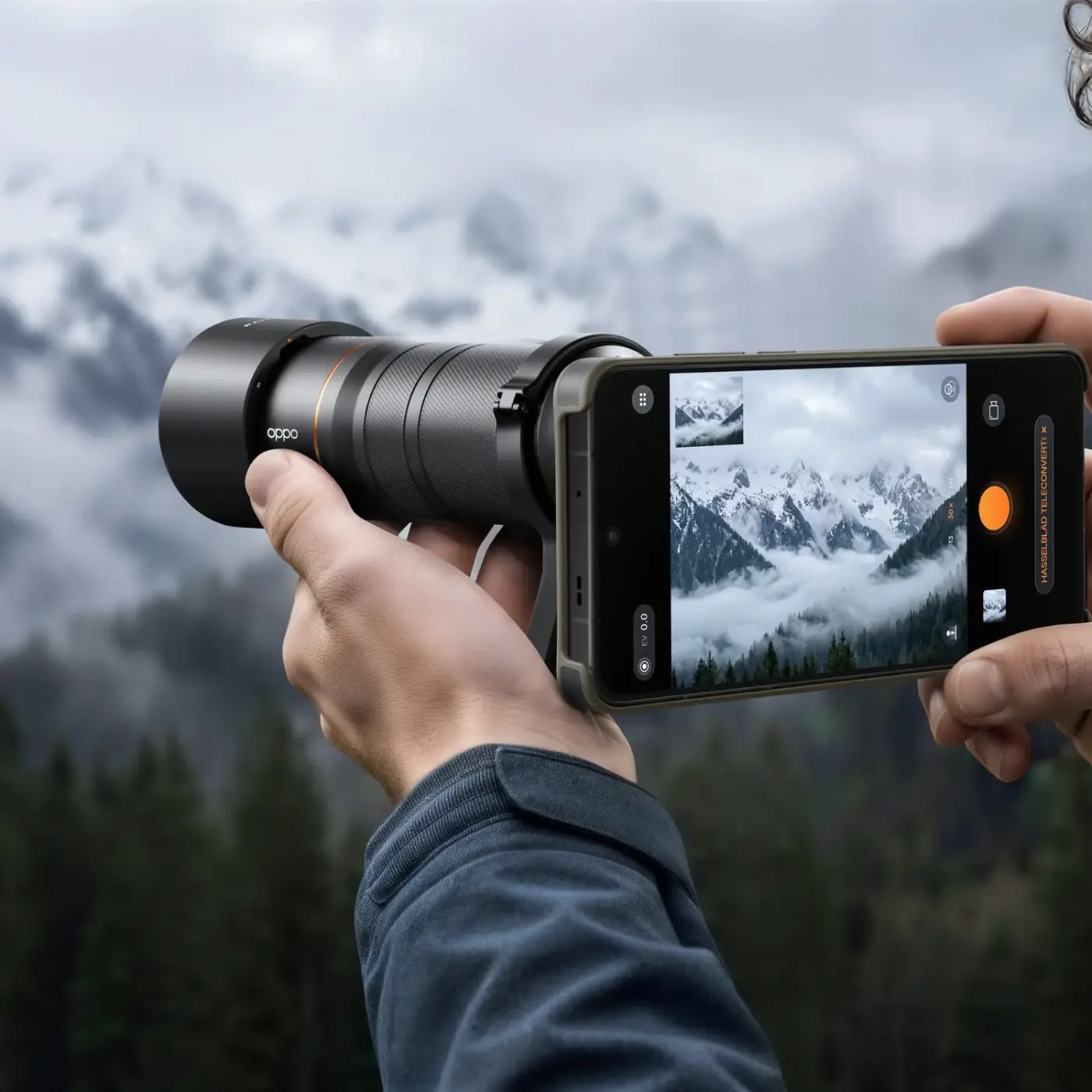
Interestingly, this converter is not placed in front of the 230mm camera. It attaches to the 70mm telephoto camera and produces a field of view equivalent to 300mm. This means the large 200MP sensor of the 70mm camera serves as the basis. OPPO describes this as 13× optical magnification and says the high resolution also allows further cropping.
This makes the phone look and operate increasingly like a small camera. The combination is not entirely compact, of course. You need to carry the case and separate lens, and attach the accessory before taking spontaneous photographs.
More control over image processing
Software processing remains an important difference between a smartphone and a conventional camera. Phones often combine multiple images, brighten shadows and attempt to correct noise and blur automatically. This produces an attractive result straight away, but it can also create unnatural details and an overly smooth appearance.
Hasselblad Master Mode is intended to give photographers more control. In this mode, the Find X9 Ultra can save 50MP files as JPEG MAX and RAW MAX. ISO, shutter speed, focus and white balance can also be adjusted manually.
Video options include 8K at 30 frames per second, 4K at up to 120 frames per second and the O-Log2 profile. These features go beyond simply taking a quick photograph or video for social media. At the same time, the final result still depends on how OPPO processes data from different pixels and exposures.
Does it replace a superzoom camera?
In terms of reach and portability, there is a case to be made. Covering 14mm ultra-wide to 230mm telephoto in a single phone is impressive. The separate converter even extends that to 300mm.
Even so, this does not mean that a genuine superzoom camera has become redundant. It offers a continuous optical zoom range, a better grip, more extensive controls and generally more predictable performance with moving subjects and in low light. The OPPO switches between different sensors, while cropping and image processing fill in part of the range.
That is ultimately the real value of having 230mm on a smartphone: not the promise that a phone can replace every camera system, but the ability to capture a new photograph that would otherwise have remained out of reach. For travel, street details and well-lit moments at concerts, this is no longer a gimmick. It is another way of seeing, always close at hand.
The OPPO Find X9 Ultra is available with 512 GB of storage for approximately €1,574.