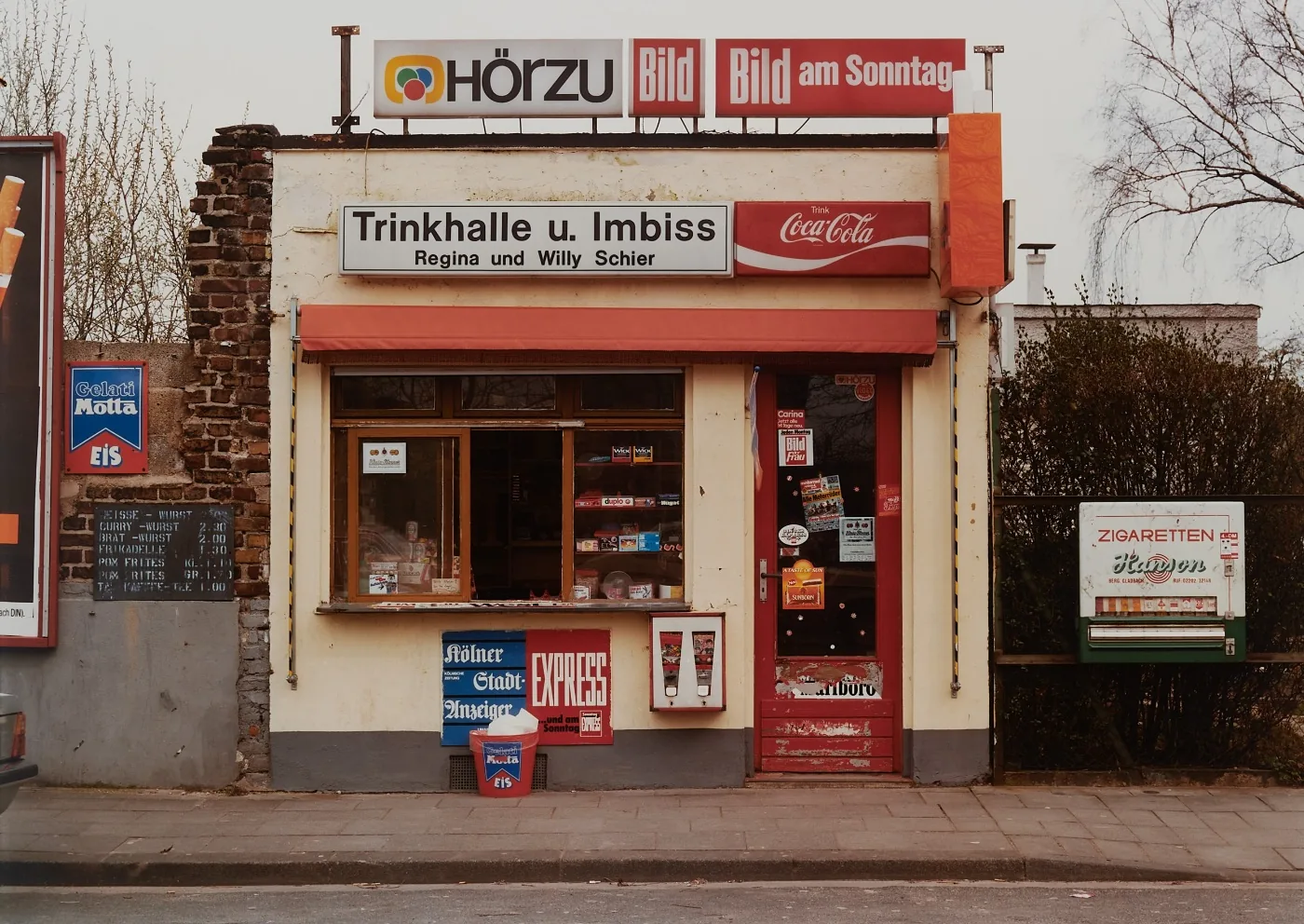
Photo: © VAN HAM Art Estate: Tata Ronkholz, 2025 – Trinkhalle / Kiosk, Köln-Nippes, Merheimer Straße 294, 1983
Tata Ronkholz was one of the first students in the renowned photography class led by Bernd and Hilla Becher at the Kunstakademie Düsseldorf. Her fellow students included Candida Höfer, Axel Hütte, Thomas Ruff, and Thomas Struth, all now internationally renowned artists. During this period, Tata Ronkholz’s work received the same international recognition as that of her peers.
The retrospective Designed World: Through the Eyes of Tata Ronkholz (1940–1997) , which was on view at Huis Marseille from February 14 through June 21, 2026 , marked the first major tribute to Tata Ronkholz as a multifaceted artist.
Objective Documentary Photography
Tata Ronkholz was a photographer, product designer, and interior architect. Her photographic series belong to the tradition of objective documentary photography, a movement strongly shaped by the artist couple Bernd and Hilla Becher. Ronkholz’s work is likewise characterized by clear compositions, a serial approach, and a documentary style focused on architectural structures and everyday architecture.

Using her large-format camera, Ronkholz made sharply defined, realistic photographs that emphasized the subjects rather than the artist’s individual style. Black-and-white work predominates, although color photographs also appear: Ronkholz engaged with the artistic color photography that emerged in Germany in the seventies and eighties, following the New Color Photography introduced by American photographers Stephen Shore and William Eggleston.
Kiosks and Small Shops
Tata Ronkholz became best known for her compelling series of photographs of kiosks (Trinkhallen) and small shops. In them, she captured moments typical of urban culture of everyday life. These photographs were made between 1977 and 1985, mainly in the Ruhr region but also in Cologne, Düsseldorf, Leverkusen, and Krefeld.
The photograph Trinkhalle, Köln-Nippes —with its chewing-gum and cigarette vending machines and advertisements for ice cream and newspapers—is as entertaining and engaging as Boutique, Köln-Mülheim , where, according to the sign, records were sold alongside clothing.

The photographs show how greatly products, decorations, and advertising in public space have changed. Through her choice of subject, Tata Ronkholz’s work indirectly reveals social, cultural, and economic changes and shows how people shape the world around them.
Industrial Gates
Another important body of work is devoted to industrial gates photographed by Ronkholz between 1977 and 1985. The austere black-and-white images of these gates, with their grilles and bars, offer a glimpse into industrial sites. The gates divide private and public space, inside and outside, activity and stillness. The aesthetics of these near-abstractions give new meaning to everyday scenes.
Collaboration with Thomas Struth
In 1979, Ronkholz and fellow student Thomas Struth began an extensive documentary series about Düsseldorf’s Rhine harbor (Rheinhafen). Their starting point was the planned redevelopment of this historically rich harbor area, which in its original form was regarded as an industrial site of urban-historical and architectural importance.

Their aim was to document the harbor in its entirety, including its buildings, technical installations, and operational structures. In carefully composed images, they recorded façades, interiors, silos, warehouses, cranes, and harbor basins before these disappeared in whole or in part or were fundamentally altered.
Tata Ronkholz as a Product Designer
Between 1961 and 1965, Tata Ronkholz studied furniture design at the Werkkunstschule Krefeld (school of applied arts), after which she worked as a freelance designer until 1977. This part of Ronkholz’s body of work was also represented in the exhibition, including images of furniture and lamps with geometric forms and designs for office and cafeteria furniture.
Ronkholz’s designs are characterized by clear forms and functional elegance. Also on view were her early photographs of architectural details made in Italy and France in 1975–1976. They likewise reveal her strong affinity with aspects of the “designed world” in different areas of life.

The exhibition was based on Tata Ronkholz’s estate, acquired in 2011 by VAN HAM Art Estate in Cologne, alongside the collection of the Stadtmuseum Düsseldorf. Other notable works came from the Photographische Sammlung/SK Stiftung Kultur’s own collection—the institution also curated the exhibition—and from private collections.
More information is available from Huis Marseille.