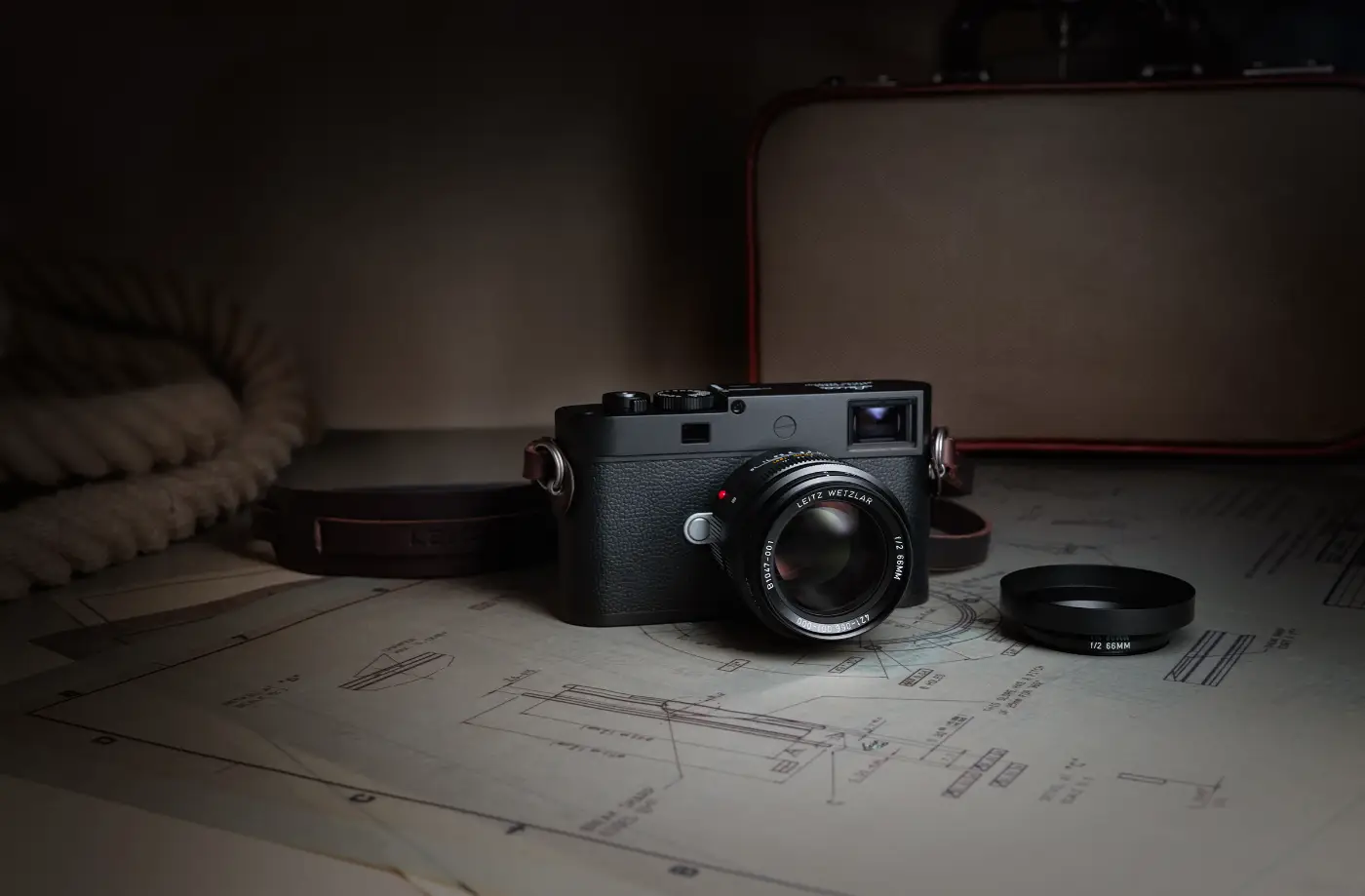
A 66 mm lens almost sounds like a measurement error. Yet Leica chose precisely this unusual focal length for the new Summicron-M 66 f/2. The lens is based on an extremely rare predecessor developed for the US Navy in the late 1960s. Around two hundred were made at the time. Now the former spy lens is back, albeit in a slightly less secret run of 660 units.
Built for covert missions
The original Elcan 66 mm f/2 was designed by Dr Walter Mandler, who was responsible for a series of influential Leica lenses at Ernst Leitz Canada. The US Navy wanted a compact, unobtrusive lens capable of capturing exceptionally fine detail.
That also explains the curious 66 mm focal length. It was not an attempt to make photographers choose between a 50 and a 75 mm lens, but the result of an optical calculation. Mandler sought the best balance of resolution, contrast and size. The answer was not a neat round number, but 66 mm.
That is quite a departure from a warning not to lose the lens cap.
Many examples were used with the Leica KE-7A, a military version of the Leica M4. Together, the camera and lens formed a compact kit for discreet reconnaissance photography.

Some kits even came with instructions explaining how to destroy the equipment if captured. That is quite a departure from a warning not to lose the lens cap.
Between 50 and 75 mm
In practical use, 66 mm sits squarely between a standard lens and a short portrait telephoto. Compared with the Leica Summilux-M 50 f/1.4 Classic, it brings the subject slightly closer and compresses the background a little more. At the same time, its angle of view remains wider and is likely easier to work with than that of a 75 mm portrait lens.
For street photography, 66 mm is on the long side if you like to include plenty of the surroundings. For portraits, details and more measured reportage, however, it can be a welcome middle ground. You gain more working distance than with a 50 mm lens without immediately getting the stronger compression of a longer telephoto.

With its maximum aperture of f/2, the Summicron-M 66 f/2 is slower than the Summilux-M 50 f/1.4. The new Leica Noctilux-M 35 mm f/1.2 ASPH. also admits more light and can blur the background more dramatically. Even so, f/2 is still easily sufficient to separate a subject from the background, especially at this slightly longer focal length.
Classic character, modern engineering
Leica has not simply copied the original optical formula. The design has been adapted to modern production methods and the high resolution of today’s digital M cameras. Wide open, the lens promises soft bokeh combined with crisp contrast. Stop it down and it delivers the quality for which the original was designed: high resolution and precise rendering of fine detail.
Leica is therefore taking a different approach than it does with its modern APO lenses. The APO-Summicron-M 50 f/2 ASPH. was primarily developed to minimise optical aberrations. The new 66 mm also aims to retain some of its predecessor’s character and history.
This fits the Leica Classic line. Leica has previously reissued historic versions of the Summaron-M 28 f/5.6, Thambar-M 90 f/2.2, Noctilux-M 50 f/1.2, Summilux-M 35 f/1.4 and Summilux-M 50 f/1.4. The Summicron-M 66 f/2 may be the strangest choice in the series, but that is precisely what makes it one of the most interesting.
Military quirks retained
Mechanically, too, the 66 mm differs from ordinary Leica M lenses. The aperture ring turns in the opposite direction, and the distance scale follows the layout of the military original. Experienced M photographers will no doubt make a few wrong turns at first.
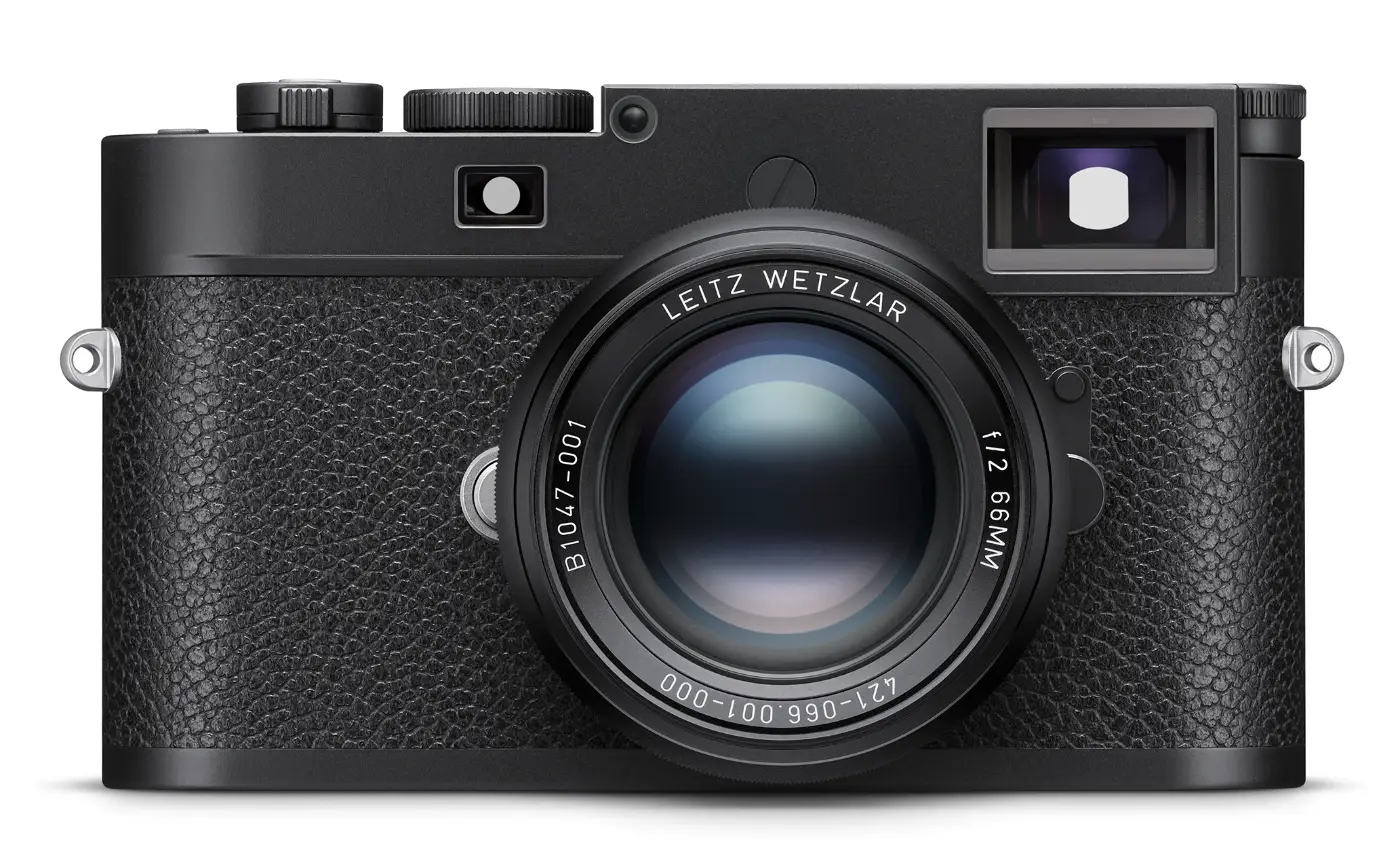
The front ring bears not only the serial number, but also the B1047 optical design number and Leica’s internal material number. The name ‘Leitz Wetzlar’ replaces the former ‘Elcan’, short for Ernst Leitz Canada.
There is also a small ‘60’ engraved on the side. It does not indicate a 60 mm lens, but the precisely measured focal length of 66.0 mm. Such markings were once used on precision lenses whose actual focal length was recorded exactly.
A natural match for the Leica M EV1
Traditional Leica M cameras use fixed frame lines in their optical viewfinders. There is no exact 66 mm frame, so you have to estimate the final crop to some degree. The Leica M EV1 with electronic viewfinder displays the lens’s full field of view directly, allowing more precise framing and focusing.
Even so, most of the 660 examples are unlikely to be carried through all kinds of weather every day. Its unusual story, limited production run and wealth of historical details make it at least as much a collector’s item as a working lens.
Price and availability
The Leica Summicron-M 66 f/2 has been available in very limited numbers since 3 September 2026. The recommended retail price is €9,850 including VAT.
In November 2026, the example with serial number 001 will be auctioned at the Leitz Photographica Auction in Wetzlar. Whoever secures it will probably be buying a lens destined for fewer secret missions than its predecessor. Its collector value is unlikely to be a concern.