You can photograph textures and abstract subjects in any season. Finding subjects often requires nothing more than looking carefully around you; some of the best can be found right in your backyard.
Photographing textures and abstract subjects does require careful study before you take the picture. Because you are working with shapes, lines, and color rather than depicting the subject as a whole, creating a strong composition becomes even more important. Observe the subject closely and try to capture its essence in your images.
In abstract photography, we omit nonessential information to reveal the subject’s underlying structure. We do this by magnifying something very small or by selecting a small section of a larger whole.
The honey fungus caps were photographed from above at very close range. By leaving the rest of the fungi out of the frame, the image emphasizes the caps’ round forms and beautiful colors.
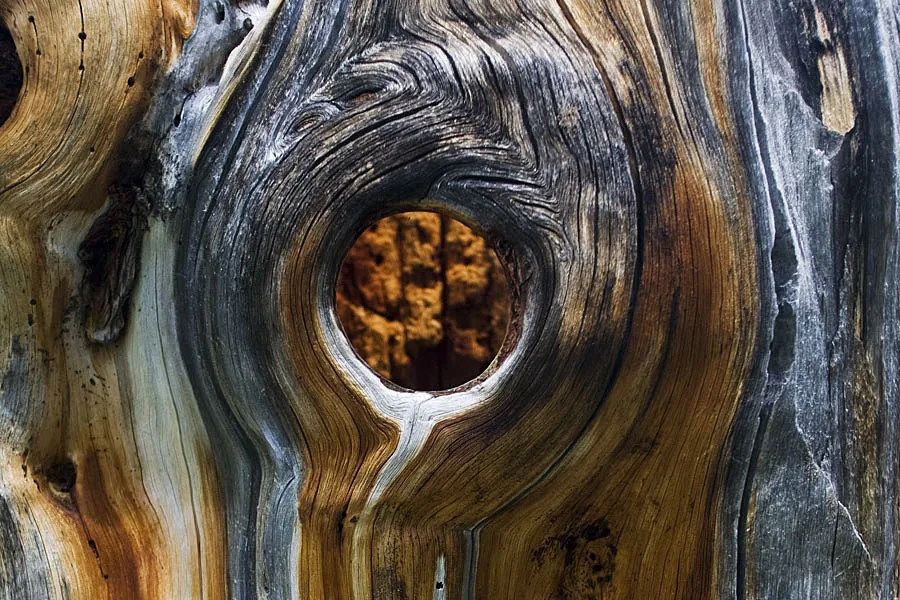
When photographing textures, consider how the elements in the subject relate to one another. Their relationships determine the structure, which can be defined by shape, color, lines and planes, light and shadow, or the rhythm of the elements in your subject.
In the image of the dead tree, the emphasis is on the curved vertical lines in the wood. Filling the frame with them draws the viewer’s attention to the vertical pattern of lines. Including the hole in the tree interrupts that pattern and adds variety to the image.
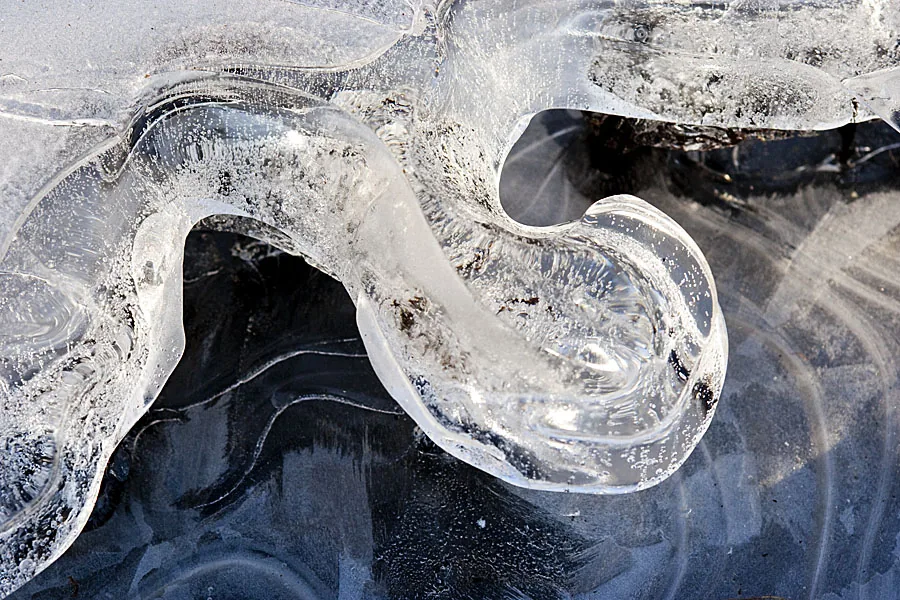
In the winter ice formations often provide exceptionally beautiful motifs and textures for abstract photography.
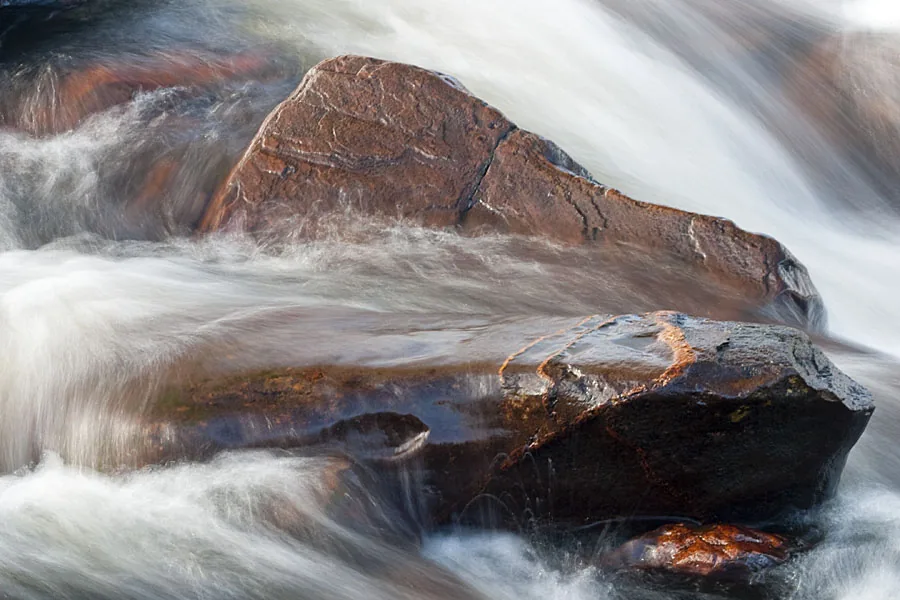
A very slow shutter speed adds another dimension to the image of the stone in flowing water. The motion renders the fast-flowing water milky white, creating an appealing texture. To achieve this effect, the shutter speed generally should be no faster than 1/25 second. The longer the exposure, the softer and whiter the water will appear.
Almost any camera can photograph abstract subjects and textures. If you use a compact camera, try its macro mode, which lets you get very close to your subject. Some of the most beautiful abstract forms and textures emerge at close range.
If you use a DSLR, you can choose any of your lenses, depending on the subject. Use a wide-angle lens to capture the texture of clouds in the sky, for example, or a very long telephoto lens to isolate a small detail in a vast landscape. If you want to get extremely close to your subject, a macro lens is recommended.
When working close to your subject, use a small aperture to obtain enough depth of field to keep it sharp from front to back. Because this often requires a slow shutter speed, using a tripod is advisable.