Excerpt from Scott Kelby's Digital Photography book, Chapter 3, The Truth About Lenses—Some Lenses Have Two Apertures
Some Lenses Have Two Apertures
Sometimes you will see a zoom lens with two different apertures. This means that at the shorter end (on an 18-200mm lens, that would be around 18 mm), the lowest available f-stop is f/3.5. Zoom to 200 mm, and f/5.6 is the lowest available setting. In between, the f-stop gradually increases. (At 100 mm, for example, it is f/4.)
This means two things. (1) When zoomed out (18 mm), you can shoot in much less light than when you zoom to 200 mm. (The lower the lens's f-stop, the easier it is to get sharp handheld photos in low light.)
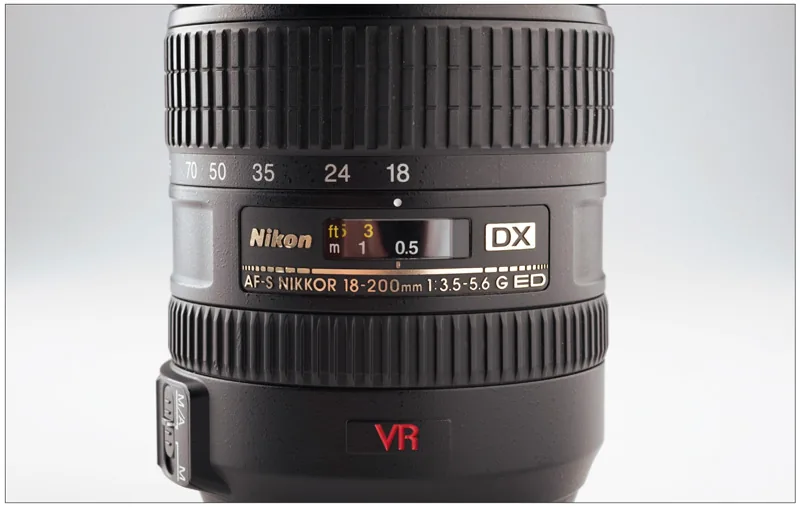
It also means (2) that the lens is not as expensive. Truly ‘good glass,’ as it is called, has a constant aperture. (The f-stop remains the same throughout the zoom range.) So the lens stays at, say, f/2.8 whether you zoom in considerably or not. Nikon's 70-200mm f/2.8 VR lens always shoots at f/2.8, whether you zoom out to 70 mm or zoom all the way in to 200 mm.
Use the Focus Limit Option for Faster Focusing
When you let the camera focus automatically, the lens first examines everything in the frame, far away and nearby, and then concentrates on what it thinks you are aiming at. This may take only two seconds. If you mainly photograph distant subjects (a sporting event or a bird in a tree, for example), set the lens to Limit instead of Full Focus. It will not even try to focus on things that are two or three meters away. That lets it focus faster, so you do not miss that one decisive goal.