In March 2024, Huis Marseille presented the first major retrospective of American artist Deborah Turbeville (Stoneham, 1932 – New York, 2013). The exhibition included a large selection of vintage collages and unique works, some of which had never been shown before.
With her incomparable, dreamy and melancholic images, Turbeville gave a new impetus to (fashion) photography in the 1970s and 1980s. The Photocollage exhibition brings together images from her most important series for the first time, including from Bathhouse (1975), Ecole des Beaux-Arts (1977), Unseen Versailles (1982) and Studio St. Petersburg (1995-96).
Working mainly for leading fashion magazines and brands, Deborah Turbeville never considered herself simply a fashion photographer. From her earliest work in the 1970s, she developed a recognizable style, using sepia tones, overexposure and soft focus to veil her black-and-white images.

In her work, enigmatic female figures pose in public spaces and interiors of monumental buildings, or wander through desolate winter landscapes. The images evoke a dreamed world or a time that has already passed, and – in the case of her commercial assignments – prioritize creating an atmosphere over selling a brand. Often the clothing from the brands Turbeville worked for was barely visible.
The images evoke a dreamed world or a time that has already passed
As one of the few women in a male-dominated profession, Deborah Turbeville chose a path at odds with that of her colleagues. She looked for models whose faces suggested a rich inner world. They were often people who did not see themselves as models and needed some convincing before allowing themselves to be photographed.
Turbeville then shows them lost in thought, in relaxed poses bordering on lethargy – nothing like the modern, sexy and confident women seen in other reports in the same fashion magazines. She wanted to look beyond the models' appearance: "I enter the private world of women, where you would otherwise never go," she once said.

Turbeville’s artistic practice extended beyond taking photographs. She experimented in the darkroom and continued at the studio table, tearing, scratching, burning or taping her prints. This gave new prints a patina that made them appear to come from another time.
“After I create the image, I destroy it,” she said. “The idea of decay is really at the core of my work.” Doubled edges in some images reveal repeated editing, rephotographing, printing and reworking.
However, the stories Turbeville tells remain open and unfinished, like fragments of dreams
The result is a breathtaking collection of manipulated, torn and pieced together works of art. The exhibition in Huis Marseille presents authentic vintage prints characterized by this distinctive material quality.
This materiality is particularly evident in the collages that Deborah Turbeville made throughout her life. In it she pinned her own photos with T-pins on brown paper and arranged contact prints and notes as a kind of storyboards. The – already enchanting – works thus take on the character of a film script.

However, the stories Turbeville tells remain open and unfinished, like fragments of dreams. The exhibition also brings together a wide selection of these authentic collages.
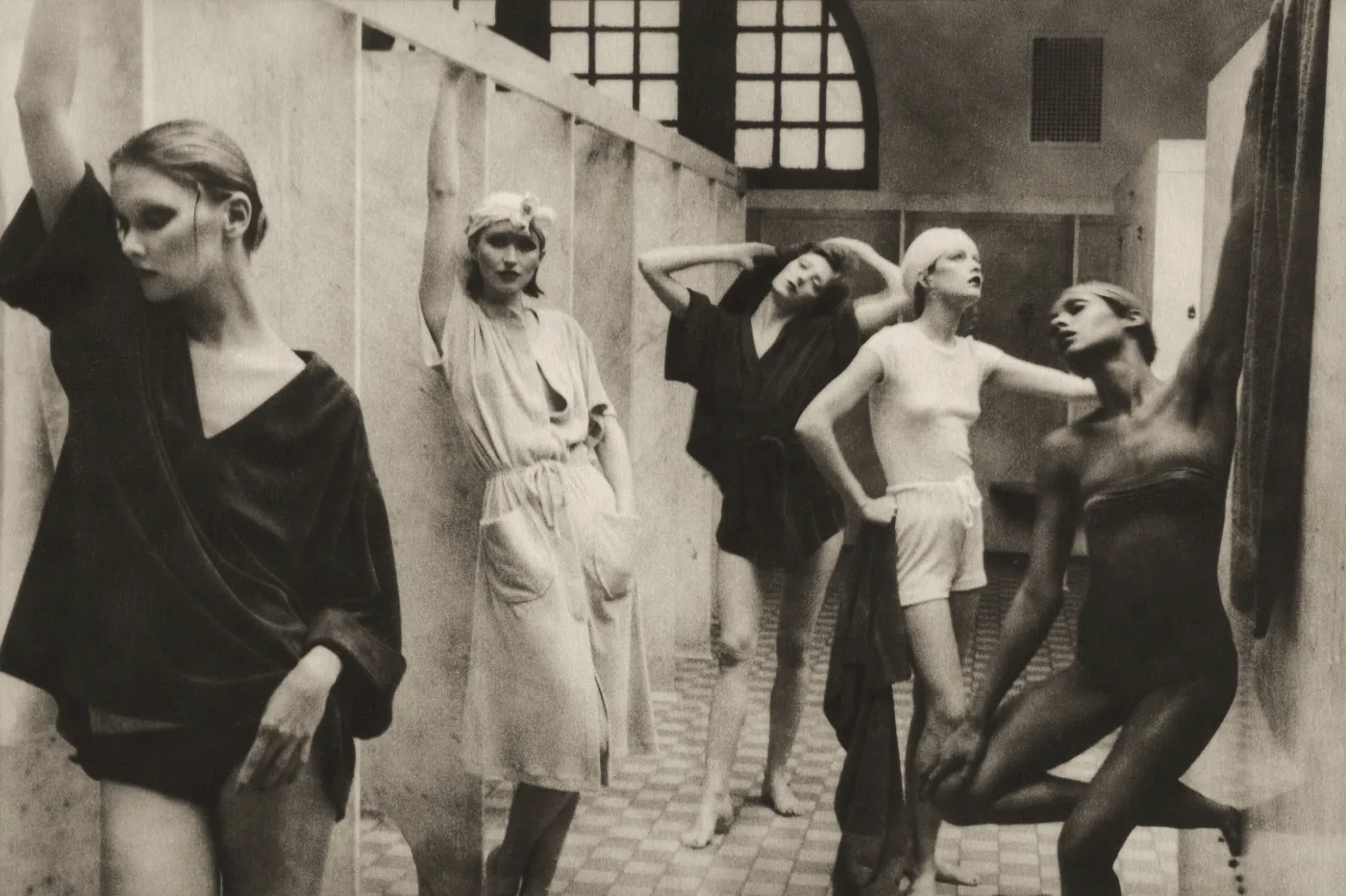
Photocollage is built around five themes: 'The Beginning', 'Revelations', 'Architecture of the Past', 'Houses Elsewhere' and 'Fictions'. From Turbeville's early years, her first collages, commissioned works and early polaroids shown. Her most famous photo shoot was, of course, Bathhouse (1975). This was part of an editorial with swimsuits for American Vogue, commissioned by art director Alexander Liberman.
The photo shows five models leaning against the shower walls of New York's Asser Levy bathhouse. This photo caused a lot of controversy: some readers thought that the women looked like drug addicts or lesbians and that the bathhouse looked like the gas chamber of a concentration camp.
Turbeville herself said: “For me, the main problem was how to get five girls onto a spread.” The editorial marked her breakthrough, and she continued to produce unsettling images throughout her career.
Biography
American artist Deborah Turbeville (Stoneham, 1932 – New York, 2013) began her photography career in earnest at around forty. Before then, she experimented with a Pentax camera in the 1960s while working editorially at Harper’s Bazaar and later Mademoiselle. Despite her limited experience, she was admitted in 1966 to a prestigious workshop led by photographer Richard Avedon and art director Marvin Israel, who encouraged her to make the transition to full-time photographer.
From the 1970s onwards, Turbeville photographed advertising campaigns for fashion houses such as Comme des Garçons, Guy Laroche, Charles Jourdan, Calvin Klein, Emanuel Ungaro, Romeo Gigli and Valentino and her fashion reports were published in magazines such as Vogue, Harper's Bazaar, Nova, New York Times Magazine and Vogue Italia.
Her work is in the collections of institutions such as the Metropolitan Museum of Art, the Museum of Modern Art and the Whitney Museum of American Art in New York, the Los Angeles County Museum and the Getty Museum in Los Angeles, the Art Institute of Chicago, the National Portrait Gallery in London and the Center George Pompidou in Paris.
Deborah Turbeville - Photo collage
March 16 – June 16, 2024
Huis Marseille