In Chile, the Vera C. Rubin Observatory has begun one of the most ambitious photography projects ever: the southern night sky will be captured for ten years with a 3.200-megapixel digital camera. For photographers, it is above all an impressive reminder of what photography does at its core: make time, light and change visible.
When most photographers think of a large camera, they picture a medium-format body, a technical camera or perhaps a heavy studio setup. The LSST Camera at the Vera C. Rubin Observatory is in a different league. Built for the Legacy Survey of Space and Time, the instrument captures images of the night sky at a resolution of approximately 3,2 gigapixels. It is not intended to produce one beautiful final image, but a living archive of the cosmos.
According to the initial reports surrounding the start of the survey, the camera will take hundreds of exposures each night over the next ten years. This will create an increasingly deep and up-to-date view of stars, galaxies, supernovae, asteroids and other objects that move or change in brightness.
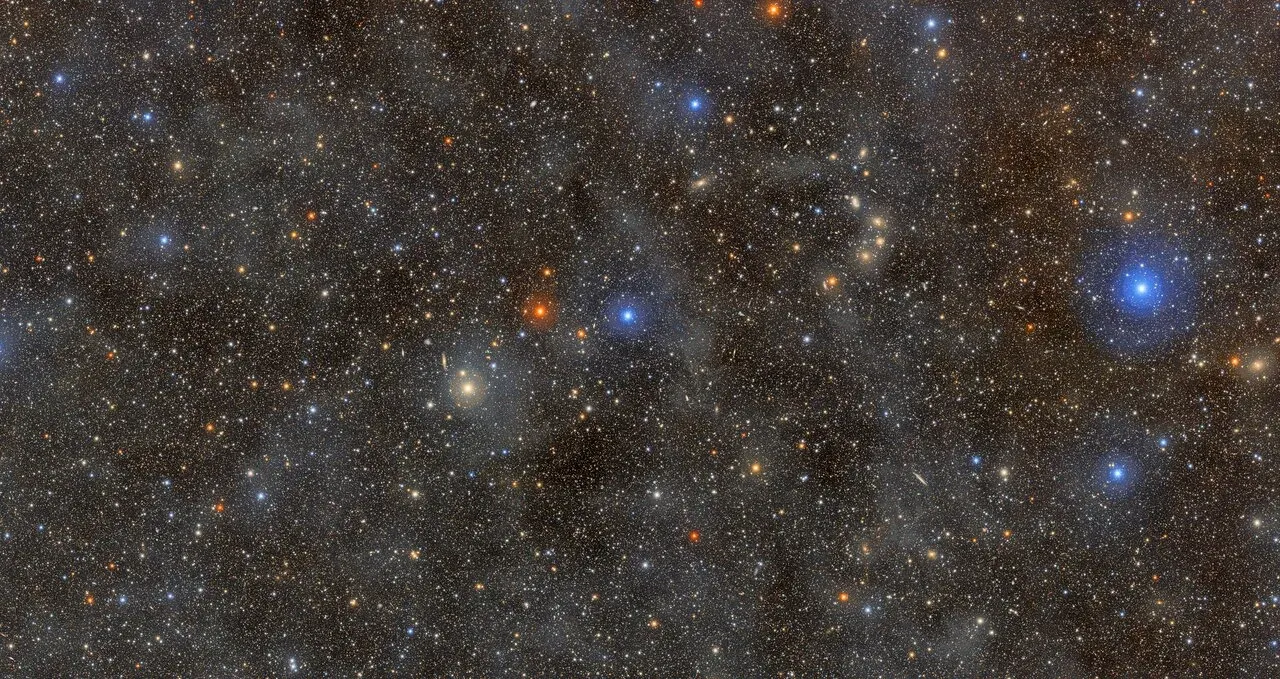
Ocean of Stars
This 1,7-gigapixel image of a star field in the constellation Lupus shows the unprecedented view of the universe offered by the NSF-DOE Vera C. Rubin Observatory. Equipped with the LSST Camera—the world’s largest digital camera—Rubin combines a wide field of view with the ability to detect extremely faint objects. This capability allows Rubin to reveal details of the cosmos across an enormous range of scales, from distant galaxies to individual stars and the wispy clouds of dust that extend throughout our galaxy.
The faint, glowing clouds in this image are galactic cirrus clouds: clouds of interstellar gas and dust visible in the foreground of the Milky Way. Rubin’s ability to capture such scenes in unprecedented detail will open new perspectives on the structure of our galaxy and the universe beyond.
Not one photo, but a photographic record of time
What makes this project special is not only its resolution. It is above all the repetition. The Rubin Observatory photographs the same areas of sky again and again. As a result, the night sky is no longer a static backdrop, but a scene in which changes become visible: an asteroid moving, a star brightening, an explosion in a distant galaxy or an object that had previously simply gone unnoticed.
Photographers will recognize that idea. A strong series can tell more than a single image. Think of a long-term landscape project, a streetscape that changes over the years or a timelapse in which the pattern only emerges after a great deal of patience. Rubin does something similar, but on a cosmic scale.
A camera with 189 sensors
The LSST Camera is not simply a larger version of an ordinary digital camera. Its focal plane consists of 189 individual CCD sensors that together produce an image of approximately 3.200 megapixels. Each exposure covers an enormous area of sky, allowing the telescope to capture large parts of the southern sky in a relatively short time.
That makes the camera interesting from a photographic perspective. While much consumer equipment focuses on speed, autofocus and image stabilization, this system is about scale, precision and repeatability. The challenge lies not in operating the camera, but in reliably capturing, calibrating, storing and searching an almost unimaginable amount of image data.
Astrophotography as data photography
Much of the technology will sound familiar to amateur astrophotographers: long nights, filters, calibration frames, noise reduction and combining multiple exposures. Everything here is simply scaled up to an extreme degree. The Rubin Observatory uses different filters to collect information about color and composition. By comparing images, researchers can automatically detect changes in the sky.
The project therefore demonstrates how closely photography and data analysis have become intertwined. A photo is not only a final image for a wall or screen, but also a measuring instrument. This has long been true in science, but we see the same development in everyday photography: cameras recognize subjects, software stacks images, phones compute night images from multiple exposures and AI assists with selection and post-processing.
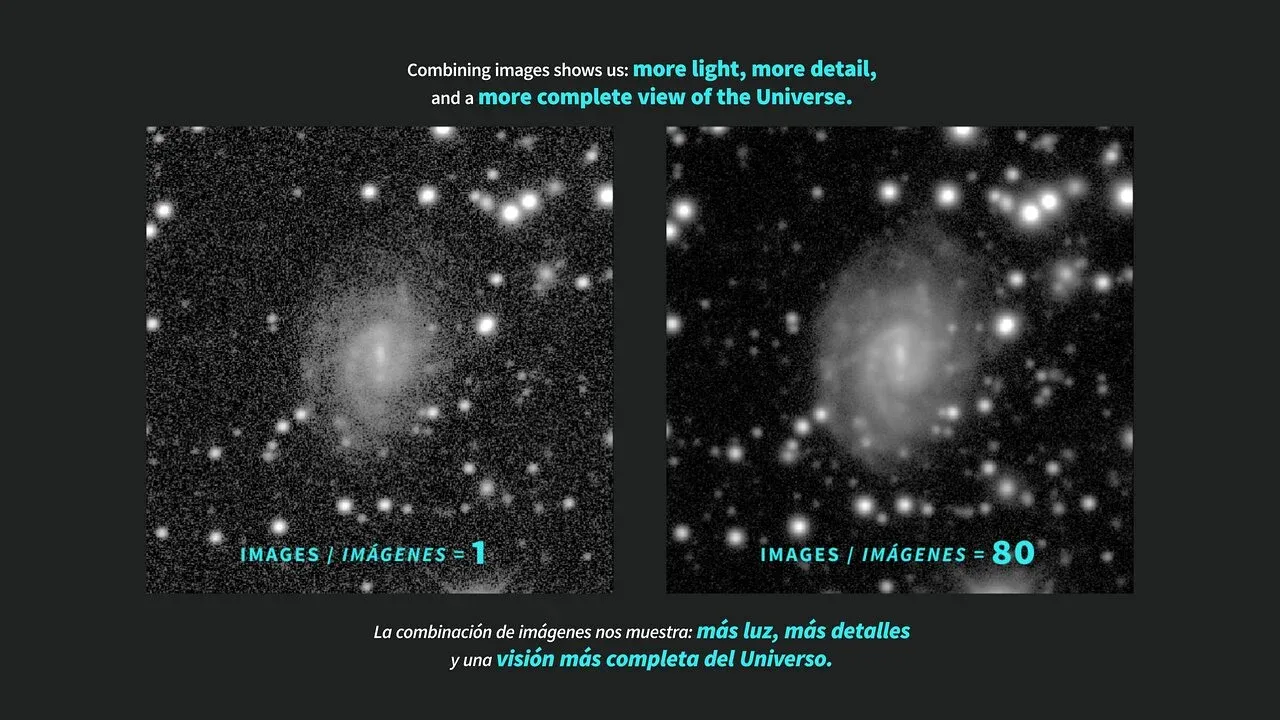
The depth of NSF–DOE Rubin’s LSST
This infographic shows how combining multiple exposures reveals far more detail than a single exposure can capture. By merging multiple images of the same area taken by the Rubin Observatory, we can collect more light, make fainter objects visible and create a sharper, more detailed view of the universe.
You can also see how a photo can be an image, a memory and measurement data all at once in NASA’s Artemis II in Eclipse.
Why this is inspiring for everyday photographers too
You do not need a telescope in Chile to apply something from this project to your own photography. Perhaps the most important lesson is to work in series. If you are always searching for that one spectacular photo, you can sometimes miss the power of repetition. Photograph the same place at different times. Document a project for a year. Do not just make individual images; build a visual archive.
This certainly applies to astrophotography. The Milky Way, phases of the Moon, meteor showers and night skies above the landscape are ideal subjects for projects in which timing and preparation play a major role. Even with an ordinary mirrorless camera, a fast wide-angle lens and a tripod, you can achieve a great deal. To learn more about night photography and the Milky Way, read about astrophotography with Albert Dros.
The world’s largest camera asks a simple question
The start of the Rubin survey is big news for astronomers, but it is also a wonderful moment for photographers. This camera shows that photography is much more than a device or file type. It is a way to observe, compare and give meaning to change.
Over the coming years, the world’s largest camera will not take vacation snapshots or portraits. It is creating a slowly growing timelapse of the universe. In doing so, it reminds us of something very simple: every photo is a piece of time captured in light.
Source: Vera C. Rubin Observatory.