NASA has released a remarkable image from the Artemis II mission. Taken from the capsule with a Nikon Z9, the photograph shows the Moon almost completely covering the Sun. This is not a conventional eclipse seen from Earth, but a quiet occultation viewed from space itself.
The image is titled Artemis II in Eclipse. The Moon appears as a dark, almost tangible disk in front of the Sun, surrounded by a delicate glow. NASA says Saturn and Mars can also be seen on the right-hand side of the frame. The fact that the image was made with a Nikon Z9 and a 35mm lens makes it especially interesting to photographers—not because the camera should take over the story, but because the photograph shows that even in space, photography still begins with light, timing, and point of view.
An eclipse from the capsule
The Artemis II crew watched the Sun disappear behind the Moon for almost an hour. At closest approach, the spacecraft was about 6,545 kilometers above the lunar surface. From that perspective, the Moon appeared much larger than the Sun, giving the event a different character from a solar eclipse as seen from Earth.
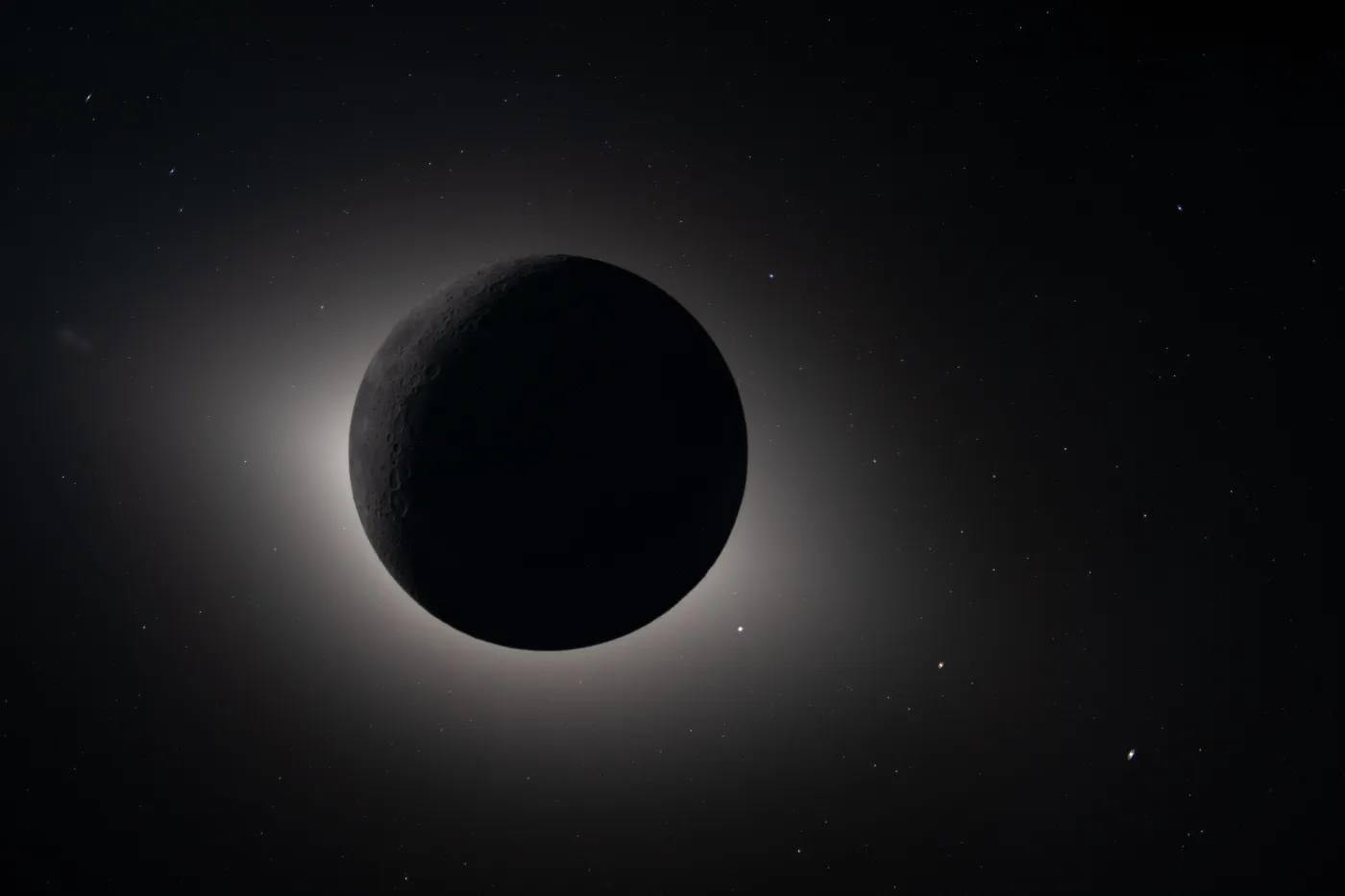
That is precisely what makes the photograph so compelling. It is not only a technically impressive moment, but also a shift in perspective. From Earth, an observer sees the Moon briefly pass in front of the Sun. Here, the camera looks on from a spacecraft moving past the Moon. The eclipse therefore becomes less of a spectacle in the sky and more of a spatial experience: for a moment, the Sun, the Moon, and the capsule occupy a rare alignment.
The camera as a silent witness
The image was made with a Nikon Z9 and a 35mm f/2D lens. The exposure settings were f/2, 2 seconds, and ISO 1600. Those figures do not automatically make the photograph exceptional, but they do reveal something about the conditions: very little light, a moving spacecraft, and a subject with enormous contrast.
Here, the camera is above all a silent witness—not the protagonist, but the instrument that keeps a fleeting moment visible. Nikon notes that its cameras and lenses have been used on NASA missions since Apollo 15. What matters in this case is that the system delivered enough detail and dynamic range to record the faint light around the Sun.
Researchers at Tokyo City University also analyzed images of the solar corona made with the same camera during Artemis II. Such images are not only beautiful; they can also yield data about the delicate light around the Sun. This is where photography touches science: the image is at once a memory, evidence, and measurement data.
Also read: Albert Dros’s astrophotography tips and How to photograph the total solar eclipse if you would like to photograph stars, the Milky Way, or a supermoon yourself.