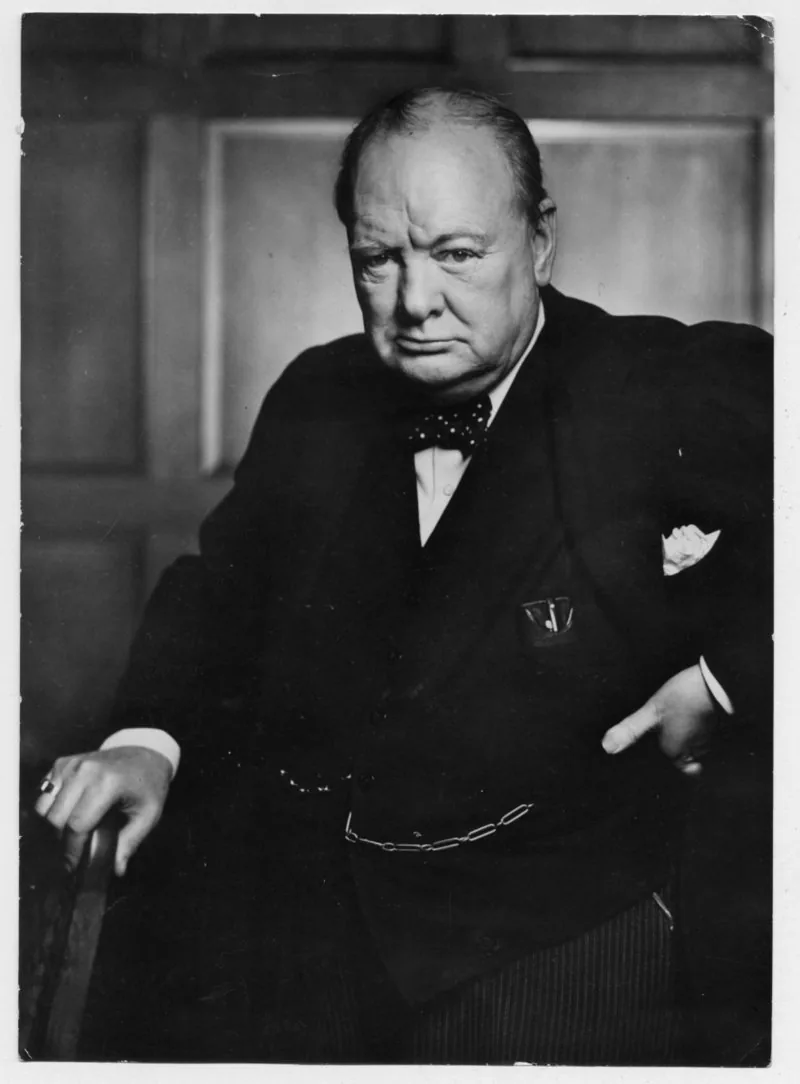
England’s most powerful man does not look happy—and Sir Winston Churchill is anything but happy. He has just been deprived of his trademark, the ever-present Corona cigar. The culprit: photographer Yousuf Karsh (1908-2002).
It is December 1941, near the end of a turbulent year. Winston Churchill is in Ottawa, Canada, to address Prime Minister Mackenzie King and members of the Canadian Parliament about the war in Europe.
Also present in the government building is the Armenian-born portrait photographer and Ottawa resident Yousuf Hovsep Karsh, who is one of King’s personal friends.
Karsh, who has realized that photographing famous people could make him famous in turn, has already received permission to make a portrait of Churchill in the few minutes following the speech.
Churchill himself has not been told. After his impassioned speech, he is somewhat surprised to encounter Karsh’s camera setup: “What’s this, what’s this? Why was I not told?” Karsh rescues the situation by explaining that he wants to make a photograph worthy of commemorating the historic occasion.
Churchill mischievously lights a fresh cigar and magnanimously tells the photographer that he may take one picture.
Once Karsh is certain that every technical detail is in place, he approaches his subject with his customary politeness, says, “Forgive me, sir,” plucks the cigar from Churchill’s mouth, and returns to his camera. The silence is deafening.
says, “Forgive me, sir,” plucks the cigar from Churchill’s mouth, and returns to his camera
As Churchill’s priceless expression begins to form—his face showing his displeasure at losing the cigar—Karsh presses the shutter.
Churchill then begins to smile graciously and gives Karsh permission to take another photograph. Churchill tells him, “You can even make a roaring lion stand still to be photographed.” In Karsh’s archives, the portrait would later appear under the title “The Roaring Lion.”
Karsh may have risked his life by taking Churchill’s beloved cigar, but his career as a portrait photographer was now assured. In the years that followed, he photographed an impressive series of movie stars and politicians, elevating their stature to mythical proportions while becoming one of the twentieth century’s greatest portrait photographers himself.
And Churchill? In retrospect, he was equally pleased. The photograph portrayed him as a defiant statesman not to be trifled with, met every propaganda need, and became an icon of resistance to Germany during the Second World War.