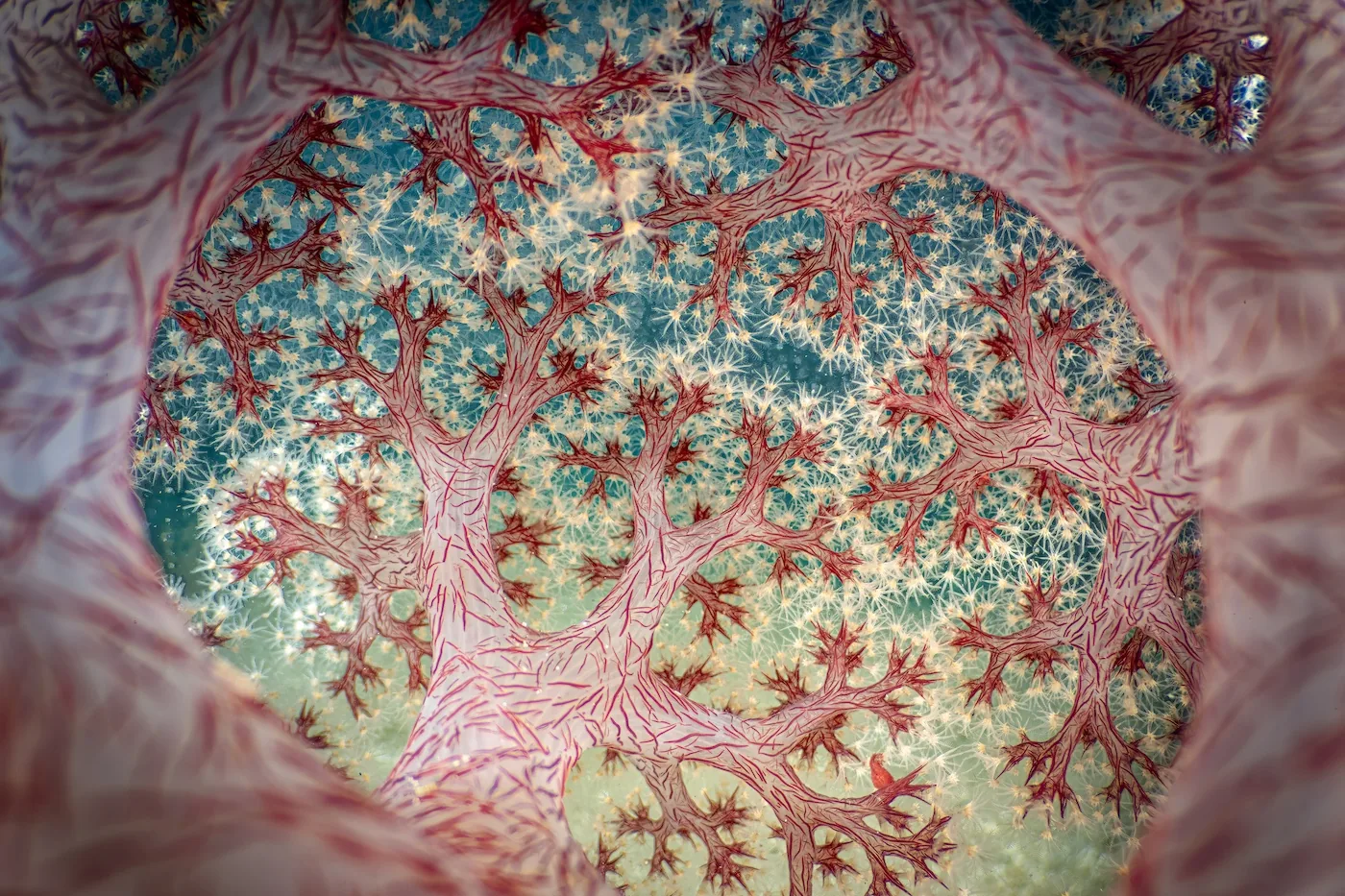
photo: © Ross Gudgeon - Fractal Forest / CUPOTY
Australian photographer Ross Gudgeon has won the top prize at Close-up Photographer of the Year 2025 with Fractal Forest, an extraordinary underwater photo taken in a cauliflower coral in the Lembeh Strait, Indonesia. The image earned Gudgeon the competition’s top honor and a cash prize of £2,500.
Ross Gudgeon: "Named for its cauliflower-like shape, this soft coral is made up of numerous small, round polyps that give it a fluffy texture. I wanted to explore a perspective not possible with conventional lenses, but an underwater lens made that possible. By gently guiding the lens through the coral's branches without damaging them, I was able to photograph the subject from the inside, creating a different perspective on a common marine organism."
(Technical information: Sony A7R IV, Sony FE 90mm f/2.8 Macro G OSS, ISO: 400, f/9, 1/100 sec., Nauticam EMWL with 160º objective lens and 2x Retra Pro flashes
Post processing: DXO Pure Raw, Adobe Lightroom, Topaz Photo AI and Adobe Photoshop)

Close-up Photographer of the Year is an international photography competition that aims to reveal the hidden wonders of the world through macro-, micro-, and close-up photography.
The seventh edition of the competition attracted more than 12,000 entries from 63 countries. A panel of 22 expert photographers, naturalists and editors spent more than twenty hours in Zoom meetings to select the winners and the Top 100 photos.
Arachnids Dinner
A lynx spider (Oxyopes sp.) feeds on some termites in Hong Kong.
Artur Tomaszek: "Lynx spiders are ambush predators that actively hunt their prey by sight. Although they produce and use silk, they do not build webs to catch prey. I came across this while surveying moths on a particularly memorable evening. It had been a very hot spring with little rain, but that evening it suddenly started to rain, causing thousands of termites to begin their mating dance and swarm the air. This provided the lynx spider with an excellent opportunity to secure its evening meal. The biggest difficulty in taking the photo was the thousands of termites flying right into my face, attracted by the camera flash. Finally, the spider managed to capture two or three termites at a time, creating this striking scene."
(Technical information: Canon EOS R5, Laowa 100mm f/2.8 2x Ultra Macro APO, ISO: 320, f/11, 1/160 sec., Cygnustech diffuser, Lightroom)

This year's winning photos are spread across 11 categories, with subjects ranging from frogspawn resembling a galaxy and a ghostly swarm of mayflies approaching a Hungarian city, to an ice-covered tree in Nagano and a fantastical landscape created by oxidizing a copper plate with household materials.
Tracy Calder, co-founder of CUPOTY, said: "The winning image embodies everything close-up photography can achieve – showing us a perspective we've never seen before and revealing hidden beauty in a familiar subject. The judges were captivated."
Butterflies Dragonfly Alphabet Calligraphy
A beautiful demoiselle damselfly (Calopteryx virgo) takes off from a reed stem near Gatchina, Russia.
Dmitrii Melgunov: "Beautiful damselflies are one of my favorite subjects. In this case I managed to capture one rising from a curved reed stem against the clear sky reflected in the water. This angle allowed me to obtain a minimalist, graphic image that I further enhanced by converting it to black and white and increasing the contrast. The composition formed by the reed stems resembled the letter "A", as if drawn by the damselfly with the fine calligraphic brushstrokes of its airy flight. To capture the perfect moment of this split second, I used the 30 frames per second burst mode on my camera."
(Technical information: Canon EOS R7, Canon RF 100-400mm f/5.6-8 IS USM, ISO: 5000, f/8, 1/8000 sec.)
The eighth Close-up Photographer of the Year competition opened in May 2025. More images can be seen in the winners’ gallery at www.cupoty.com.