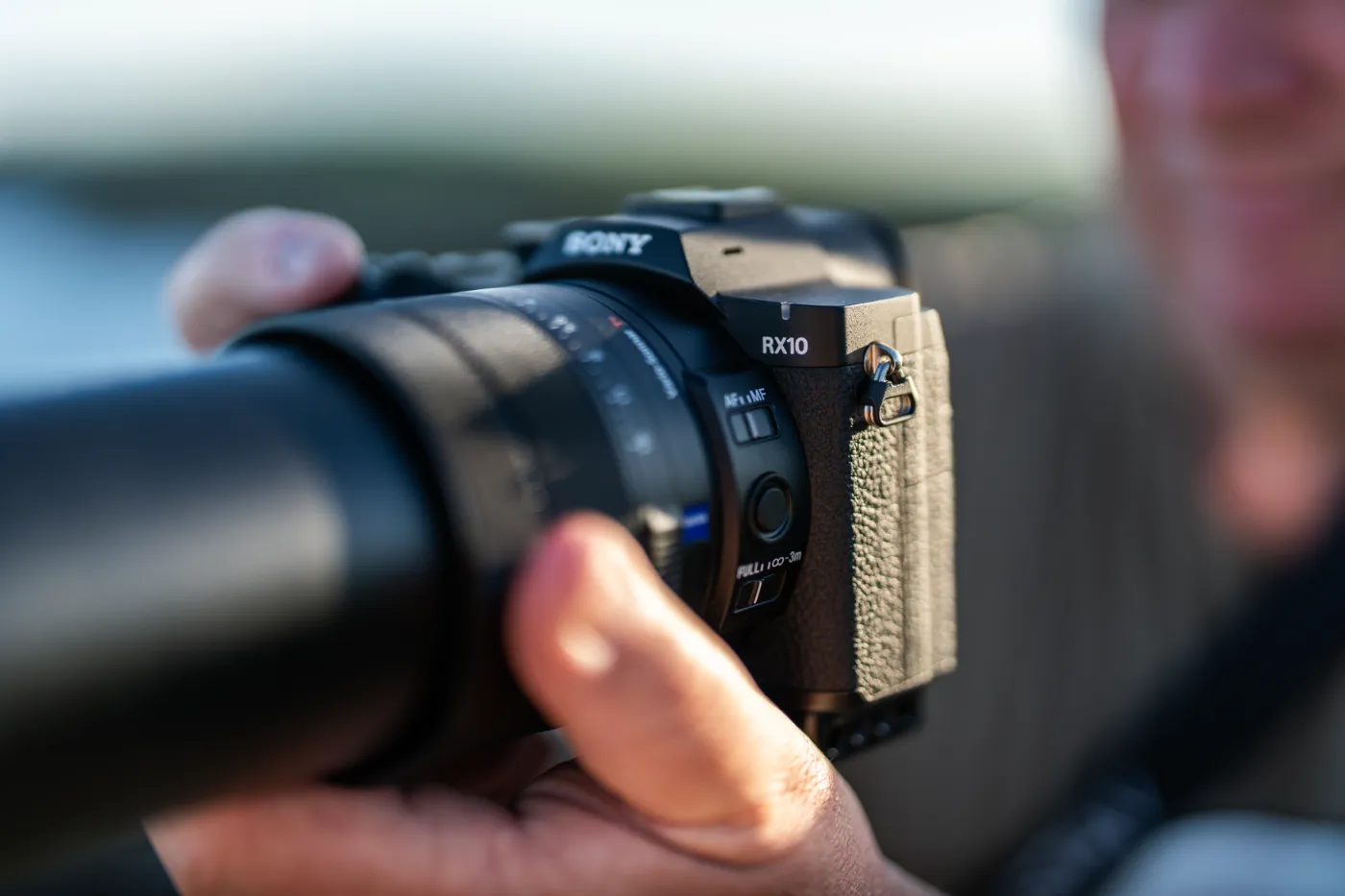
The Sony RX10 V has now been announced. The fifth generation of the RX10 series remains true to the familiar idea of one camera with an enormous zoom range, while primarily adding modern autofocus, faster processing, and more robust video capabilities.
Sony describes the RX10 V as an all-in-one superzoom camera for everyday photography, nature, and sports. That is exactly where this camera becomes interesting: not as a small pocket compact or as a replacement for a mirrorless camera with interchangeable lenses, but as a camera for anyone who wants to go from wide angle to supertelephoto in a single body.
One lens from 24 to 600mm
The zoom range remains at the heart of the RX10 series. The RX10 V has a ZEISS Vario-Sonnar T* 24-600mm-equivalent lens with 25x optical zoom and an F2.4-4.0 maximum aperture. In theory, the same camera can therefore photograph a landscape, a portrait, a detail in the city, and a distant bird.
This makes the RX10 V particularly attractive to photographers who do not want to keep changing lenses. Think of a walk through a nature reserve, a school sports day, a trip where you want to carry very little, or a day when you do not yet know what you will encounter. You give up the flexibility of interchangeable lenses, but gain simplicity and reach.

Close-up photography also remains part of the concept. Sony specifies macro shooting from approximately 3 centimeters at 24mm and tele-macro from approximately 72 centimeters at 600mm. The latter may be especially useful for details in nature, such as flowers, insects, or textures you do not want to approach too closely.
Faster focusing with subject recognition
The biggest advance is probably not in the lens, but in processing and autofocus. Sony uses in the RX10 V a 1.0-type stacked Exmor RS CMOS sensor of approximately 20.1 megapixels, together with the BIONZ XR image processor. According to Sony, the RX10 series now gains three new processors, including one for Real-time Recognition AF.
This subject-recognition system can identify people, animals, birds, insects, cars, trains, and airplanes. In automatic mode, the camera selects which type of subject to track. Human pose estimation is also included, allowing the camera to keep following a person even when their face is not clearly visible.
For sports and wildlife, this matters more than it may appear on paper. With a bird in flight, a child running across a sports field, or an animal repeatedly disappearing behind branches, the lens is not the only decisive factor. The camera must also continue to recognize and track the subject. Sony claims up to 60 AF/AE calculations per second and blackout-free continuous shooting at up to 30 frames per second with AF/AE tracking.
When a bridge camera still makes sense
The RX10 V is primarily about convenience in the field: moving from a landscape to a bird, a sports moment, or a detail without changing lenses. That is exactly where a bridge camera can still make sense. Not as a replacement for a mirrorless camera with fast primes, but as a practical all-in-one camera for travel, nature, events, and days when you do not know what you will encounter.
That makes it related to cameras such as the Nikon Coolpix P1100, which likewise centers on providing extensive reach in a single fixed lens.

This connects with an earlier Fotografie.nl article about endangered species photographed with the Sony RX10 III. It raised the same question: how much can you achieve with one fixed superzoom camera, especially when distance and quiet are important?
Video gets more serious
Sony is positioning the RX10 V as more than a stills camera. It supports 4K 120p video, although Sony notes that this uses a slightly narrower angle of view. This enables slow-motion footage, for example of sports, animals, or movement in nature.
Sony also lists Active Mode image stabilization for handheld video, a Multi Interface Shoe with a digital audio interface for compatible microphones, AI-assisted Auto Framing, S-Cinetone, S-Log3, LUT support, time-lapse, and Shot Mark. That is a fairly extensive video package for an all-in-one camera.
For many Fotografie.nl readers, the combination will be the most interesting part. Anyone who primarily takes photographs but occasionally wants to produce useful video need not immediately head out with a separate video camera, gimbal, or set of lenses. The RX10 V attempts to combine those roles in one device.
More practical operation
Sony says it has also refined the controls, with a design more closely aligned with its Alpha mirrorless cameras. The camera has a larger Quad-VGA OLED viewfinder, a 3.0-inch LCD screen, and uses the NP-FZ100 battery. According to Sony, the RX10 V captures approximately 630 photos using the LCD screen and approximately 570 through the viewfinder. That is about 50 percent more than the previous model.

Sony also mentions dust and moisture resistance, with the usual caveat that the camera is not guaranteed to be completely dustproof or waterproof. 2.4 and 5 GHz Wi-Fi, USB-C, 4K 30p live streaming, and support for the Creators’ App make the camera more current than older RX10 models.
Who is the Sony RX10 V for?
The RX10 V appears particularly appealing to photographers who spend a lot of time outdoors and do not want to carry too much gear. Nature, birds, children on the sidelines, vacations, zoos, walks, and travel are all logical use cases. Wide angle, normal range, and supertelephoto are immediately available under the zoom ring.
The recommended price is substantial, however. Sony reports that the RX10 V can be preordered starting July 9, 2026, for €2.499,-. For that amount, you could also buy a mirrorless camera with a lens or assemble an attractive used kit. Choosing the RX10 V will therefore depend mainly on how much you value the all-in-one concept.
That is precisely where this camera’s appeal lies. The RX10 V is neither a nostalgic compact nor a minimalist street camera. It is more of a tool for photographers who want to capture many different subjects without having to think about which lens is mounted on the camera while on the move.
One camera for many moments
The Sony RX10 V shows that the bridge camera has not disappeared. The segment has become smaller, but the idea remains compelling: one camera, one fixed lens, an enormous range, and enough speed to capture genuine moments.
For those seeking maximum image quality or creative lens choice, a mirrorless camera remains the more logical option. But for photographers who mainly do not want to miss a moment, from a landscape to a bird in flight, the RX10 V is a serious new option. Not because it does everything better, but because it brings a remarkable amount together in one camera.
Read also: Endangered species photographed with the Sony RX10 III