This article covers the Sony A550 (2009 model).
Older camera reviews remain available online as a reference resource for photographers.
The A550 sits at the top of Sony's new midrange amateur lineup. It is a camera with remarkably high performance: powerful, but without unnecessary baggage.
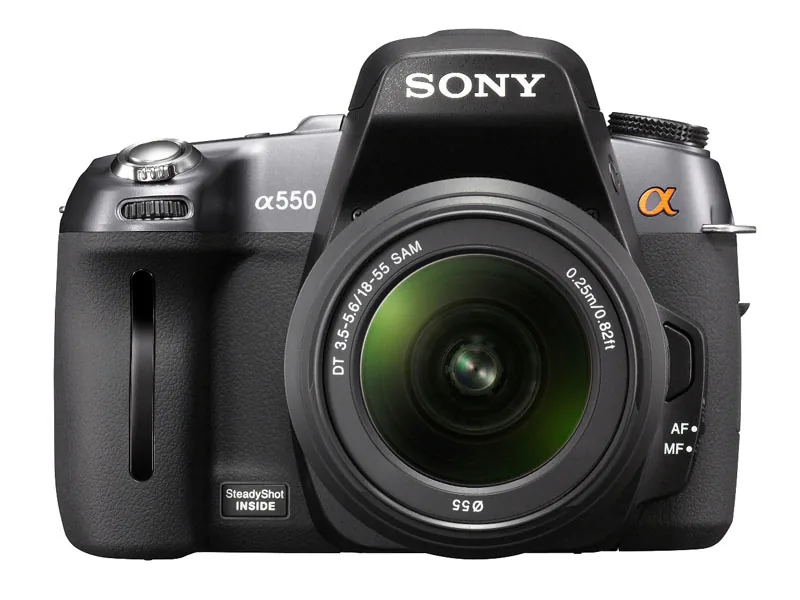
The list of highlights is impressive: up to 7 frames per second, 14.2 megapixels, ISO 12,800, and Auto HDR. It also has the only live-view system that retains fast autofocus. Even in live view, you still get a shooting rate of 4 frames per second!
The A550 (and the almost identical A500) targets two groups: demanding first-time DSLR users and photographers who started with a basic DSLR but have developed higher expectations.
Sony reasons that beginners and average enthusiasts may also be interested in fast bursts and high ISO settings, even if only to photograph their children or clubmates from the sidelines or inside a gym.
Until now, that would have led you to a semi-professional camera. With this A550, you do not have to pay top dollar. In terms of construction, it is simply an amateur camera.
This A550 offers an entirely new shooting experience!
Live View with Fast Autofocus and a Tilting Screen
Sony knows that new DSLR users want live view because they are accustomed to working that way with a compact camera. But until Sony entered the picture, live-view focusing was sluggish, just like on a compact. Yet those users are switching precisely because compact cameras cause them to miss so many moments.
Sony therefore built a dedicated live-view sensor into its DSLRs to provide the live-view image. The mirror does not need to rise in live view, allowing the camera's fast AF system to remain active.
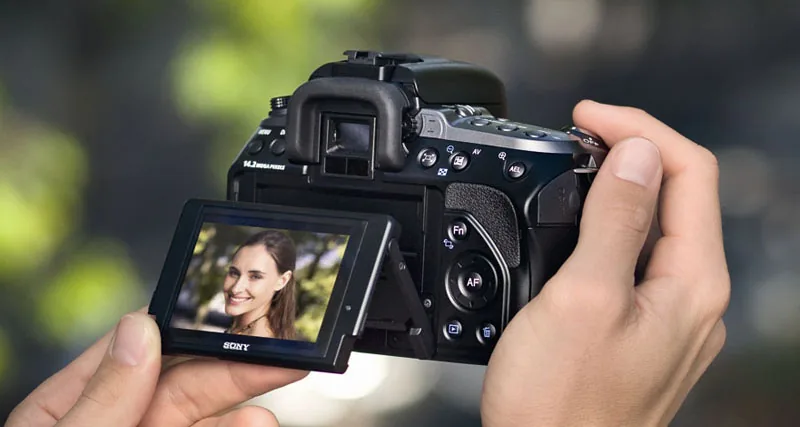
On the A550, your live-view image is also displayed on a large, brilliant 920,000-pixel screen. Shooting with it is a genuine pleasure, especially when paired with responsive, fast autofocus.
Shooting this way is so much fun. The tilting screen encourages you to try all kinds of viewpoints. A large, clear display naturally makes you pay more attention to composition.
A550 buyers should definitely consider the new, compact, affordable 1.8/50 mm lens at some point. It is a fine, fast portrait lens and very suitable for candid portraits with live view. Image stabilization is available with every lens because it is built into the camera.
Remarkably, the camera also remains fast in live view, delivering 4 frames per second in continuous mode. This A550 offers an entirely new shooting experience!
Live View with MF Check and 100% Frame Coverage
Sony's live-view system has one drawback: you see slightly less than the photo will contain. On the A500 and A550, there is a solution. Press the 'MF Check LV' button and the mirror flips up, giving you live view directly from the sensor with full coverage. In this mode, focusing must be manual, or you can briefly return to the regular live-view method and focus quickly there.
It delivers high-level noise reduction and detail
When focusing manually, you can magnify the image (7x or 14x) for maximum precision. In this mode, you can focus anywhere within the frame (normal live view is limited to the nine AF sensors, together or individually) and magnify that area as well.
This is useful for tripod shots. For macro work, magnifying the live-view image is invaluable because it is by far the most precise way to place focus exactly where you want it.
That is another major plus for Sony, although it makes the lack of visual depth-of-field preview all the more unfortunate. Combined with live view, that feature works extremely well, as several cameras from other brands demonstrate.
High-ISO Performance and Low Noise
The A550 has a new CMOS sensor and a matching Exmor processor. They perform very well. Everything is clean and smooth through ISO 800, while ISO 1600 and 3200 also remain very good.
Even areas, such as out-of-focus backgrounds, show only a very restrained noise pattern that is not really distracting. Color noise is suppressed exceptionally well. Sharpness and detail are also excellent.
At ISO 3200 and 6400, the A550 performs better than Nikon's D90 and D300s, and falls only slightly behind the much more expensive EOS 7D. The A550's ISO 12,800 setting has limited usefulness; here again, the Canon performs better. The JPEGs look good, and for noise and detail there is little need to resort to RAW processing.
That does not apply, of course, if you also want to adjust white balance, color, contrast, sharpening, and so on afterward. The automatic white balance performs quite well. Comparing shots in a bracketed exposure sequence shows that the contrast range remains broad even at high light levels.
A switchable HDR function that can expand the photo's dynamic range
Conclusion: this Sony A550 delivers genuinely high-level noise reduction and detail!
It is unfortunate that you cannot set the limits of the automatic ISO range yourself. It runs from 200 to 1600, while the manual range extends from 200 to 12,800.
Surprisingly, the D-Range button is located on the outside. It also activates the HDR function.
Extending Dynamic Range with Auto HDR & D-Range
White balance and metering mode do not have dedicated external buttons; they are accessed through the versatile function menu. There is, however, a dedicated D-Range button for optimizing tonal values and bringing out more detail in highlights and shadows. You can choose from 5 levels plus an automatic setting.
The highest setting is useful, for example, when shooting from a dark room toward the light, and it works well. The same button also gives access to the switchable HDR function, which expands the photo's dynamic range. The camera takes two shots, one with a generous exposure and one with a restrained exposure, then combines them into a single image file.
The strength of the effect, determined by the exposure difference between the two component shots, is adjustable. The camera takes the two shots immediately one after the other.
Using a tripod is not required: even if you move the camera slightly between shots 1 and 2, everything is still combined neatly and automatically. Naturally, the subject itself must not move; that is where the method reaches its limit...
Live view and fast AF make shooting wonderfully enjoyable
Ease of Use, Menus, and Help Features
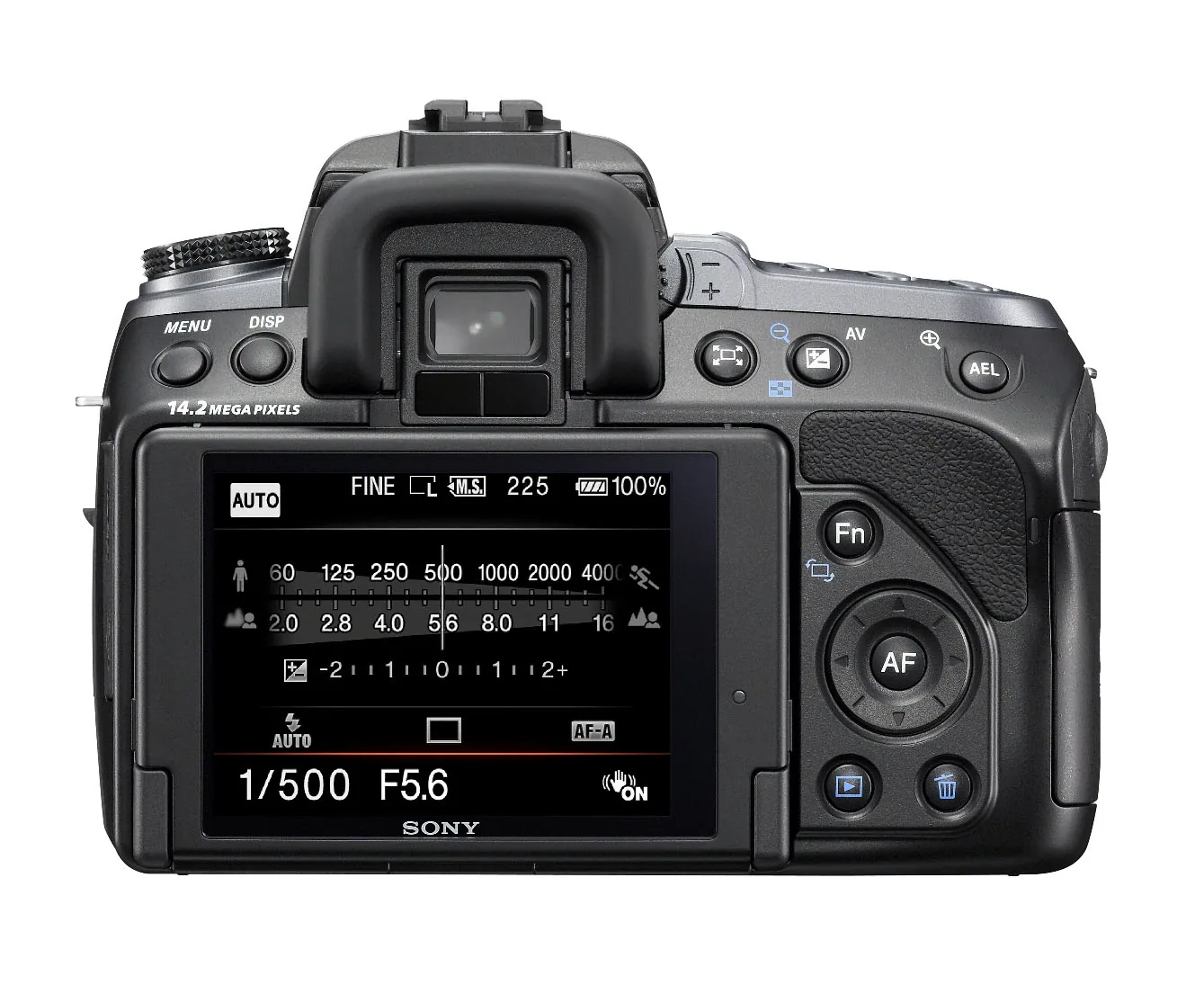
The A550 has new information displays for aperture and shutter speed, and they work well. Icons also show how settings affect depth of field and the rendering of motion. If desired, the camera continually explains the purpose of functions and settings. Handling is good, and the buttons and functions are easy to understand quickly.
The layout is clear and sufficiently comprehensive. Sony has kept the number of menu options limited because it does not want to burden buyers with choices that most users would rather avoid.
Oddly, the round control pad on the back is used only for menu navigation and sensor selection; it would have been useful to assign additional functions to it. The A550 is adequately equipped but offers fewer configuration options than Nikon, Olympus, and Pentax DSLRs. Those cameras provide many more ways to fine-tune functions and edit photos in-camera.
Sony has mastered the art of leaving things out and confidently focuses on essential functions. Many newcomers to DSLR photography will appreciate that. Technical enthusiasts may find the A550 too basic.
Real-World Experience and Target Audience
Live view and fast AF make shooting wonderfully enjoyable. The optical viewfinder was barely used during the test; the large, colorful LCD is much more pleasant and inspiring. You might accept average image quality just to have it, yet this new sensor also delivers very attractive results.
The Sony A550 is an ideal DSLR for beginners who want powerful performance. More experienced DSLR users will find it a useful creative tool, provided they can live without visual depth-of-field preview. And no, it cannot record video...