There is quite a lot to criticize about the Sigma DP2. Yet the internet is full of galleries featuring stunning DP2 photographs. How can that be?
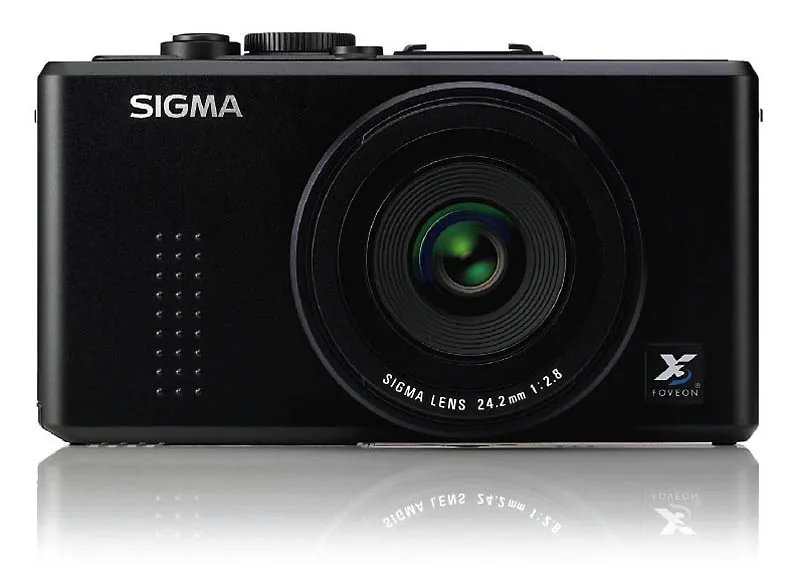
The Sigma DP2 is a compact camera with a DSLR-sized image sensor. That is the shortest summary of this type of camera. Its fixed-focal-length lens is pleasantly compact.
The Sigma is slightly larger than the average compact camera, but it is still easy to carry all day. Sigma's idea: a compact camera that delivers DSLR quality.
Optical Quality
One of the absolute highlights of this unconventional camera concept is the lens. Apart from a small amount of distortion, there is nothing wrong with it. This 2.8/24.2 mm lens (equivalent to approximately 41 mm) produces beautifully sharp photographs.
Its maximum aperture of f/2.8 is good, but not spectacular. There are no gimmicks here that might compromise quality.
The angle of view corresponds to 40 mm on a 35 mm camera. It is an excellent choice if you want to do everything with one lens. You can shoot broad views, everything looks very natural, and there are no exaggerated perspective effects.
Although the focal length is only 24.2 mm, the lens extends quite far when the camera is switched on.
Sigma uses a retrofocus design to achieve optimal correction of optical flaws, including vignetting.
Images that radiate quality
Foveon
The second element in this camera's quality concept is the Foveon 3XF sensor. A conventional sensor works according to the mosaic principle: the photosites sensitive to the three primary colors sit next to one another. The colors are therefore captured at different positions.
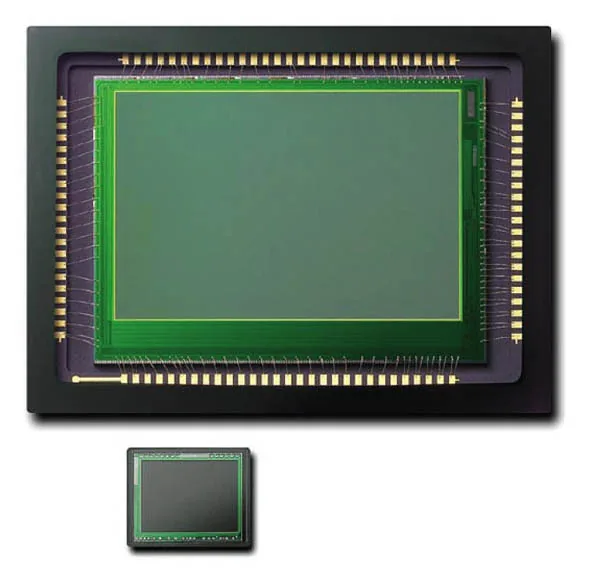
With Foveon, every position on the sensor is sensitive to every color. The sensor has three color-sensitive layers (sensitive to red, green, and blue, just like color film). It has 2652 x 1768 pixels (4.7 million) per color, for a total of 14.1 million.
Sensor manufacturer Foveon, since acquired by Sigma, explains this technology well on its website,
Practical shots show that the combination of an excellent lens and Foveon sensor technology is highly successful: tack-sharp results across the entire frame, down to the finest details. You immediately sense that there is something special about these photographs: they are punchy and crisp. Images that radiate quality.
The sensor measures 20.7 x 13.8 mm, slightly smaller than an APS-C sensor and slightly larger than those used by Olympus and Panasonic. The crop factor is 1.7x. The DP2 has roughly the volume of a Canon PowerShot G11 compact camera, but its photographs are clearly sharper and more detailed.
Beautifully sharp grain, however. That makes it exceptionally useful for creative work
Kodachrome
The Sigma DP2 delivers very subtle color nuances. The overall impression is reminiscent of the famous Kodak Kodachrome slide film, the film that National Geographic accepted as its only slide film for many years. The distinctive sharpness evokes the same association. This is simply beautiful.
But... that applies mainly at the low ISO settings: 50, 100, and 200. At 400 there is a little noise, while 800 remains tolerable. At 1600 and 3200, you can almost see the noise in the thumbnails.
Beautifully sharp grain, however. That makes it exceptionally useful for creative work, including black-and-white photography. At 1600 in particular, it feels very much like looking at prints from pushed Kodak Tri-X black-and-white film. Incidentally, ISO 1600 and 3200 are available only when RAW is selected as the file format, which may say a great deal...
Sluggish
The reduced usefulness of the higher ISO settings is one of the sacrifices the Sigma DP2 demands. Its slow, noisy autofocus is another. Fortunately, you can easily select a second AF mode that disables the close-focus range. The camera then focuses somewhat faster, although performance remains mediocre.
There is a very good manual-focus mode that you can activate directly. You can estimate the distance and set the number of meters, or use the electronic magnifier on the LCD screen to focus very precisely.
Once you are familiar with this camera, you can work almost as quickly this way as with autofocus. The advantage is that you can reuse the chosen setting for several shots, whereas AF has to focus again each time.
It is a shame that Sigma did not expand this excellent manual focusing system with features for optimizing depth of field. A camera like this calls for them.
Unreadable
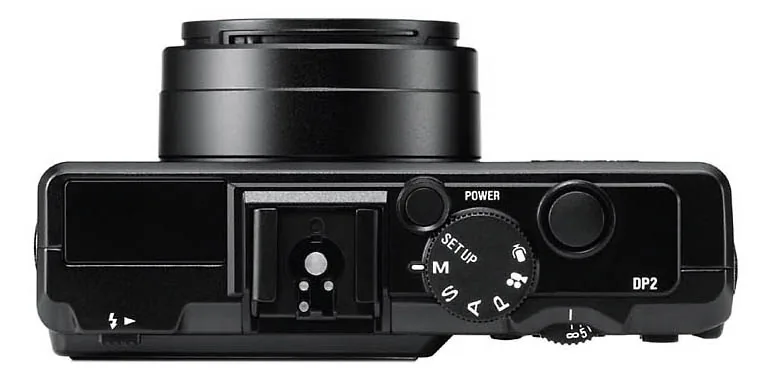
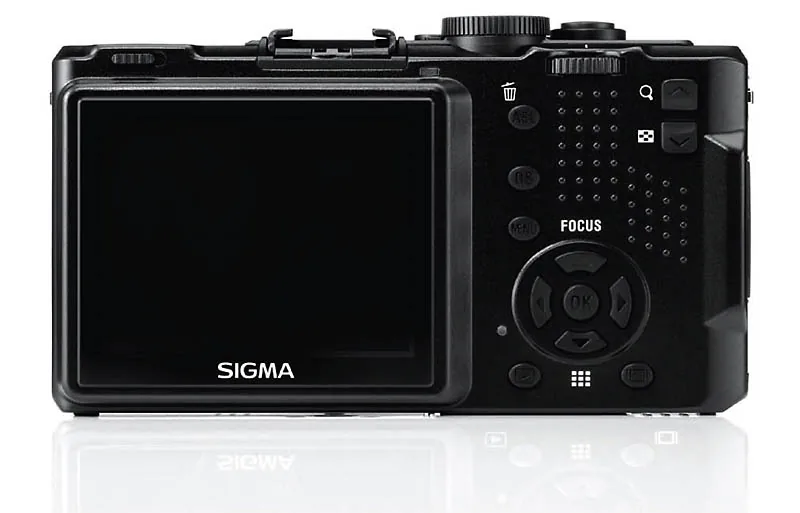
Another reason this Sigma DP2 is regularly criticized is the black buttons on the back. Text or a symbol is engraved on them, but it remains black on black—and therefore unreadable. After using the camera for a while, this Braille-like problem matters less. Still, it is absurd for a camera maker to let its design ambitions go this far.
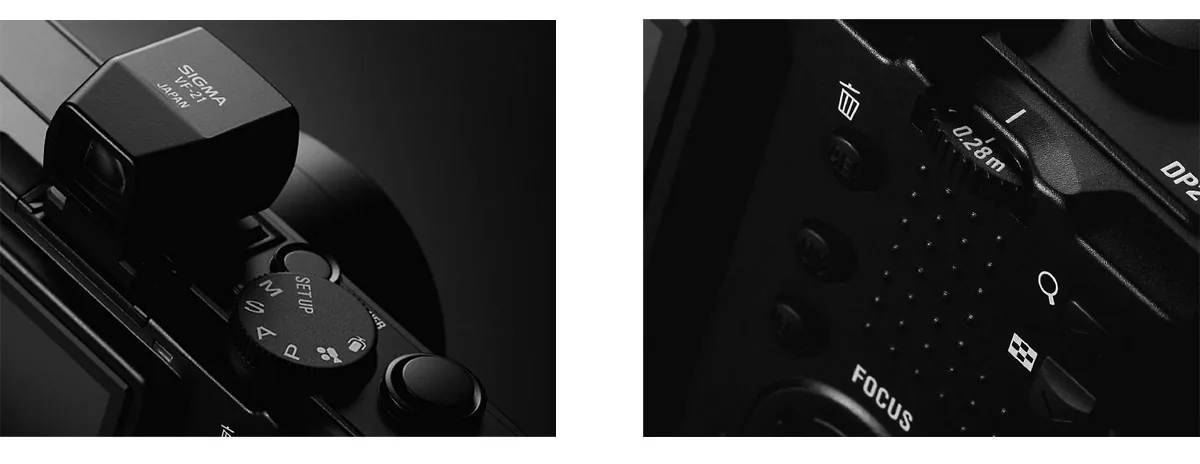
The rest of the controls deserve nothing but praise. Setting the ISO value, applying exposure compensation, activating bracketing, adjusting white balance, and so on can all be done very quickly. It differs from other cameras, but this interface is genuinely good.
Unfortunately, the LCD screen on the back of the camera is low quality, which also costs Sigma points. It is far from brilliant. The optional accessory viewfinder makes shooting with the DP2 much more pleasant.
An unusual box of quality for photographers who know what they are doing
Software
Sigma supplies the camera with a good software package (Sigma Photo Pro) that lets you process RAW files effectively. The camera encourages you to do so. That is not because its JPEGs are poor: external processing does not materially improve sharpness or detail, and the gain in shadow and highlight definition is limited as well.
However, automatic white balance is not always perfect, and the camera sometimes chooses very restrained color intensity.
With one click in the software, you can compare what the camera produced with what the software creates using its additional processing power. When there is a difference, the latter is usually better.
A trial version of SilkyPix developed specifically for the Foveon X3 image sensor is currently available. This version is available only for Windows; hopefully, the final version will also be released for Mac.
Love It or Hate It
The Sigma DP2 is a camera you either love or hate. In several respects, it loses out to the most basic 200-euro compact. But this is not an ordinary compact camera. It is really intended for photographers who prefer a slower, more deliberate approach. That starts with the lens. You are assured of completely natural, unexaggerated perspectives. This purity fits the camera perfectly.
You choose the aperture carefully. F/2.8 already produces good quality and is excellent for creating blurred backgrounds in close-ups. Sigma also offers a dedicated close-up lens that gets you closer than the minimum focusing distance of 28 cm.
There is no image stabilization. If you do not want to leave optimal sharpness to chance, a compact, lightweight travel tripod simply belongs with this camera. The slow autofocus is what it is; the good manual focus matters far more.
That is how this camera's usage concept unfolds: an unusual box of quality for photographers who know what they are doing, at just over the price of a high-quality lens. That is not such a bad proposition.