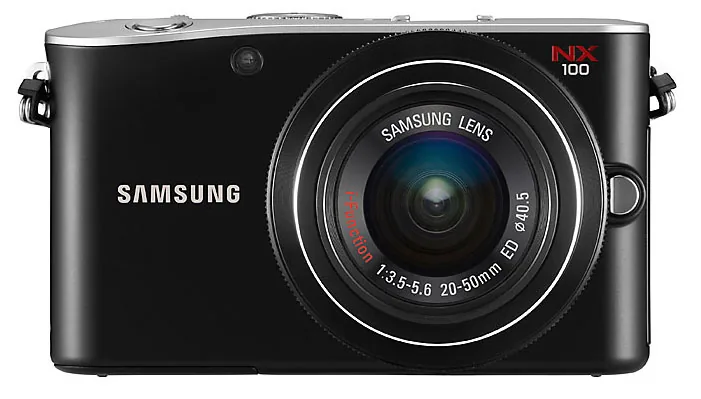
Mirrorless cameras—the convenience of a compact with the quality of an SLR—are attracting increasing interest. Samsung intends to play a major role in this market. The Samsung NX100 is aimed at a broad audience, from compact-camera users looking to step up to demanding enthusiasts who want a compact addition to their gear.
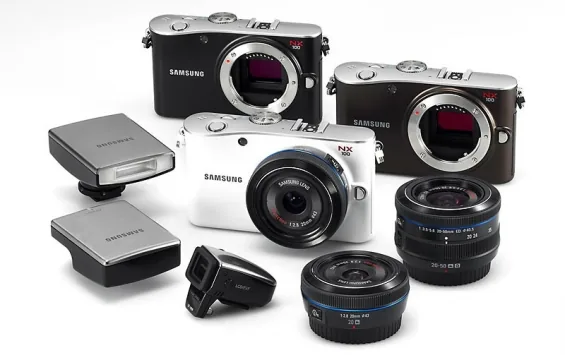
Samsung's ambitions for the NX system are clear from its continually expanding lens lineup: a 60 mm macro and an 18-200 mm zoom are due soon, followed later this year by a 16-80 mm zoom, a 16 mm pancake (20 and 30 mm models are already available), and a fast 85 mm portrait telephoto.
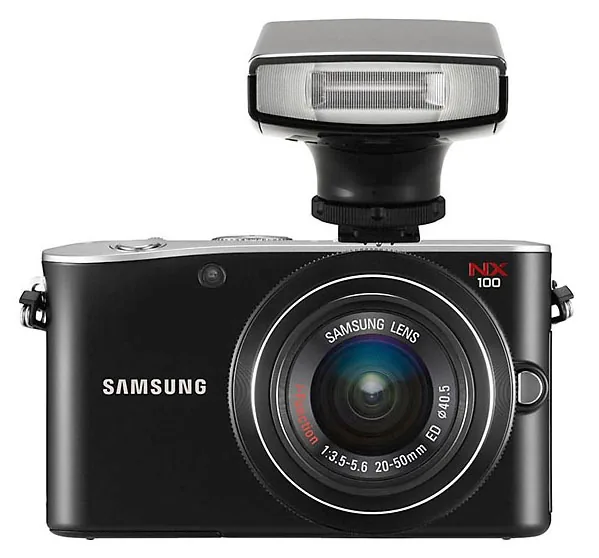
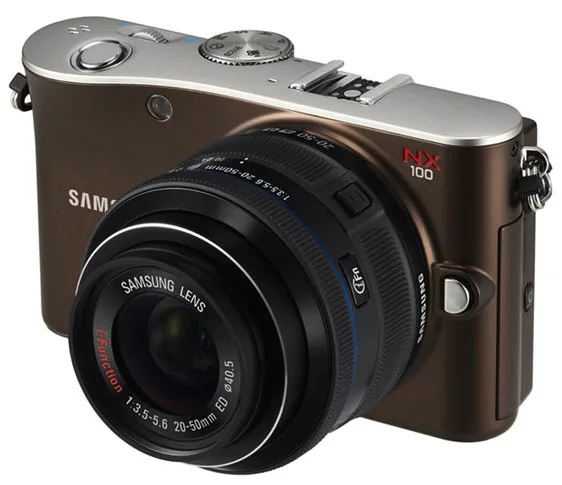
The Samsung NX100 comes with a new, especially compact standard zoom: a 3.5-5.6/20-50 mm. It is noticeably smaller than the existing 3.5-5.6/18-55 mm. The lens retracts to take up minimal space.
Amoled
The NX100 is Samsung's first mirrorless camera without a built-in viewfinder. Photographers compose on the 3-inch AMOLED display already used in the NX10. It is beautifully bright and sharp and remains reasonably usable in sunlight.
i-Function is a clever idea that provides intuitive control over important settings
An attachable LCD viewfinder is also available. It uses the same display as the NX5 and is comparable to the add-on viewfinder for Panasonic GF cameras. Its resolution is not exceptionally high, but it is functional and useful if you also want to shoot with the camera held to your eye.
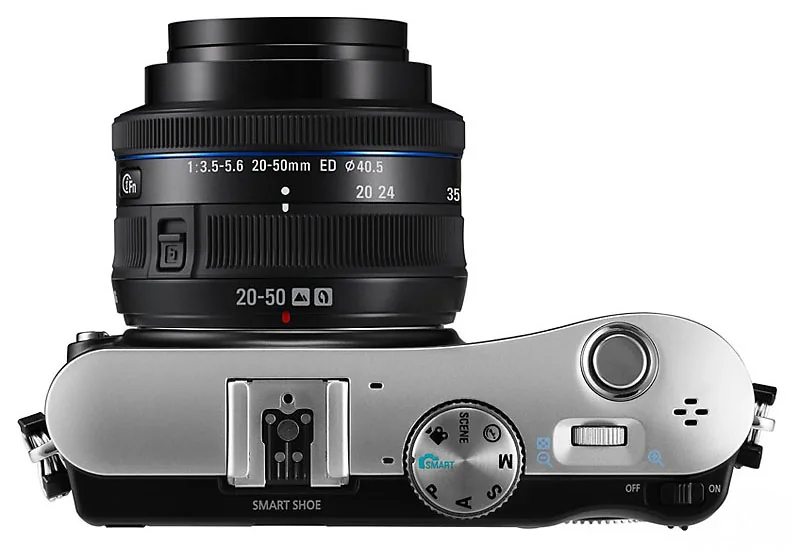
The front ring is the i-Function ring. Every new lens will have one. A firmware update for previously released camera models now enables i-Function on those models as well.
i-Function
Samsung clearly intends i-Function to set it apart. Its lenses have an extra control ring that can directly adjust shutter speed, aperture, exposure compensation, white balance, or ISO. It is a clever idea that provides intuitive control over important settings and actively invites experimentation.
Using the i-Function ring for exposure compensation is the most natural choice. It amounts to a new way of shooting: you hold the camera in front of you and adjust the zoom with your left hand.
With the same hand, you then grasp and turn the i-Function ring to see whether making the image slightly brighter or darker improves it.
Even a beginner can discover that a lighting effect looks better when the image is made a little darker, or that a child's portrait looks more delicate when made slightly brighter—simply by turning the ring and watching what happens. In this way, i-Function encourages creativity and experimentation.
The NX100 also gives experienced photographers plenty of options and capabilities
Press and Turn
The i-Function button sits next to the i-Function ring. Pressing the button and turning the ring selects the setting to adjust. In P, A, S, and M modes, the choices are shutter speed, aperture, exposure compensation, white balance, and ISO.
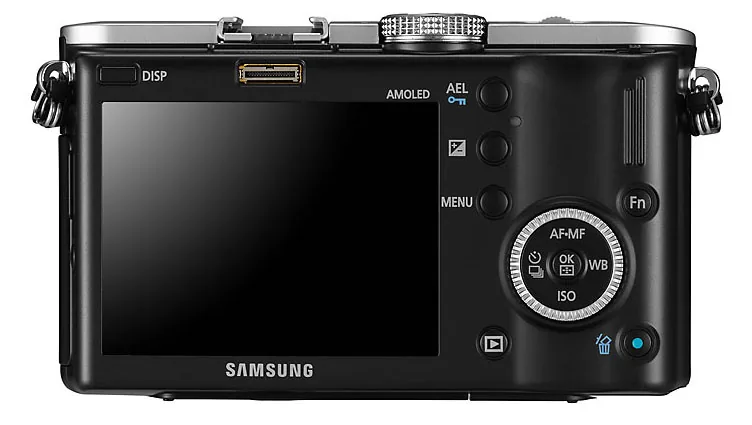
Conventional controls are also plentiful. The FN (Function) button provides quick access to important functions that do not have their own dedicated button.
You can customize this menu list—for example, to show only ISO, exposure compensation, and white balance. I would include exposure compensation alone, keeping it immediately available, much like the large rear control dial on various Canon EOS cameras. Turn the large mode dial on top of the camera to the i symbol to select i-Program; the lens’s i-Function ring can then choose a scene mode.
Conventional Controls Too
Alongside this innovative control concept, the NX100 can also be operated conventionally. It provides the familiar buttons and functions found on an SLR, making for a traditional, recognizable way of working.
The NX100 also gives experienced photographers plenty of options, including extensive bracketing and correction features and comprehensive white-balance controls. Each white-balance setting can be fine-tuned to taste.
Images shot at ISO 1600 still look clean and detailed, with little noise
Sharp
The NX100's autofocus feels especially responsive because the 20-50 mm lens focuses so quickly. Focusing is generally fast and accurate and, in practice, barely slower—if at all—than an entry-level SLR. It works very well.
Like other mirrorless cameras, it has limitations when tracking fast-moving subjects. For vacation and family photographs, however, the NX100 is fast enough.
You can choose multi-area AF, in which the camera selects the focus point, or single-area AF. The focus box can be positioned anywhere in the frame, and its size can also be adjusted for very precise focusing on small details.
Good High-ISO Performance
Like the NX10, the image sensor delivers more than 14 megapixels—and on an APS-C sensor, providing an enormous quality advantage over a compact camera. Images at ISO 1600 remain clean and detailed, with little noise, making that setting very usable. Noise is much more apparent at 3200. The maximum setting is 6400.
Image stabilization cannot help in low light. Samsung does not build it into the camera, and the 20-50 mm lens lacks it; the larger 18-55 standard zoom does include it. Even so, the retractable 20-50 is preferable for its compact size. Its strong high-ISO performance means stabilization is not greatly missed, and stabilization is ultimately useful only for stationary subjects.
Color reproduction was also excellent. Some picture styles, such as the one for forest scenes, produce heavily saturated colors, but these settings can be adjusted to taste. Do not try to customize every option during your first week with the camera; learn and refine them through practical use.
Comparison
The NX100 should be compared first with Sony’s NEX cameras because they use the same APS-C sensor size. Their sensor performance and overall image quality are very similar.
NEX cameras operate more like compact cameras, so settings rely more heavily on menus. The NX100 has more buttons, allowing faster access to more functions, and i-Function contributes to that advantage.
In concept, the NX100 is closer to Olympus models and Panasonic GF cameras. Its larger image sensor distinguishes it from them by making it less susceptible to noise.
A Strong Contender
Taken together, these qualities put the Samsung NX100 in a very strong position. At roughly twice the price of a good compact camera, the NX100 is certainly an appealing high-quality camera.
These mirrorless cameras are most attractive when paired with a compact lens. That means using the 20-50 mm, which also produces beautifully sharp images.
For extra reach, you can always add the 50-200 mm zoom. Most photographs will still be made with the smaller zoom, however, and it forms an excellent combination with the NX100.