The Samsung NX10 looks like a DSLR, but it is much smaller. Its sensor comes from the DSLR world. So is this the compact alternative to a DSLR?
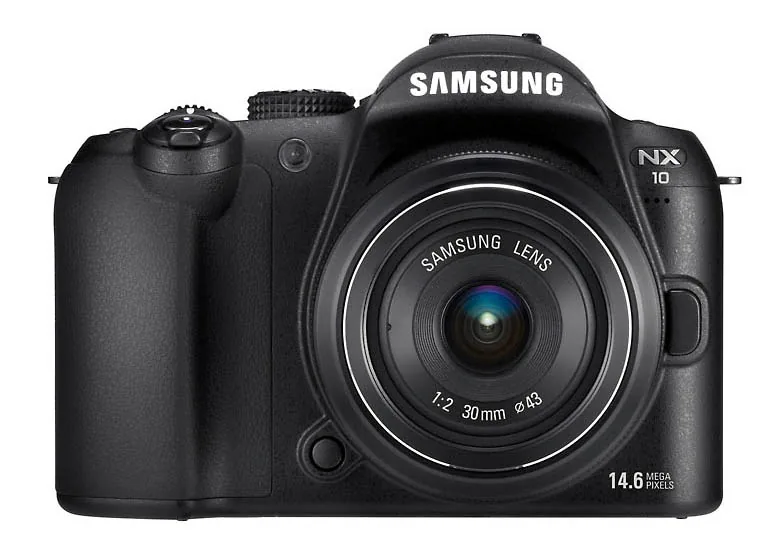
The Samsung NX10 resembles a traditional digital SLR, but place it beside one and it is clearly about 20 to 30 percent smaller. In the hand, its smaller size is no drawback: this exceptionally solid-feeling camera handles well.
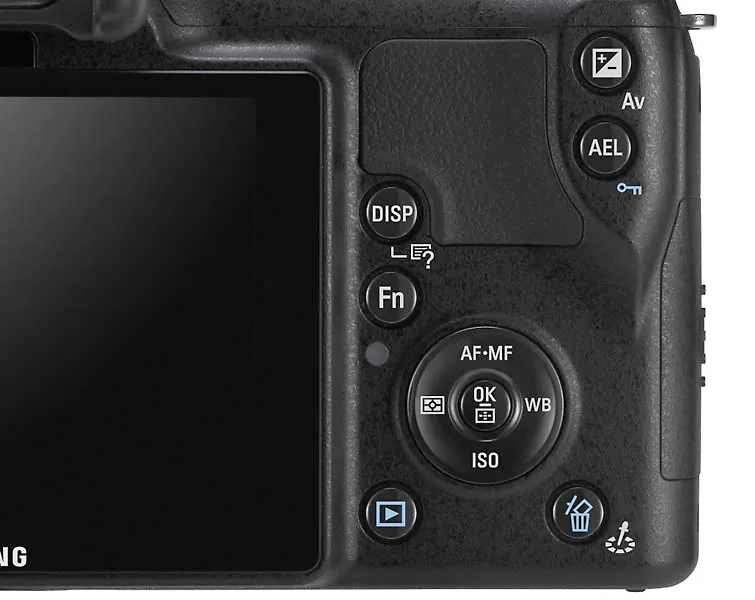
On the back you see a large, clear Amoled screen. When you hold the NX10 up to your eye, the LCD viewfinder is automatically switched on. A good LCD viewfinder, much, much better than that of hybrid cameras with a fixed megazoom.
The Amoled screen is characterized by its nice high contrast, and the viewing angle is very wide. The energy consumption of this new display technology is very low, and that is of course an important point with a camera like the NX10.
With that viewfinder and that screen it is just a pleasure to work, because you immediately see the result. The image does not lag behind. Exposure data and other settings appear below the image, easy to read and clear.
You also have little trouble with noise at ISO 1600 and 3200
The AMOLED screen and viewfinder use exactly the same layout. The information is complete except for one item: the ISO setting. It would have been useful to see that below the live image as well, especially when the camera is set to Auto ISO.
The large, bright Amoled screen is still quite usable even in a lot of light.
Impressive
That minor drawback is offset by the Samsung NX10’s high image quality, even at high ISO settings. Noise remains limited at ISO 1600 and 3200 (the maximum), so you can let Auto ISO do its job with little concern.
And if you have manually selected a high ISO setting and forget to reset it later, you will not be punished with shots with unnecessary noise and loss of detail.
One caveat: the optional high-ISO noise reduction is far too aggressive, so leave it off. The camera's standard noise reduction works well.
What the NX10's autofocus system has over the system of a reflex camera is its flexibility
Update June 15: It has now become apparent that this has been adjusted for the cameras that have now been delivered. Later firmware versions than that of our test camera apply lighter noise reduction as standard. The resulting noise level is already surprisingly low, but it becomes even better if you enable noise reduction for high ISO values in the menu. There is no loss of detail, so there is no reason to disable this noise reduction.
If you look at color saturation and contrast, you will see that Samsung is somewhat modest on this point. Turn them up a notch in the Photo Wizard (on other cameras these are the image settings) and you will get sparkling results.
Update June 15: This has been improved with the newer firmware versions. By default, the image is already more powerful and punchy.
Fast
The autofocus of this NX10 works about as fast as an entry-level SLR. That is a compliment, because contrast focusing works slower in principle than the phase detection system of reflex cameras.
In practice, this means that in most situations you immediately have a sharp image and can print immediately. If you are used to working with a reflex, focusing on the NX10 will seem very normal.
If you are moving up from a compact camera, the speed will be a delight. Taking another shot is much faster than with a compact, although a DSLR remains faster in this respect.
The focusing system is more than adequate for everyday use, creative work, and vacation photography. For fast action, however, a DSLR with a faster focusing system is the better choice.
Flexible
What the NX10's autofocus system has over the system of a reflex camera is its flexibility. You can place the focusing frame anywhere in the picture. With a reflex you are bound to a number of fixed positions around the image center. With the NX10 you are really invited to take advantage of these extra options.
With the NX10 you are really invited to take advantage of these extra options.
For example, it is a good idea to set the focus area slightly above the center as standard. You almost never put a subject in the middle, and certainly not a face. By placing the field a little higher than the center you force yourself to a better composition, which works very well!

It is also useful that you can vary the size of the focus field. This is done very quickly with the control wheel, and you do not have to go into the menu for it. So you can immediately adapt it to your subject.
One reason the NX10 is so enjoyable to shoot with is its shutter button
You can of course also use automatic selection of the focus area, but that is more for the very beginning. Soon you will want to have full control over the setting point, and the NX10 makes this very possible. Automatic focusing on faces is also possible. Also a great option for beginners, but normal focusing is faster, so if you have more experience, go for that.
Compact and Manageable
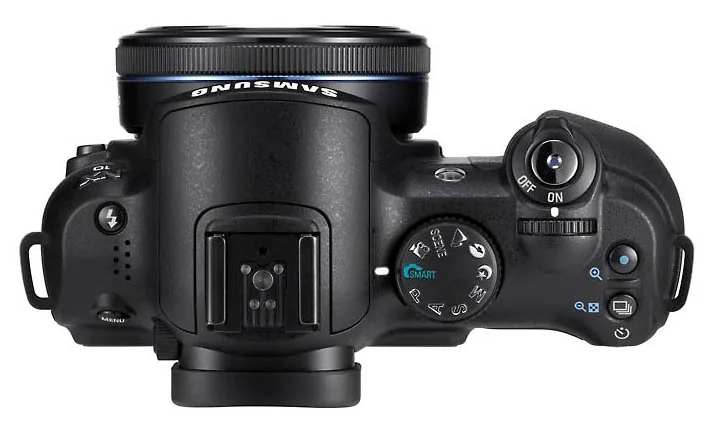
One of the camera's most distinctive handling features is its large shutter button, angled forward. It operates perfectly and helps keep the NX10’s small size from becoming a drawback.
Really, in this regard, sometimes it's the little things that matter. One of the reasons that the NX10 photographs so well is that shutter button.
Lenses
Samsung worked with Pentax for a time and consequently marketed its own DSLRs with a Pentax bayonet mount. The NX10 uses a new, smaller mount, allowing Samsung to design more compact lenses. Retaining the Pentax mount would have made little sense because the distance between lens and sensor is much shorter on the NX10 than on a DSLR.
So even if they fit on the mount, the reflex lenses would still produce a blurry image. Samsung is kind enough to release an adapter with which the lenses of the Samsung (and therefore also Pentax) reflexes can be used on the NX10. You have to focus yourself.
In addition to its compactness, the 2/30 mm has more strengths: its high quality and its high luminosity
And that means that you have to use a very modern camera in a very old-fashioned way. But: if you still have some nice Pentax lenses lying around, it is a nice option. Samsung currently has three lenses available and serious work is being done to expand the range.
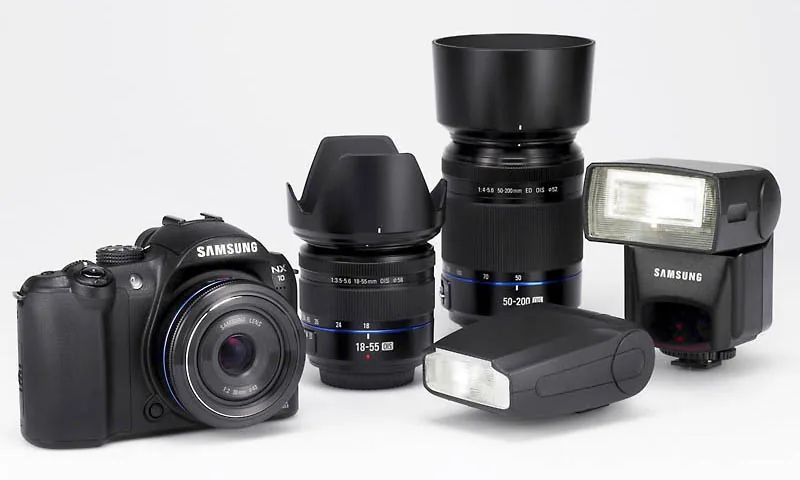
Zoom and Prime Lenses
The standard zoom is a capable 18-55 mm lens whose compact build suits the camera well. For telephoto work, Samsung offers a 50-200 mm zoom. It is compact, though not much smaller than comparable DSLR lenses, because Samsung chose to retain the large APS-C sensor that is largely responsible for the camera's high image quality.
Both zooms are equipped with optical image stabilization. You can use shutter speeds up to 2 stops slower, so if you can normally use 1/60 s hand-held, it will be 1/15 s with stabilization enabled. It is possible to make the stabilization work permanently: the image in the viewfinder and on the LCD screen will then show much less vibration. This disappears if you opt for stabilization when recording only, but the stabilization works most effectively. It will also make a difference in power consumption.
Its permanent live view functionality gives you maximum control over the photos you take, more than with a reflex
Third lens is the extra flat and extra bright 2/30 mm (without image stabilization). Equipped with this, the NX10 fits in your pocket. It is not a zoom, in terms of angle of view it is exactly between telephoto and wide angle. Universally usable, although you will often miss telephoto or wide angle.
In addition to its compactness, the 2/30 mm has more strengths: its high quality and its high luminosity. Very suitable for flashless photos in low light, for capturing atmospheric images and it is often very nice that you can create nice blurred backgrounds with the large apertures.
Final Verdict
The Samsung NX10 is certainly an alternative to a reflex camera, provided you are not looking for fast action photography. However, it offers a lot for holiday photos or hobbies and there is no compact camera that comes even close in terms of speed and quality. Thanks to its permanent live view functionality (LCD screen and LCD viewfinder), you have maximum control over the photos you take, more than with a reflex.
Finally, the camera's build quality makes an excellent impression. Samsung deserves credit for that.