For photographing trees, forests, and almost all the aspects discussed in the first part, a compact camera will take you a long way. But more is needed in a forest where lighting conditions are difficult—especially in summer, when the trees are full of leaves. Here is a ‘shopping list,’ plus the five best tree-rich locations.
What Should You Pack in Your Camera Bag?
Did we mention difficult lighting conditions? A tripod, even a small one, is highly recommended. Most cameras have a self-timer that is ideal for this branch of photography. With slow shutter speeds, the risk of camera shake increases considerably.
Choosing Lenses
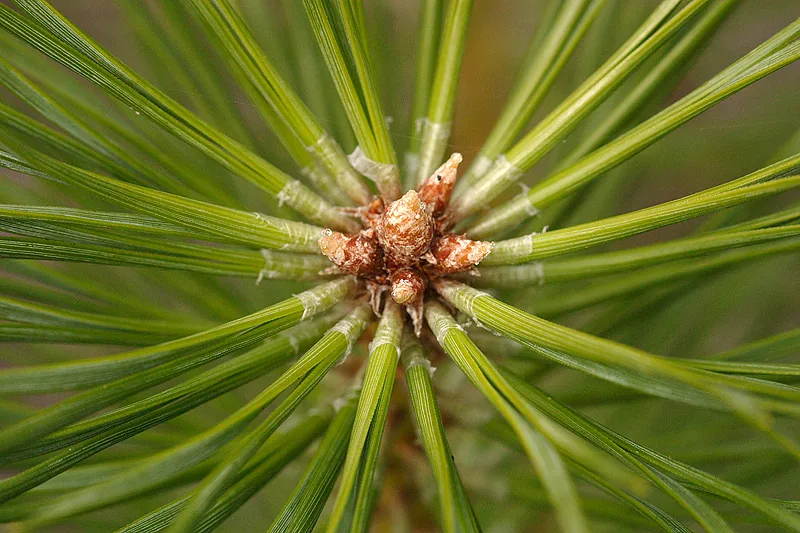
Anyone wanting to capture the expanse or grandeur of a forest will benefit from a wide-angle lens. The lenses on most compact cameras start at 35mm, which is not really wide enough. Keep this in mind when buying one, because some cameras start at 28 or 24mm. For owners of a digital SLR, the ‘crop factor’ that often applies can be a disadvantage in this type of photography. A 28mm lens can therefore quickly become the equivalent of a 50mm lens. Fortunately, most brands have introduced so-called ultra-wide-angle lenses, some specifically developed for digital cameras. These lenses sometimes start at 10mm. The disadvantage is that distortion occurs relatively often, suddenly making a straight tree trunk look like a banana. You should therefore test this carefully before purchasing such a lens.
The well-known Dutch photographer Martin Kers often uses this ‘technique’
Using a long telephoto lens may not immediately seem like the obvious choice in a forest, but nothing could be further from the truth. A telephoto lens compresses the image slightly. The well-known Dutch photographer Martin Kers often uses this ‘technique.’ A telephoto lens is naturally also very useful for photographing animals in the forest. The faster such a lens is, the better—and more expensive—it will be. Gaining one stop of light, for example from F4 to F2.8, more than doubles the price.
Taking Notes
When photographing trees and forests, you should also keep your eyes open and make notes about places worth revisiting in different weather, at another time of day, or in another season. The best way to keep track is in a file or database on your computer, or in a simple notebook. It can be as detailed as you like. At a minimum, note the location, a description of the subject, the season or month in which you should return, and any points that caught your attention. This valuable information is often lost if it is not recorded somewhere. It is also useful to mark the location on a topographic map or record it using a GPS system, for example.
Tree-Rich and Forested Locations
The advantage of the Netherlands is that so many different landscapes can be found within a relatively small area. In fact, it is possible to make beautiful photographs of trees and forests almost anywhere.
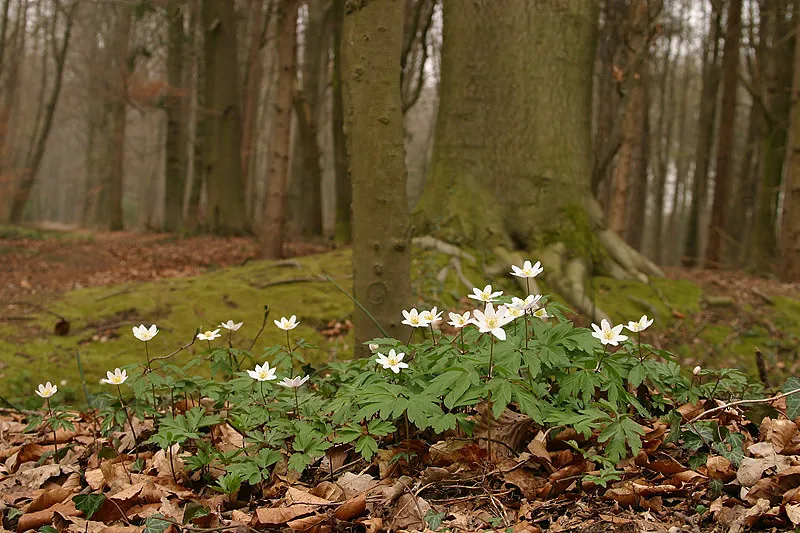
Fotografie.nl has nevertheless selected five special locations for you. The numbers following ‘topographic map’ refer to the 1:25,000 map sheets published by the Dutch Topographic Service.
Winterswijk - Bekendelle
Forests growing on loamy soil often have rich spring flora. If a stream also winds through such a lush forest, the photographic possibilities are even greater. The small Bekendelle forest near Winterswijk is a wonderful example. In autumn and winter too, this forest and its stream, the Slinge, have plenty to offer. (Topographic map 41E).
Doorn - Austerlitz
Extensive forests lie along the road between Amersfoort and Doorn (N227). They originated as production forests, but have become increasingly varied in recent years. The many snowy mespil shrubs are a striking feature, coloring the landscape red until late autumn. Their combination with yellowing larch forests creates a true spectacle of color. (Topographic maps 32C and 32D).
Dieren - Veluwezoom
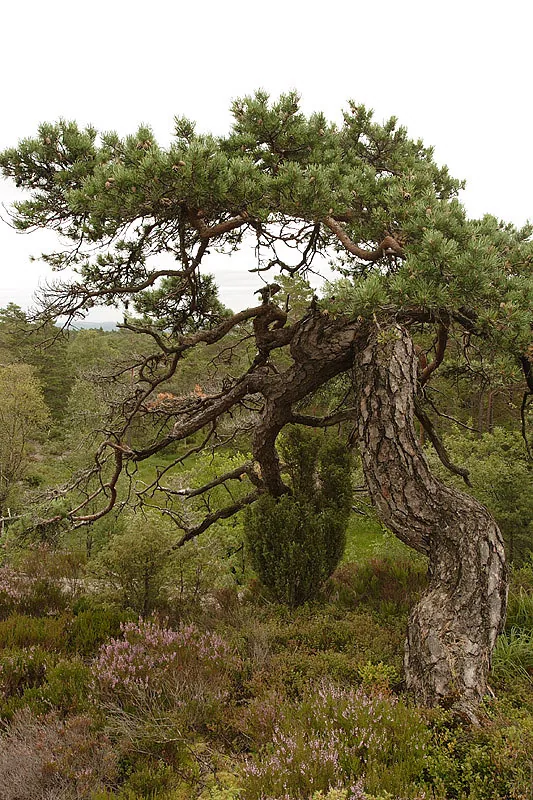
The Veluwe is one of the best-known natural areas in the Netherlands. The Veluwezoom is slightly less well known, but at least as beautiful. The so-called Carolinaberg lies near Dieren. Several fine beech forests and beech avenues can be found here.
The differences in elevation make it possible to create beautiful images of clean lines in the forest in every season.
Because beech forests have little undergrowth, their linear forms stand out even more clearly. (Topographic maps 33D, 33G, 40B, and 40E).
Finsterwolde - Carel Coenraadpolder
The Carel Coenraadpolder lies at the far eastern edge of Groningen. It is not the first place that comes to mind when thinking about photographing trees and forests. Quite the opposite: almost nowhere else in the Netherlands is the landscape as empty as it is here.
The colors—or their very absence—are especially impressive when sunshine alternates with hail showers or other showers. The occasional tree or group of trees adds something special to an autumn or winter photograph. (Topographic maps 8A and 8C).
Kale Duinen - Appelscha
Drifting-sand areas are becoming increasingly rare in the Netherlands. Various nature organizations are taking far-reaching measures to support this type of landscape, which is also highly interesting photographically.
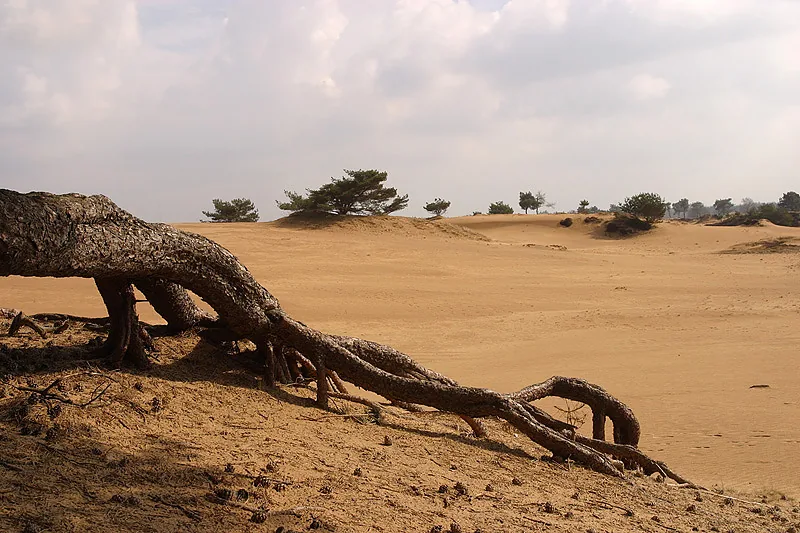
On the Aekingerzand, also known as the Kale Duinen near Appelscha, evergreen and often irregular Scots pines stand out beautifully against the warm yellow sand. It is worth visiting in every season. Tree roots are also a photographic subject in every season, especially in drifting-sand areas such as the Kale Duinen near Appelscha. (Topographic maps 11H, 12C, 16F, and 17A).
Also read About Trees and Forests, Part 1.