The E-510 had been eagerly awaited, after the E-400 raised expectations. It adds image stabilization and live view. But can all of that really work with such a small sensor? How seriously should we take Olympus?
After a few hours of exploring the camera and taking photographs, there is a real sense of excitement. This is a new way to shoot with an SLR! It is a responsive camera that delivers a high success rate for action snapshots. At the same time, its excellent live view on the rear LCD makes it a capable camera for tabletop work, packshots, macro photography and studio photography.
You cannot help but respect what Olympus has created here. It shows the real benefits of designing a digital SLR system from scratch rather than adapting an existing full-frame system.
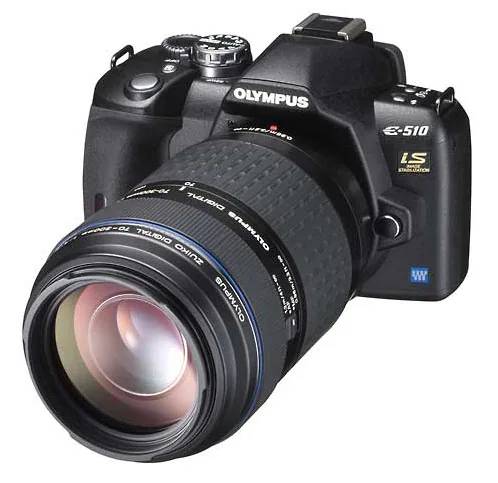
Image stabilization becomes more important as the angle of view narrows. In full-frame-equivalent terms, this newly announced 75-300 mm lens offers a range comparable to 150-600 mm.
Live View
Let us start with live view. Some people may expect it to work just as it does on a compact camera, but the technology is not quite that simple.
When you activate live view, the mirror first flips up and the image received by the sensor then appears on the screen. This takes time, and the camera's fast autofocus, which is part of the SLR system, is temporarily unavailable.
You therefore need to focus beforehand or focus manually, optionally using the 10x or 14x magnification function for very precise adjustment. Alternatively, you can still let the camera focus. The advantage is that you can freely choose the area on which the camera focuses. Move the focus box to that part of the image, press the focus button and the camera focuses automatically.
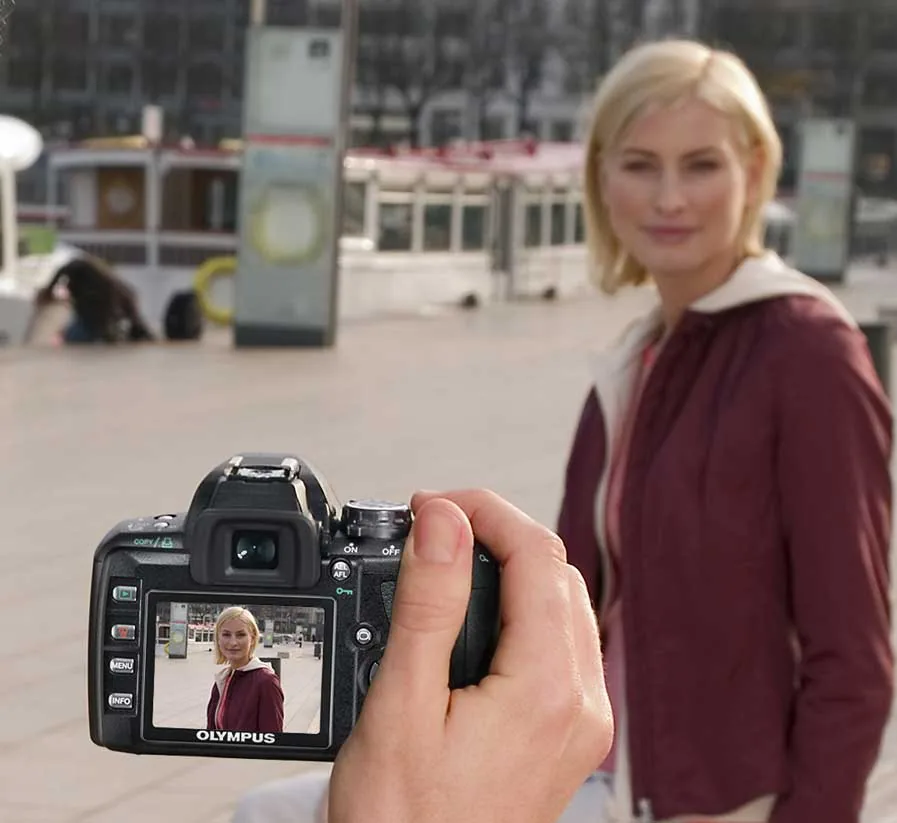
This is particularly useful in busy studio situations. Live view also makes composition more comfortable—and is easier on your back, because you do not need to crouch behind the SLR viewfinder whenever the camera is positioned lower. It also gives you a convenient preview of exposure and white balance.
Image Stabilization
The E-510's second highlight is image stabilization. The technology is generally more effective when built into the lens, while an in-body system is more economical for the user. With Olympus, both approaches are available: the two Leica zoom lenses for the Panasonic L1 have their own image stabilization. Leica, Panasonic and Olympus use the same bayonet mount, so their cameras and lenses are interchangeable.
Image stabilization greatly expands the photographic possibilities, and that is immediately apparent when shooting with the E-510. It makes photography more relaxed because you need to worry less about holding the camera perfectly still. The advantage in usable shutter speeds is 2 to 3 stops: with care, a handheld exposure of ¼ s can work, while 1/8 s is more reliable.
Image stabilization works especially well in combination with Auto ISO. When necessary, the E-510 increases the sensitivity up to ISO 400. Because ISO 400 looks very good on the E-510, you can shoot with confidence even in less favorable light or with slower lenses.
Small Image Sensor
The Four Thirds standard used by Olympus, Leica and Panasonic is based on a smaller image sensor than those used by other brands. While those systems generally have a crop factor of 1.5 or 1.6, here it is 2. That means a 150 mm lens gives the same angle of view as a 300 mm lens on full-frame film. This offers some interesting advantages. A Sigma f/2.8 150 mm lens with an Olympus mount does roughly the same job as an f/2.8 200 mm lens for Nikon, Canon and comparable systems, while saving money, size and weight.
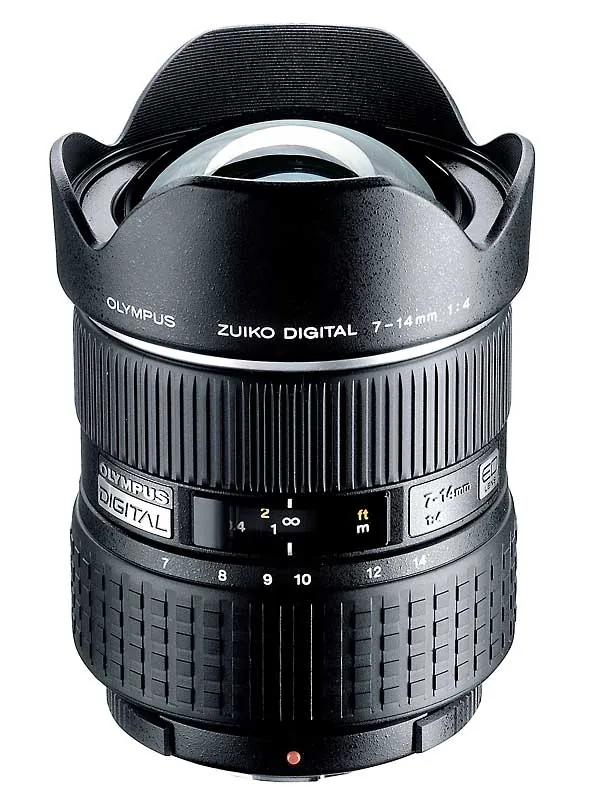
Olympus and Leica make lenses designed specifically for the Four Thirds standard. Sigma also participates by offering digitally optimized lenses—intended for crop factors up to 1.7—with a Four Thirds mount. Sigma does not yet offer anything wider than the 18-50 for this system; a 10-20 would be very welcome.
Olympus makes the system even more attractive by offering faster lenses for the same price as competing camera brands—or less. Consider the f/2 150 mm, the f/2 35-100 mm and the f/2.8 90-250 mm. Also consider the reach of a Sigma f/5.6 300-800 mm. For clarity, apply the x2 factor when comparing the angle of view with full-frame format.
That extra lens speed is useful for another reason: the smaller the capture format, the greater the depth of field. Photographers who want selective focus, such as fashion and portrait photographers, need a fast lens. To avoid losing that capability with a smaller sensor, you need even more lens speed.
Noise?
The small image sensor therefore brings advantages, but the smaller the sensor, the smaller its pixels must be to keep pace with competitors in resolution. At the time, the threshold for acceptable noise was generally about 1 ISO stop lower than on cameras with APS-size sensors, as used by most competitors then. Where ISO 800 produced acceptable noise on those cameras, the comparable limit for Four Thirds cameras was ISO 400.
In images shot at ISO 400, no noise is visible on the E-510. It is effectively concealed by an electronic noise filter that can be set to low, standard or high, or switched off entirely. When viewing enlarged images on a screen, the normal setting appears to smooth things a little too much, at some cost to fine detail. At ISO 400 and even ISO 800, the noise filter also works well on its low setting. This retains better sharpness while showing little or no noise. The combination of ISO 400, low noise filtering and +1 sharpening is particularly impressive, producing crisp, attractive results suitable for everyday use. At ISO 800, it seems better to increase the noise filter by one setting.
It is impressive what Olympus extracts from such a small sensor, although at the higher ISO settings of 800 and 1600 it still does not match larger sensors. Whether that difference is visible depends greatly on the application. Fortunately, the camera offers extensive control. Image stabilization also lets you work at ISO 400 in situations where you might choose ISO 800 or higher on another camera.
Olympus SLRs let you process RAW files in the camera with control over many parameters. The RAW file remains untouched, and you can create as many JPEG variations as you like.
In-Camera RAW Processing
The camera can of course capture RAW images, including RAW and JPEG simultaneously. A useful feature is that further processing can also be performed in the camera. You can create as many versions of each RAW image as you like: when RAW processing is activated, the camera applies the current settings for noise filtering, sharpening, white balance, compression, contrast, saturation and more.
Additional editing options are available for cropping, resolution and red-eye correction, among other adjustments. In short, the camera can produce print-ready photographs.
Versatile
Olympus clearly recognizes a new generation of SLR users who have little or no background knowledge of photography but appreciate the functionality and quality of an SLR. It is therefore helpful that the camera includes many practical scene modes, including specialized high-key and low-key modes. At the same time, virtually every parameter can be adjusted. A clear LCD control panel provides a complete overview on one screen and lets you change settings directly without first entering the menus. It is a well-considered design.
Unfortunately, something went wrong in the Dutch translation of the manual: although the camera can use Dutch menus, the Dutch manual refers to the English menu terms. This is very inconvenient. Olympus should provide a translation list as an erratum; otherwise, beginning photographers will find it difficult to follow.
Handling
The camera is very easy to use. It can be configured so that you can manually fine-tune autofocus at any time without first switching to manual focus. You can also set the focusing direction of the ring to your preference. Many people will appreciate the E-510's grip, which offers a more secure hold than the E-410's flatter design, although that camera is also pleasant to use. Its grip also accommodates a larger battery than the E-410. It is almost easy to overlook that this Olympus also has an effective automatic dust-removal system.
The E-510 is compact but remains manageable for hands of any size. Its grip is covered with a textured material for a secure hold.
4:3
Cameras in the Four Thirds system use an image format with a width-to-height ratio of 4:3, like digital compact cameras. Whether you want to work with that format is a decision to make before almost anything else, and it is entirely personal. The more common full-frame ratio of 3:2 gives horizontal images a more panoramic feel. For vertical images, especially portraits, 3:2 can often feel too tall. The 4:3 ratio makes it easy to create harmonious compositions, and 4:3 is often particularly useful for illustrative applications, whether for book pages, magazine illustrations or web pages.
Viewfinder
The E-510's viewfinder is slightly disappointing. It is bright but rather small. Anyone who looks through an old Olympus OM-1 again will immediately see that the digital SLR still had room to develop. Olympus pioneered in this area in 1972; it was time to do so again.
The viewfinder image is bright but small. An accessory eyepiece magnifier fits into the eyepiece opening and provides useful additional magnification, although it introduces some distortion. Eyeglass wearers should check whether they can still see the shooting information clearly when using it.
Conclusion
At the time of this review, the E-510 was one of the most versatile SLRs available and suited a very broad audience, from absolute beginners to demanding photographers with experience and technical insight. It was also well suited to business applications, from photographing a reception to making product shots. The compactness of the camera and its system was demonstrated by the dual-zoom kit, which paired the 14-42 mm standard zoom with a 40-150 mm zoom. In full-frame-equivalent terms, that lens covered 80-300 mm while remaining light, small and easy to carry. This also made the E-510 an attractive travel SLR.
N.B.
The camera is no longer sold and was succeeded by the E-520. Within Olympus's classic DSLR line, the closest successors to the Olympus E-520—a 10-megapixel Four Thirds SLR introduced in 2008—were the Olympus E-620 (2009) and the simpler Olympus E-600. Olympus later transitioned fully to Micro Four Thirds mirrorless cameras, including the PEN and OM-D series. [1 (https://nl.wikipedia.org/wiki/Olympus_E-520), 2 (https://apotelyt.com/compare-camera/olympus-e-520-vs-olympus-e-600)]