Frenchman Joseph Nicéphore Niépce (March 7, 1765 – July 5, 1833) made the first photograph, titled 'Point de vue de la fenêtre', which shows the view from his study (1827).
Joseph Nicéphore Niépce was born in Chalon-sur-Saône, France, and is regarded as one of the inventors of photography. His experiments focused on developing a process that could use a camera to create an etching plate. His inventions included the iris diaphragm and a method for making photographs permanent. He was also the first to fit a camera with bellows to make focusing easier. In 1826, the Parisian optician Chevalier—who ground lenses for both men—introduced him to Louis Jacques Mandé Daguerre, and they formed a partnership in 1829. Niépce died suddenly on July 5, 1833, before his inventions had received official recognition.
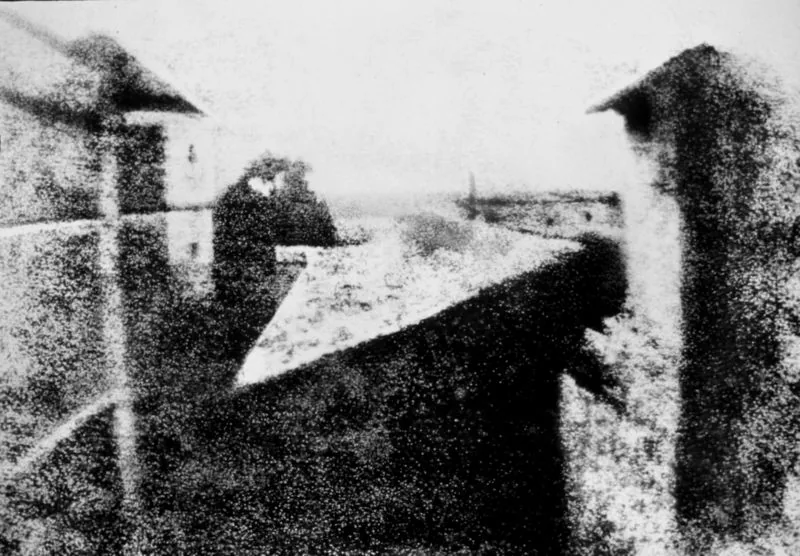
The First Photograph
The image above, titled "View from the Window at Le Gras," is the oldest surviving photograph by Niépce. It was made on a 20 x 25 cm oil-treated bitumen plate. Because of the 8-hour exposure, the sun illuminated the buildings from both the left and the right. This image is widely regarded as the first successful permanent photograph.
This text is provided without warranty under the GNU Free Documentation License
The copyright in the images shown with this article has expired, so they are in the public domain.
Read this article in Dutch: Nièpce: maker van de eerste foto.