If the court of photography needs a jester, it has to be Martin Parr. At the time this article was published, the British Magnum photographer had four exhibitions on view in the Netherlands and had given a lecture to students at Amsterdam’s Fotoacademie the week before. He seems incapable of taking a ‘normal’ photograph and revels in jokes, clichés, and kitsch—with astonishing success. “I’m a populist.”
A gray fisherman’s sweater over a blue checked shirt, black jeans, brown sandals, patterned blue socks ending at the ankle, and nondescript glasses. And yet before us sits one of the most influential and innovative photographers of his time. Martin Parr (1952), a British documentary photographer and photojournalist with more than 35 years in the profession, as well as a filmmaker and collector.
At Amsterdam’s Fotoacademie, he took an audience of around 120 people—mostly students—on a journey through his remarkable career that was as witty as it was instructive.
Parr was fifteen when he borrowed a camera from his grandfather and began documenting his social surroundings, which led seven years later to his first exhibition, Home Sweet Home (1974).
The black-and-white photographs of seventies-era living rooms, floral wallpaper, and dollhouse curtains reveal an approach that Parr has never abandoned. His advice: photograph a changing world.
The images on display also make clear Parr’s keenly developed eye for the banal. It is a remarkable gift: Parr’s lens seems to transform an apparently ordinary scene into something hilarious, absurd, or bizarre.
Parr: “I like to create fiction from reality. I try to do that by seizing on social prejudices and giving them a twist. In other words, you use prejudices.”
His advice: photograph a changing world
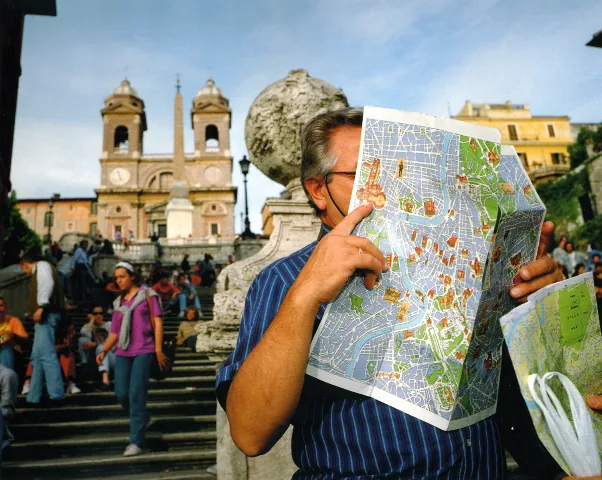
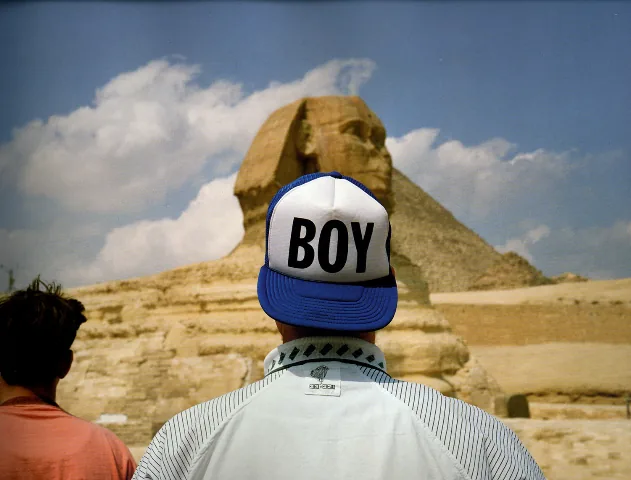
That approach can produce a humorous book such as The Last Resort (1986), about the run-down seaside resort of New Brighton, where his fellow Britons spend their vacations amid concrete, french fries, and trash. Or the series Small World (1987–1994), in which he casts an ironic eye on the international tourism industry—as if the photographs were stills from a comedy.
The strikingly idiosyncratic photographer is asked how he persuades people to pose in what looks like a farce and gets away with it. But no, he has never really had problems with his subjects. He also works ‘secretly,’ is charming and witty, and by now has a good sense of which people might become irritated—and which would not.
Anyone who wants to get to know Parr should also look at Junkfood, a photo book that presents Parr’s interpretation of Robert Capa’s famous quote: ‘If your pictures aren’t good enough, you aren’t close enough.’ But while Capa trained his camera on war zones, Parr focused on English food, resulting in outrageous close-ups of eggs, sausages & beans.
Or Common Sense (1999), which parades every European cliché past the viewer, from French snails and British bowler hats to Dutch windmills. These are glimpses of our daily lives, our clothes, the food we eat, and the places we frequent.
You have to be obsessed, to feel genuine passion; only then can you make photographs
There can be no misunderstanding: for Parr, it is all about humor—magnifying details and then isolating them. Asked what drives him, he says: “I’m a populist.” More seriously: “I’m obsessed with photography, perhaps inspired by my father, who was himself an obsessive birdwatcher. You have to be obsessed, to feel genuine passion; only then can you make photographs.”
No, of course not: Parr is not just a clown. His achievement is that, in the eighties, he was one of the first European photographers to reintroduce color photography spectacularly into a black-and-white photographic world. He also broke new ground with macro lenses and ring flashes—which until then had been used only in medicine—to place his subjects under the microscope, as it were.
Parr is prolific, too: at the time of publication, he had more than eighty books to his name, was a professor of photography at the University of Wales, Newport, and had contributed to numerous photographic projects. Since 1994, Martin Parr had also been a full member of the renowned Magnum photo agency—though only after fierce debate!
But just as you are about to conclude that Parr’s contribution to photography is truly significant, the lecture reaches its finale.
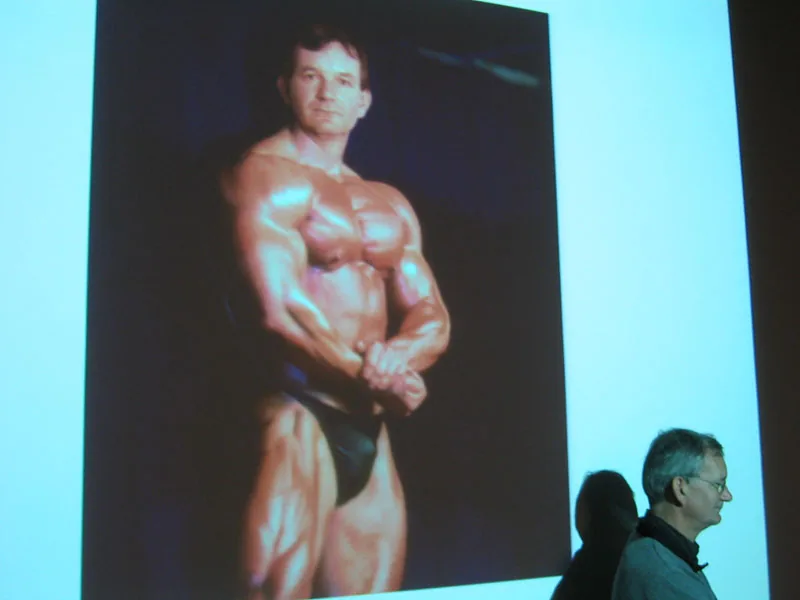
A series of composite photographs appears, showing the speaker’s head inside the gaping jaws of a shark, in front of a statue of Christ, as a Van Kooten and De Bie character among fields of flower bulbs, and in some kitschy Arab photo studio…
“I never laugh—see?”, he explains. The crowning image shows the body of a burly bodybuilder topped—once again—with Parr’s head, leaving the audience with a broad smile.
When this article was published, Parrworld had opened at the Graphic Design Museum in Breda and was scheduled to run through January 6, 2009. The exhibition gave free rein to Parr’s curious fascination with postcards, watches, photo books, photographic collections, and other curiosities.
Breda Photo 2008 also showed photographs from Parr’s series Small World and Luxury World.
During the Utrechts Licht photography festival, Parking Spaces was also on view at Flatland Gallery in Utrecht as part of a FOTODOK triptych.