Although the disposable camera, also known as a single-use camera, is not an ideal product from a sustainability standpoint, it is a textbook example of recycling and reuse. Kodak has been recycling these cameras for 19 years and returned no fewer than 1.5 billion of them to the production cycle during that period.
The interesting part of the story is that it began with Kodak too. You bought a Kodak roll-film camera (introduced in 1889) preloaded with enough film for 100 photos. When the film was full, you sent the camera to Kodak.
Kodak developed the film, printed the photos, and returned them to the customer together with a reloaded camera. “You push the button, we do the rest” became the famous words of Kodak founder George Eastman.
With today’s single-use camera it is even easier: you can drop off the camera at many locations, so customers have fewer obligations. The reuse system, however, is less closed-loop.
Collecting the cameras depends partly on the willingness of photo-processing labs. Kodak has always strongly supported the program and pays for returns; today, 84% of all single-use cameras are recycled.
Nearly one billion of the cameras were Kodak models. Kodak also accepts cameras from other manufacturers and pays for those as well. When they arrive, all non-Kodak cameras are separated and sent to their manufacturers for recycling, who in turn pay Kodak.
Grinding
The returned cameras are disassembled, and everything still in good condition is reused. The rest is ground up and melted down so it can be made into new parts. Flash models always receive a new battery. Minilab owners often remove the battery themselves, giving them a free source of power for radios, toys, and other devices.
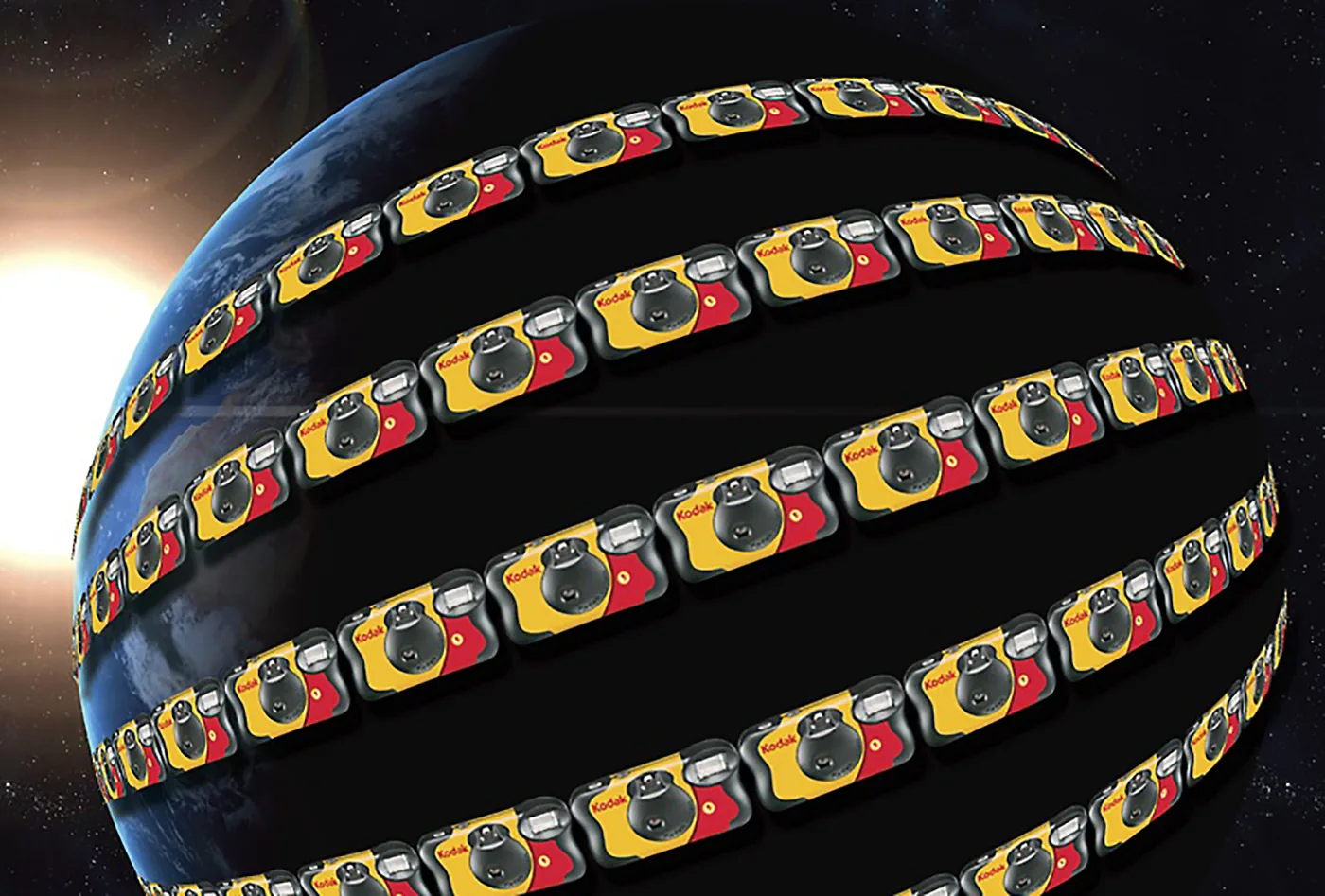
According to Kodak, if all 1.5 billion cameras were laid end to end, they would circle the Earth 5 times.
Amusement Parks
Remarkably, the single-use camera is just about the only product from the analog photography era that still sells well. It comes to the rescue when your battery is dead or your memory card is full. Many children take their first steps in photography on vacation with a Kodak Fun camera or something similar.
It is also surprising how good the resulting photos can be, provided the camera is made by Kodak or Fuji, which really are the best.
Make no mistake: these cameras use aspherical lens technology, a slightly curved film plane for maximum sharpness, and film that is relatively forgiving whether the photos are exposed at ISO 100 or ISO 1000.
All the advanced exposure and white-balance technology is effectively applied in the lab during printing. It is ingenious, really—they could almost invent it all over again.
Digital Compact Cameras
Incidentally, many digital compact cameras are disposable cameras too. If they fail outside the warranty period, repair costs are often so high that a new one costs only a little more. Falling prices have also encouraged this trend.
But these are actually the true disposable cameras, because their technical complexity makes them far harder to recycle.