photo: © John van Helvert
Havana, the capital of Cuba, is a remarkable city of 2.2 million people, nearly all of whom seem equally photogenic. Photographer John van Helvert visited San Cristóbal de La Habana, founded in 1515, and found both motivation and inspiration there.
You can make observational or confrontational images. Observational photography means looking at a situation and photographing it without being noticed. The photographer remains anonymous, as it were, and is not ‘visible’ in the image.
Confrontational photography is when you photograph someone who knows you are taking their picture. You then see that person respond to the photographer. They may smile or look angry, surprised, startled, or annoyed; whatever the reaction, it is always there and reveals itself at the moment the photograph is taken.
Old Havana: beautiful old but neglected houses and a cluttered streetscape
The photographer then becomes visible through the subject’s reaction. There are endless variations: several people responding to one another, complicated situations at intersections, or unrelated people where one responds positively while another reacts negatively. These moments create compelling contrasts within an image.
Impoverished man
In several respects, this image is the exact opposite: it is confrontational for both the subject and the photographer. The man is clearly impoverished and suffers from a skin condition. The photograph was taken from such close range (with a super-wide-angle lens 16-35mm) that it offers a stark view of his difficult circumstances. His gaze is like a hard mirror, although every photographer will experience it differently. Action and reaction unfold in mere fractions of a second.
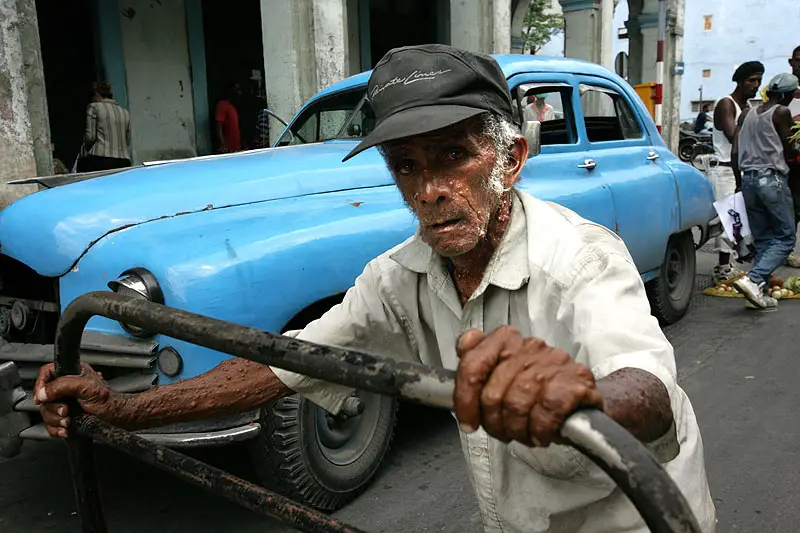
Feelings of shame about confronting this man so directly with his own circumstances can weigh on you. Every photographer is of course free to make that choice, but it sometimes gives you pause.
The person being photographed may also react negatively. This man did not; perhaps he was too modest or simply in a hurry. This is also one of those photographs where the decisive moment is crucial. Had he looked away even briefly, the image would have become uninteresting and lost almost all of its emotional weight.
A typical Cuban scene
This is Havana in a nutshell. If you walk through the streets of Old Havana on a Saturday morning, almost every car owner is tinkering with an old American car. These cars have often been on the road for around sixty years, sometimes even longer. There is almost always something wrong with them. At first glance this was an easy photograph, but in retrospect it is a beautiful convergence of several visual elements.
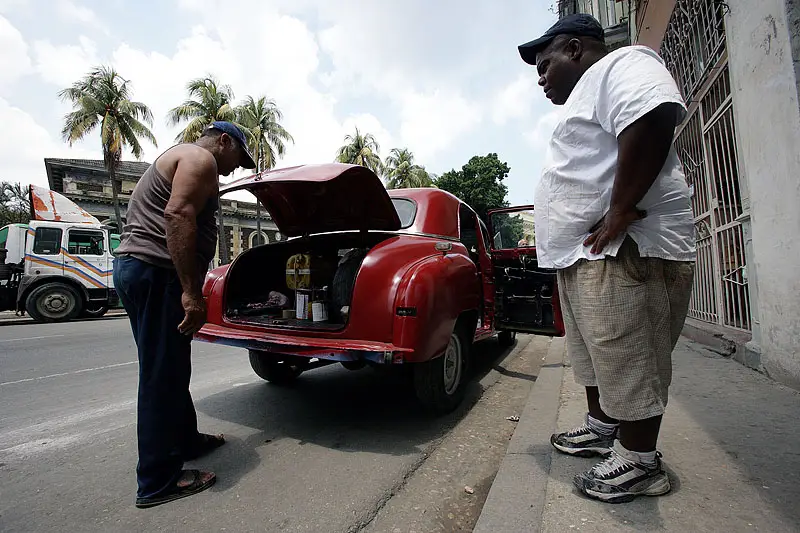
I was walking slowly along the sidewalk and had already spotted this car from a distance. The man on the left was circling it somewhat aimlessly, as though he could not quite decide how to tackle the job he had planned. What I initially saw was not yet worth a photograph. The man on the right was walking slowly toward me but paid no attention to me. When I drew close to the car, I slowed down even further until I was barely moving.
Sometimes you sense that an interesting moment may be about to develop, and you begin anticipating the situation. The man on the right had already moved a fraction beyond the car when he suddenly turned toward the man on the left, who had paused at the trunk. That brought the man on the right into profile directly in front of me. And what a profile it was! Full of character: for a brief moment they shared the same puzzled expression; a connection had formed, a silent consultation.
To readers the scene may look perfectly logical, but at the time it came as a surprise. Assuming the men did not know each other at all, this moment nevertheless emerged in front of the camera. The pronounced wide-angle perspective of the 16-35mm, the posture of both men, and the build of the man on the right also created a kind of caricature of a typical Cuban scene on a Saturday morning in Havana.
Stylish woman in the cargo bed
Another confrontational image. At a busy intersection, this stylish woman zipped past in the cargo bed of a motorized cargo bike. The image clearly shows how quickly it had to be made. The cargo bike occupied that spot for only a fraction of a second, and her wonderful smile lasted just as briefly.
I made this image with a Mamiya M7II on film. It is a slow camera compared with a digital SLR, so I could press the shutter only once. Fortunately, once was enough.
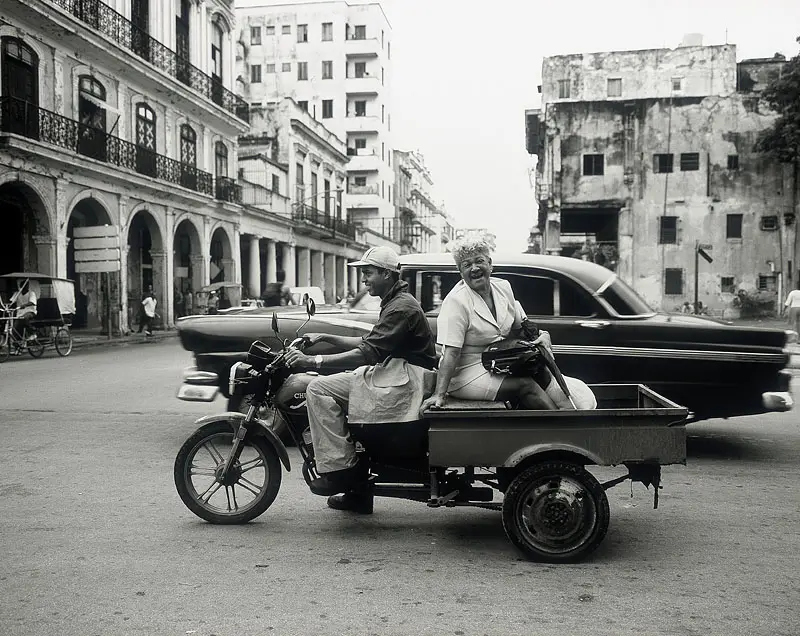
The woman’s smile directly into the camera makes my presence highly visible in this photograph. Here it produced a funny, spontaneous image, with an appealing contrast between the rather basic nature of the vehicle and the stylish woman. The fact that a beautiful old American car happened to pass behind the subject and fill precisely that part of the frame was a welcome gift.
One of Havana’s oldest boxing schools
An observational image made from a distance that still feels intimate because of the light. This is one of Havana’s oldest boxing schools. I made the photograph at dusk. From the very highest point of the stands, on 6 x 7 cm film with an extreme wide-angle lens, the center of the image—the boxing ring—appears even farther away.
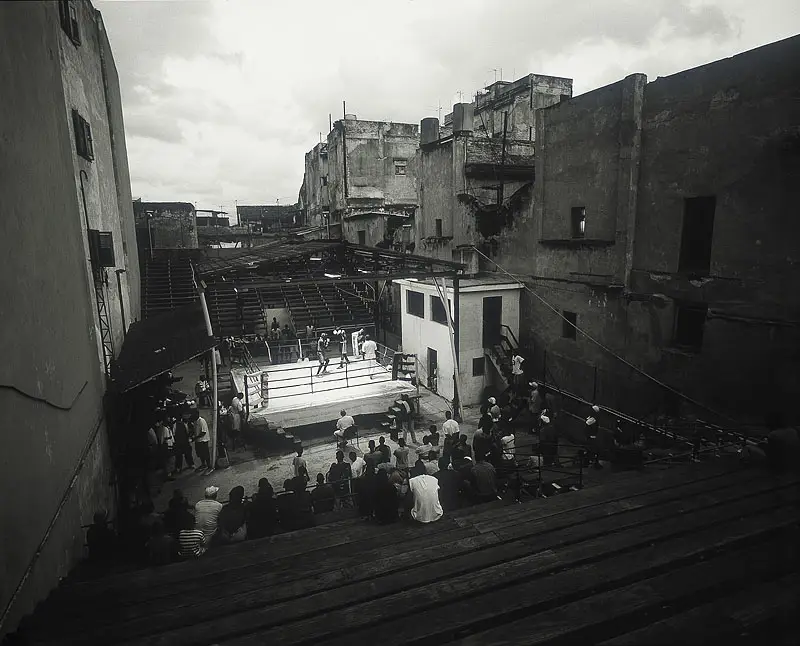
Nothing in the image gives away the photographer’s presence. Yet it is by no means a detached photograph. It is not yet dark, but direct sunlight has long since left the houses, which now form a low-key backdrop. Artificial lights illuminate the ring, creating a bright area that draws the viewer’s eye. Because the stands are not packed and those present are concentrated strongly in the front rows, an even greater sense of depth has emerged between the camera and the center.