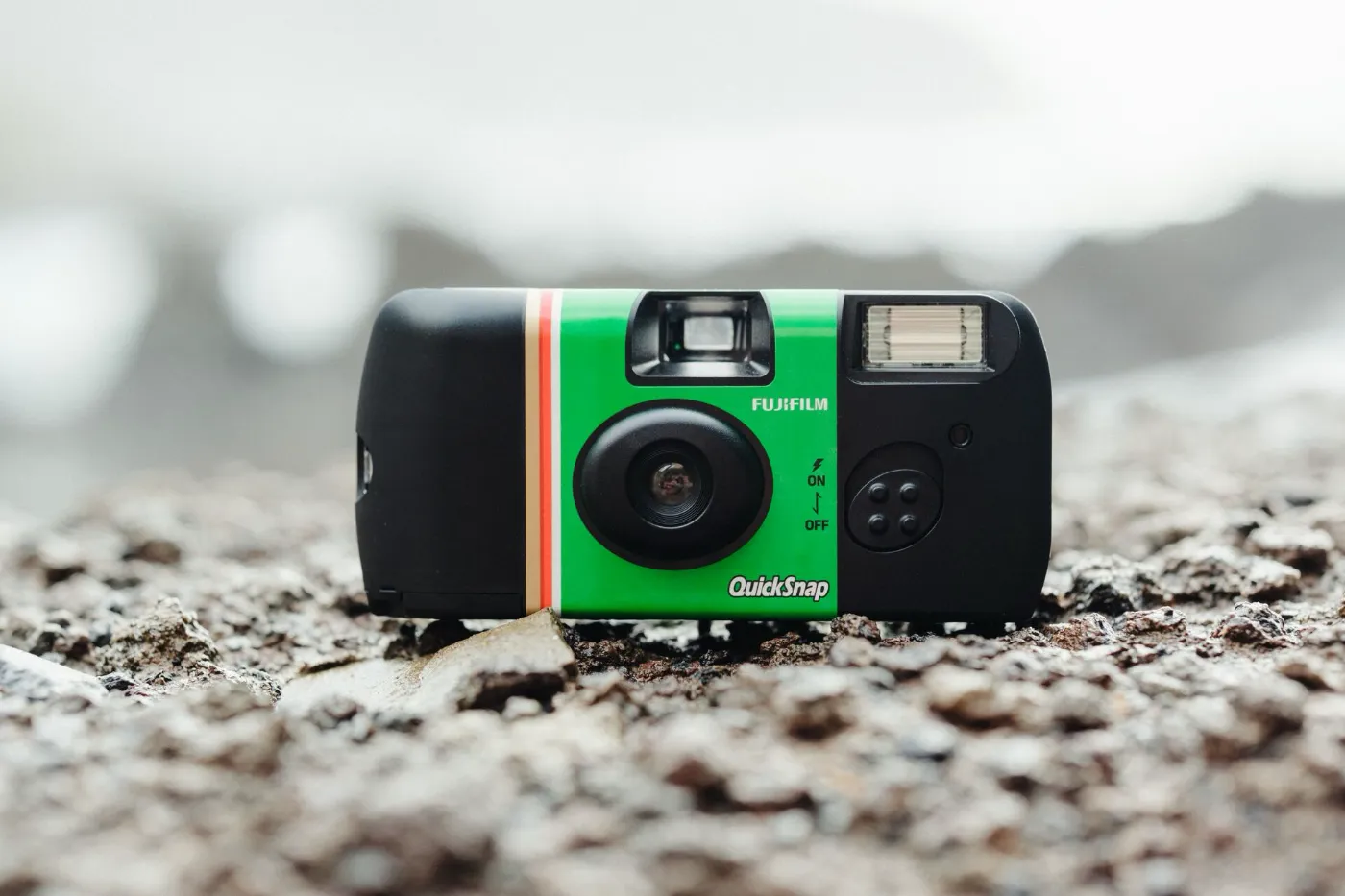
The Fujifilm QuickSnap may not be a camera you need to think about for long. That is precisely what makes it appealing. One lens, one viewfinder, a roll of film already loaded, and after 27 shots, that is it. At a time when almost every camera setting can be adjusted endlessly, such a simple film camera feels surprisingly refreshing.
There is another nice detail: Fujifilm developed its familiar single-use camera back in 1986. In 2026, that was forty years ago. That makes the QuickSnap not only a nostalgic product but also a remarkably long-lived survivor from a time when photography was far less digital and far less immediate.
A camera without a menu
The QuickSnap is Fujifilm’s well-known single-use camera: a small, lightweight 35mm camera with film inside. You do not need to load film, choose an ISO, or meter the exposure. You advance to the next frame, compose through the viewfinder, and press the shutter.

That sounds limiting, and it is. But that limitation is exactly the charm. The QuickSnap pushes you to look faster and make fewer corrections. There is no screen on the back, no histogram, and no second chance to see immediately whether the image worked. You photograph by feel and discover only later what is on the film.
QuickSnap Flash 400
The best-known version is the Fujifilm QuickSnap Flash 400. It comes preloaded with 35mm film rated at ISO 400 and usually offers 27 shots. ISO 400 is a useful middle ground: sensitive enough for cloudy days, street scenes, vacations, and indoor situations where you can use the built-in flash.
That flash matters. In bright daylight, you can simply use the camera without it, but when you shoot indoors or photograph people in the shade, the flash helps keep faces from becoming too dark. Do not expect subtle studio lighting; the light is direct and sometimes harsh. But that raw flash effect is part of the recognizable single-use-camera look of parties, trips, and family photos.
QuickSnap Waterproof
For the beach, pool, and vacations, there is the waterproof QuickSnap version. It is designed for situations where you would rather leave a regular camera at home: sand, splashes, swimming, snorkeling, or a day on a boat. Depending on the version, it is sold as a waterproof camera or for underwater photography, with a more rugged housing and simple controls that remain usable when wet.
The waterproof QuickSnap is less a camera for perfect image quality and more a camera for moments you otherwise would not photograph. Children in the pool, a jump off the dock, bright sunlight at sea: these are exactly the situations in which a worry-free film camera proves useful.
Why is it interesting again right now?
The popularity of simple film cameras fits the broader return of analog photography. Many photographers and enthusiasts are not necessarily looking for more sharpness or more megapixels, but for a different way of seeing. The QuickSnap makes that step easy. You do not need to hunt for a used compact camera, repair a battery door, or read a manual.

At the same time, it is important to be honest: a single-use camera is not the most sustainable form of photography. Anyone who wants to shoot film more often is ultimately better off with a reusable 35mm camera such as the Kodak EC35. But for a wedding, vacation, festival, or first introduction to film, the QuickSnap can still be an accessible entry point.
After taking your photos, you hand in the entire camera at a photo service or photo lab. The film is developed there, and you receive the photos as prints, digital scans, or both.
Tips for better QuickSnap photos
Use the camera mainly in good light. It performs best outdoors during the day, especially the Flash 400. Get close enough to your subject because the lens is simple and details quickly disappear when someone is too far away. Almost always use the flash indoors, even if it still seems reasonably bright to you.
Also pay attention to the background. Because you have little technical control, composition becomes even more important. A calm surface, a striking color, or a beautiful gesture often makes more of a difference than the camera itself.

Small, limited, and fun because of it
The Fujifilm QuickSnap is no replacement for a good mirrorless camera, smartphone, or reusable analog compact. It is too simple for that. But as a camera for spontaneous moments, it still has something disarming about it. You pass it around at a party, take it to the beach, or slip it into a jacket pocket without worrying about settings.
And perhaps that is exactly why the QuickSnap continues to work: it briefly gets the technology out of the way. What remains is looking, choosing, and pressing the shutter.