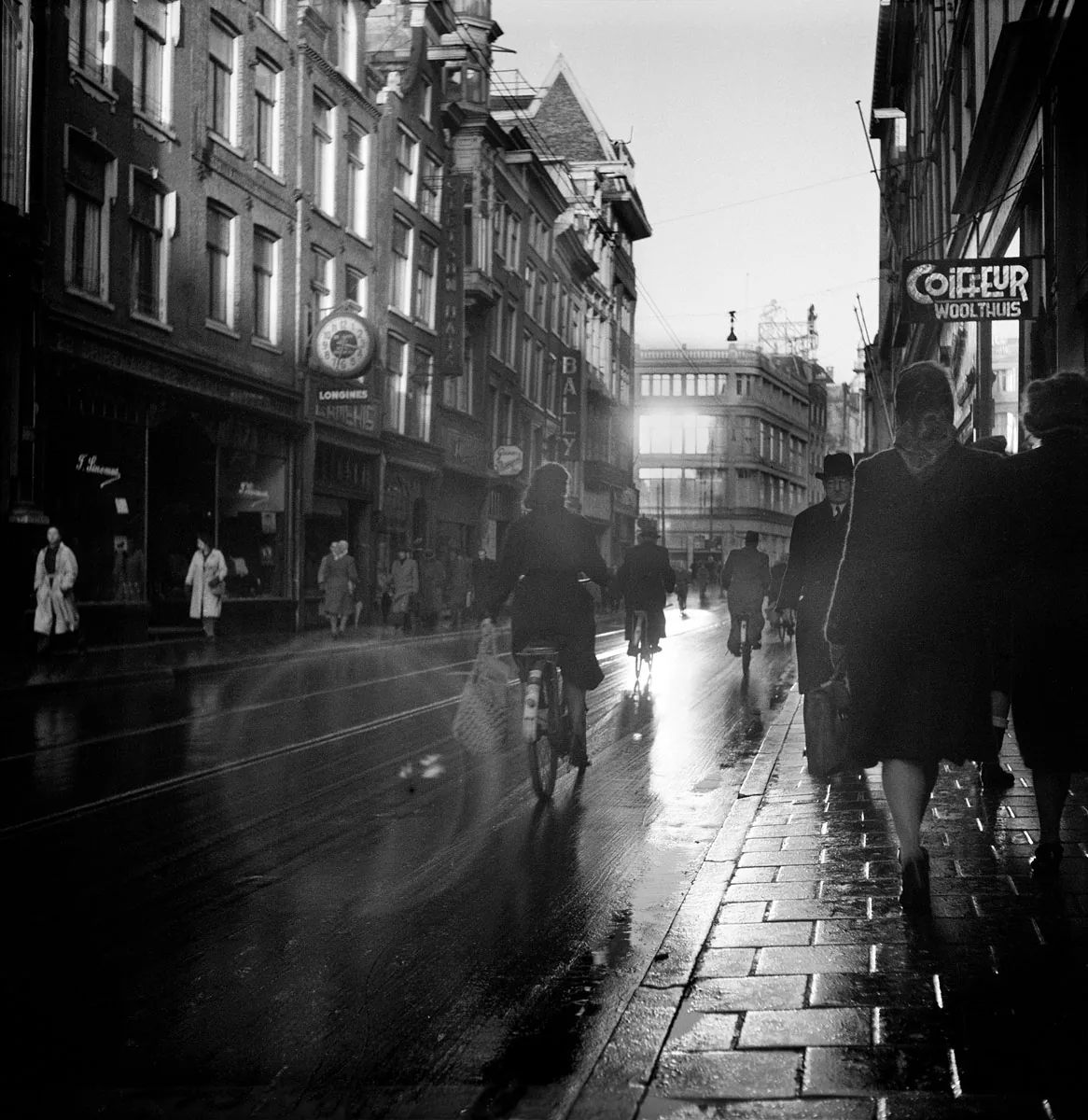
Photo: © Werner Bischof / Magnum Photos — Leidsestraat, Amsterdam, November 1945.
Swiss Magnum photographer Werner Bischof (1916–1954) worked as a photojournalist for magazines such as Life and Picture Post. In the two decades before his early death in 1954, he created an impressive and diverse body of work. To mark the 100th anniversary of his birth, Fotomuseum Den Haag mounted a major retrospective.
Featuring approximately 220 vintage photographs and contact sheets, as well as personal letters and photo books, the exhibition Standpunten offered an overview of his studio work, his work in post-1945 Europe, and his travels through Asia, South America, and the United States.
The exhibition was curated by Marco Bischof, the photographer’s eldest son. Especially for Dutch audiences, the museum added around thirty previously unseen photographs that Bischof had taken in the Netherlands in the autumn of 1945.
When Werner Bischof graduated from the Kunstgewerbeschule in Zurich in 1936, he seemed destined to become one of the leading figures in a new field: advertising photography. Despite the war, he managed to hold on to this ambition into the 1940s. Toward the end of the war and after the liberation of Europe, Bischof’s eyes were opened to what photography could also mean: bearing witness, gathering evidence, and seeking the truth. He fell in love with photojournalism and thereafter focused exclusively on social and political subjects.
Until his sudden and tragic death in 1954—a fatal car accident in Peru—he never strayed from this path: he was determined to document injustice, from famines in India to the daily consequences of war in a remote Vietnamese village.
A Journey Through War-Torn Europe
In November 1945, Werner Bischof set off north from Zurich to visit the war-ravaged countries of Luxembourg, the Netherlands, Belgium, and France. For the relief organization Die Schweizer Spende, he documented the results of the material aid that the Swiss had provided to the affected countries; for the cultural monthly Du, he created a photo essay that was published in the spring of 1946 under the title Europa.
During this journey, Bischof and his traveling companion Emil Schulthess witnessed the “terrible destruction and unimaginable chaos” in the cities they passed. Yet it was the combination of children playing among the rubble, destruction and reconstruction, grief and hope that seemed to capture Bischof’s artistic eye.
The exhibition had previously been shown in Munich and Lausanne. Especially for the exhibition in the Netherlands, Fotomuseum Den Haag added thirty previously unseen photographs that Bischof had taken in the country during this journey.
Werner Bischof — Standpunten
Photography exhibition: December 17–May 7, 2017