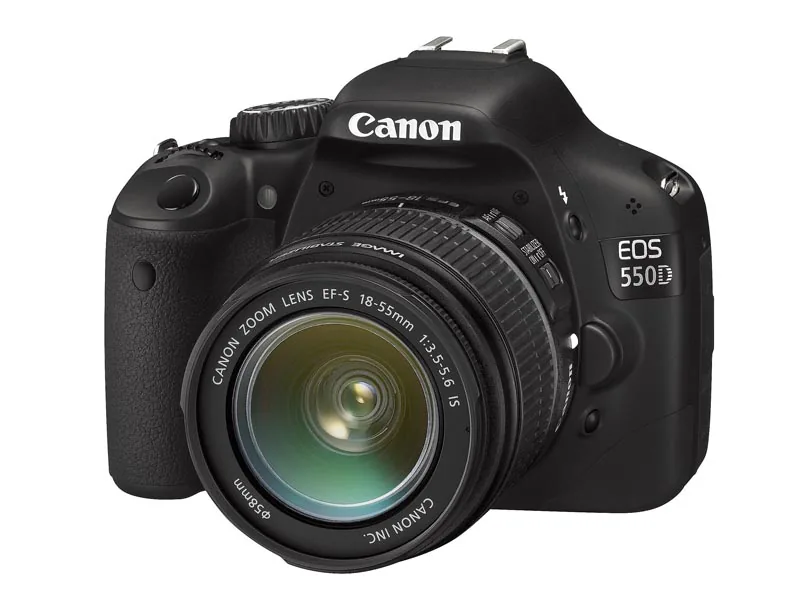
Canon's latest flagship in its consumer DSLR line offers an impressive 18 million pixels. And there's more: the Canon EOS 550D also shoots excellent video, a capability that is rapidly being taken very seriously.
Camera manufacturers regularly want to encourage their users to make new purchases. And a higher number of pixels is an easy argument.
People who know little about cameras and still want to try an intelligent question often come up with: how many pixels does it provide? But in reality, a higher number of pixels does not automatically provide better quality.
Better, but Only If...
Pixel count isn't a quality criterion, although it is often treated as one. You could argue that the more pixels there are, the smaller they are, and therefore the better a camera such as the Eos 550D is at resolving very fine detail.
That is correct, but you must use lenses that have a very high resolution. This basically means that you can only get the added value of 18 million pixels if you use high-quality optics.
The Eos 550D has the refined light metering system of the 7D and it pays off
Better—or Is It?
In principle, smaller pixels also mean: more image noise, which requires extra effort from the electronics to smooth it out. This must be done in a smart way: the noise reduction system must 'understand' when it looks at a plain white wall that contains image noise and when a piece of rough plasterwork is in the picture. That doesn't always go well.
With the Canon Eos 550D, highly detailed subjects produce very good results even at the highest ISO settings: excellent sharpness and detail with little noise.
But in larger areas, image noise is still widely present. Please note: this concerns settings at ISO 12,800 and 6400. At ISO 3200 you have a fine noise that is hardly noticeable.
The noise reduction works very well, but that does make fine details a bit less sharp. You can then increase the sharpening slightly, but that leads to additional loss of detail and then the added value of 18 MP is as good as gone. Please note that the differences with competitors with 12 or 14 MP are negligible in practice.
And so it all gets a bit complicated. Just remember that the Canon Eos 550D is among the absolute best in its class.
As for colors: white balance remains a critical point at Canon. Adjustment is required regularly. The lighting is generally well balanced. The Eos 550D has the refined light metering system of the 7D and it pays off.
So no black bars at the top or bottom, full use. This is really one of the highlights of this camera
2 : 3
Reviewing the photos you have taken gives you extra pleasure thanks to the new LCD screen on the back. Clear and super sharp, and with a 2:3 aspect ratio. So no black bars at the top or bottom, full use. This is really one of the highlights of this camera.
This also applies to the movie options. You have a wide choice of standards, formats and speeds, full lighting options and also an external microphone connection. This fulfills all the wishes of serious filmmakers.
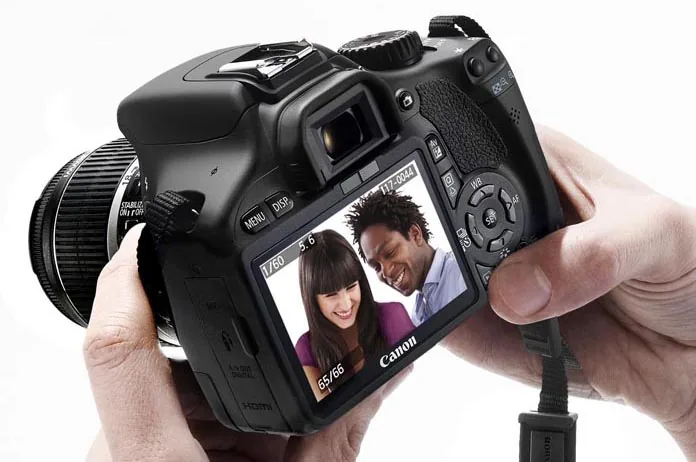
Many photographers wonder: what should I do with it? But filmmakers see it very differently. For a pittance (compared to professional video cameras) you can buy a top-class video camera. Its strongest point: a large, highly sensitive image sensor, with which you can film in cinema quality. The large sensor size means you have relatively little depth of field, which gives you wonderful opportunities to play with sharpness and blur.
For holiday videos, an HD camcorder is a better idea
You have to focus manually; the contrast AF that you use in live view (the mode for filming) is too slow for filming, too uncertain and may also make too much noise (depending on the lens used). For holiday videos, an HD camcorder is a better idea.
With the Movie Crop function, you only use the central part of the sensor, which records images in 640 x 480 pixels. The magnification factor is then 7x, so that with a 200 mm lens you get the effect of a 1400 mm.
For a fair comparison with full frame you also need to apply the 1.6 crop factor, giving an equivalent of 2,240 mm. That is interesting for filmmakers recording birds. It is a shame that Canon offers only one Movie Crop setting; additional options such as 2x and 4x would certainly be welcome.
Sometimes a small crop factor is sufficient, while you retain more quality. During the binocular show in the dunes near Castricum (April 25), Cameraland showed the spectacular Sigma 2.8/200-500 mm zoom, with the accompanying 2x converter and the Eos 550D as camera. Lens and converter together form a 5.6/400-1000 mm.
With a crop factor (for the sensor size) of 1.6x you reach the telephoto position at 1600 mm. And with the 7x crop of the Eos 550D enabled, you end up with an equivalent of 10,200 mm! With a film image of only 640 x 480 pixels, yes.
The operation of the Eos 550D is simple and transparent
Creative Auto
The EOS 550D's controls are simple and straightforward. Quick Control is a useful feature: pressing the dedicated Q button opens a screen showing all the main functions, each of which can be adjusted directly.
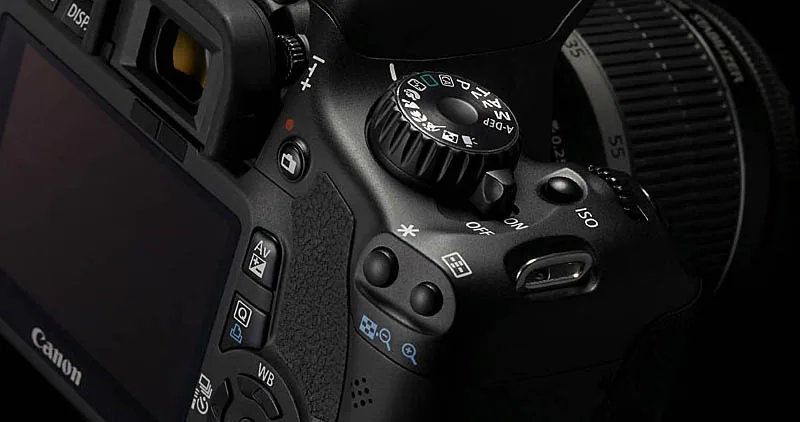
And of course we also find the Creative Auto function, which is intended to help reflex beginners become familiar with the most important settings more quickly. Aperture and shutter speed are indicated using scales that indicate the depth of field and the motion rendering, and you will also find things such as ISO, white balance, exposure compensation and image adjustment.
An easy camera, but rather poorly equipped compared to its peers
With Creative Auto, the camera works according to program automatic, but by turning the setting wheel you deviate from the chosen time/aperture combination to adjust depth of field or motion display.
ISO
A sensor that performs this well deserves to be exploited to the maximum. That is why it is good that Canon has finally decided to make the automatic ISO control adjustable. You can now determine the limit to which the ISO value can be automatically adjusted. Unfortunately, with the earlier models you never had a say in this.
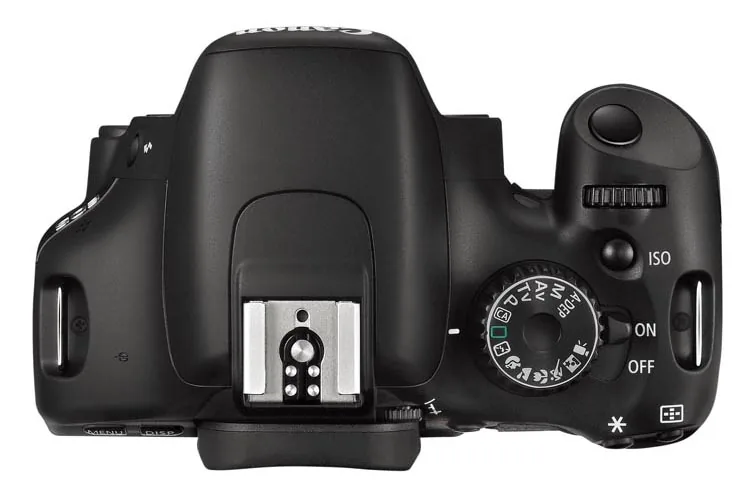
It is also good that the exposure correction can now be adjusted over five stops, instead of 2x. Of course you could maintain that the exposure is usually so good that a correction of more than 2 stops should be unnecessary, but anyone who uses exposure correction as a creative instrument (for example for delicate high-key shots with only light tones) knows that 2 stops will not always suit you. Your only solution was manual exposure control. So: welcome, that 5-stop correction.
Easy to Use
Time for balance. The Canon Eos 550D is an interesting reflex with a high level of quality. The 18 million spectacle does not yield much net, but that does not alter the fact that it can deliver top quality. However, the excellent lighting results and the beautiful screen on the back are also important advantages. When it comes to filming, the Eos 550D is a star. Cinema quality for next to nothing, that's how the film world sees it.
Overall, this is an easy-to-use camera, but it is rather sparsely equipped compared with its peers: no articulating screen, no in-camera photo editing or RAW processing, no creative filters, no additional scene modes, and no HDR function. How important those omissions are is a personal matter.