As a rock star, he enjoys enormous success worldwide. But in 1999, Bryan Adams (46) also embarked on a second career as a photographer—and once again received widespread acclaim. A conversation with a modest multitalent about ambition and “just doing your thing.”
He does not like giving interviews. He would rather let his work—his music as well as his photographs—speak for itself. He finds the thought of everyone looking inside him during such a conversation unsettling and unpleasant. But Bryan Adams is professional enough to set aside his reserve and understand that, as a public figure, he cannot avoid it; for a moment, he is willing to talk.
Not for himself, but for the charities supported by the Canadian singer and photographer, including the international fight against breast cancer. One of his greatest achievements in that effort was initiating a benefit concert in Canada in 1998 that raised more than one million dollars. With this money and the support of supermodel Linda Evangelista, a breast screening center was built at St. Catharines General Hospital.

F.nl: You began your professional career as a photographer in 1999. What prompted you to start?
Bryan Adams: ‘For years, I kept a kind of photographic journal of my work, just for myself. It really began when, years ago, I got some of my photographs back from a photo lab here in London—an incredibly exciting moment for me. I used them as artwork for my album covers. Then I began taking portraits of friends, which led to my work being published in Canada. The next step was my first book, titled Made in Canada. As you may know, the book draws attention to breast cancer, which claimed the life of a good friend of mine in 1997.’
In those early days of your photography career, were there artists or photographers who inspired and encouraged you?
‘Many, over the years. But while I was producing my first book, Herb Ritts—the American celebrity photographer who died in 2002—was incredibly supportive. He lent me his studio and his entire team. For me, it was the University of Photography. If I owe anyone thanks, it is Herb for his tremendous generosity.’
How did you experience the transition from well-known musician to ‘unknown’ photographer?
‘There was never a transition. I still practice both disciplines whenever I feel like it. One disadvantage was that once you already have a certain degree of fame, people are less inclined to give you a chance. But that was actually also the case when I started in music. Nobody believes in you; you simply have to believe in yourself and your own work. That is enough.’
Your early work resulted in two photography books, Made in Canada and Haven, both intended to raise awareness of breast cancer. Today, you also photograph for magazines such as Elle, Vogue, and Marie Claire. How do you experience that more commercial way of working?
‘It is the same. No one at any of those magazines has ever told me what to do. They come in here with a completely blank canvas and simply let me do my thing.’
But what do you want to achieve with your photographs?
‘Nothing more than creating something out of nothing, just as I do with my music. I do not expect to make money from it either. I do it because I love the medium—I love the teamwork, I love meeting interesting people, and I love working with different creative people.’
Nothing more than creating something out of nothing, just as I do with my music
Which trend in photography is worth mentioning?
‘Simple: everything is going digital, without a doubt.’ Agreed. And what effect is the digital revolution having on professional photography? ‘Well, I think there are very few photographers left who do not work digitally these days. Digital is especially useful when you regularly need to send your work quickly. At the touch of a button, your photographs can be in Australia the next moment. It is especially a free-for-all for the paparazzi—the shoot-as-fast-as-possible guys. They simply photograph someone coming out of a bar, and a moment later the image has been sent.’
How would you describe your work and your way of working as a photographer?
‘Empirical. I don’t read manuals; I pursue the things I like.’
What do you consider your greatest success, and what your greatest disappointment?
‘I consider mastering my Leica M6 my greatest success. That was quite a challenge. My greatest setback was the time I got my roll of film back after it had been scanned by an X-ray machine. The radiation had completely erased the photographs: all the work from an entire photo shoot was ruined!’
If you have the choice, how would you like people to remember you in the next century: as a pop star or as a photographer?
‘I see myself first and foremost as a musician, but that could change in the future.’
What advice would you give beginning amateur photographers?
‘Absolutely do not rely on computers to store your photographs. Learn how to make beautiful prints yourself and experiment with your work. Sometimes the best result is not right in front of you; you have to tinker a little to arrive at something interesting or original.’
You have found success as both a musician and a photographer. Do you still have ambitions and dreams for the future?
‘I would like to meet a Dutch girl and learn how to make speculaas cookies…’
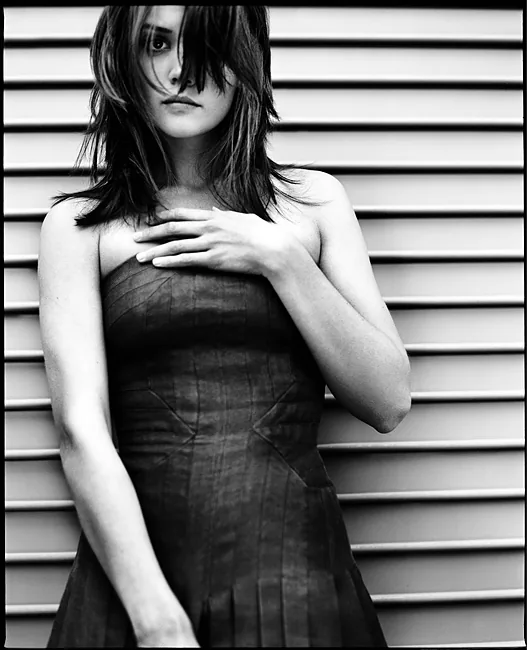
Which photograph are you proud of?
‘The photograph I took of Katie Holmes, mainly because at the time her life seemed likely to take a different course from the one it ultimately did. I therefore see it as a small snapshot in time.’