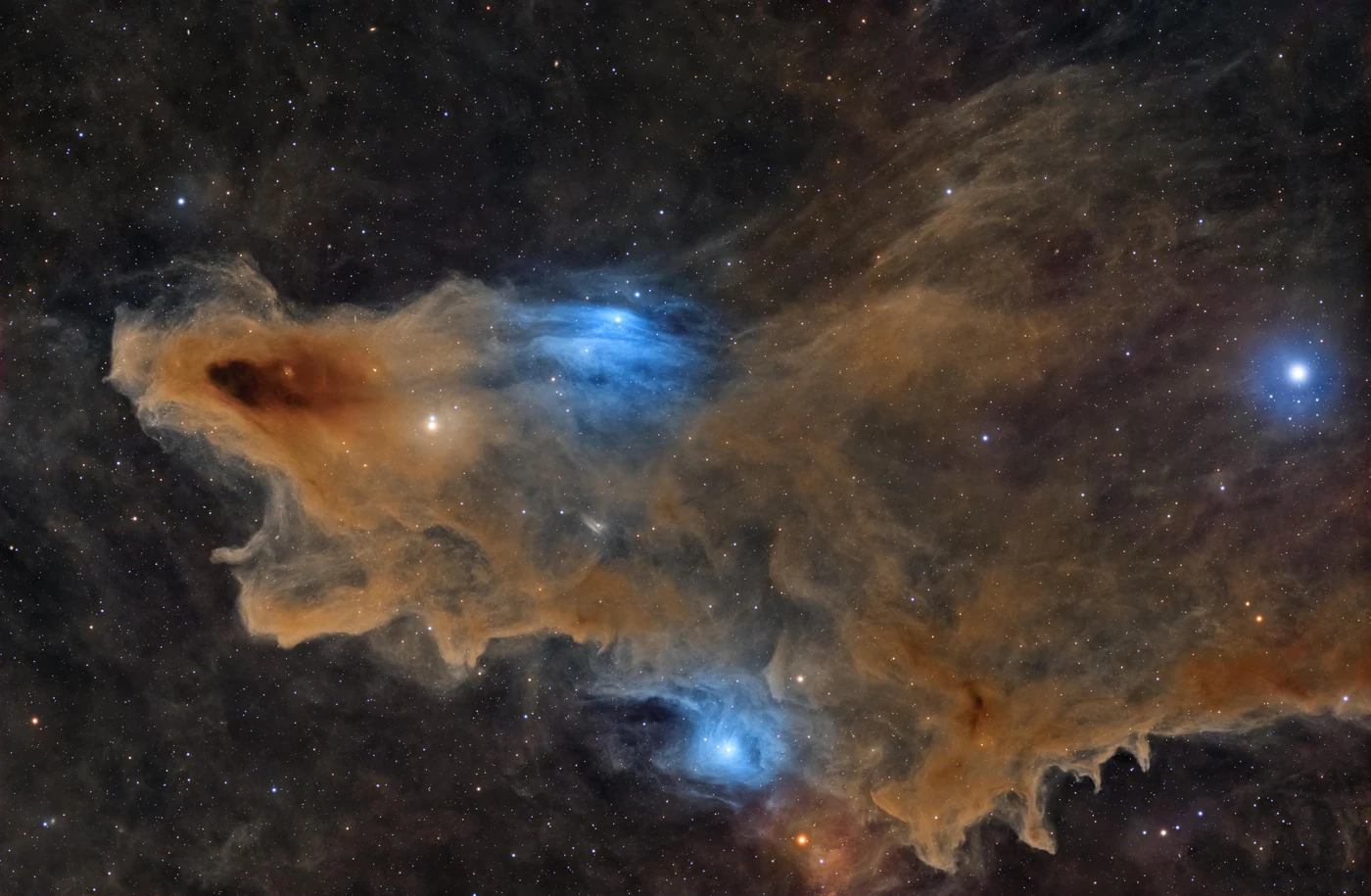
A dark mouth, a fin, a body dissolving among the stars. In Ali Alobaidly’s winning photograph, interstellar dust takes the shape of a shark. With The Quiet Predator, he wins ZWO Astronomy Photographer of the Year 2026. Five award-winning images reveal how differently photographers see the same sky: from a nebula that demands hours of exposure to a planet slowly disappearing behind the Moon.
Following the award-winning images of 2025, this eighteenth edition offers every reason to linger. Sometimes you recognize something before you know what you are looking at. An animal in a cloud, a face in a rock. Ali Alobaidly’s photograph begins with that same sense of recognition. Only when the countless stars come into view does your sense of scale begin to shift.
This is the Shark Nebula, some 650 light-years away in the constellation Cepheus. Alobaidly photographed it from Kuwait. He is the first photographer from that country to win the top prize in the Royal Observatory Greenwich competition.
A predator above the desert
The Shark Nebula bears the rather less evocative catalog name LDN 1235. It is a dark nebula: a cloud of interstellar dust dense enough to block the starlight behind it. The blue areas are reflection nebulae, where dust scatters light from nearby stars.
In The Quiet Predator, these contrasts give the shark its shape. The dark hollow on the left, the warm browns and the cool blue make the image feel almost tangible. Along the edges, the apparent animal dissolves back into delicate wisps.
According to the image details, Alobaidly gathered 28.5 hours of exposure. All that time is brought together in a photograph that initially seems effortless. Judge Steve Marsh praises its sharpness and the interplay of light and dark. Even distant galaxies can be distinguished in the image.
The subject also carries a personal meaning for the photographer. A sea predator in the sky above the Kuwaiti desert connects his love of the cosmos with the landscape of his ancestors. That thought lends the photograph an intimacy despite its unimaginable distance.
What an explosion leaves behind
In Cédric Humbert’s Abell 85, a thin, luminous shell seems to hang among the stars. An orange rim glows along its lower edge. Higher up, the form grows more tenuous, threaded with blue. Red veils surround it, with so many stars between them that the eye never quite comes to rest.
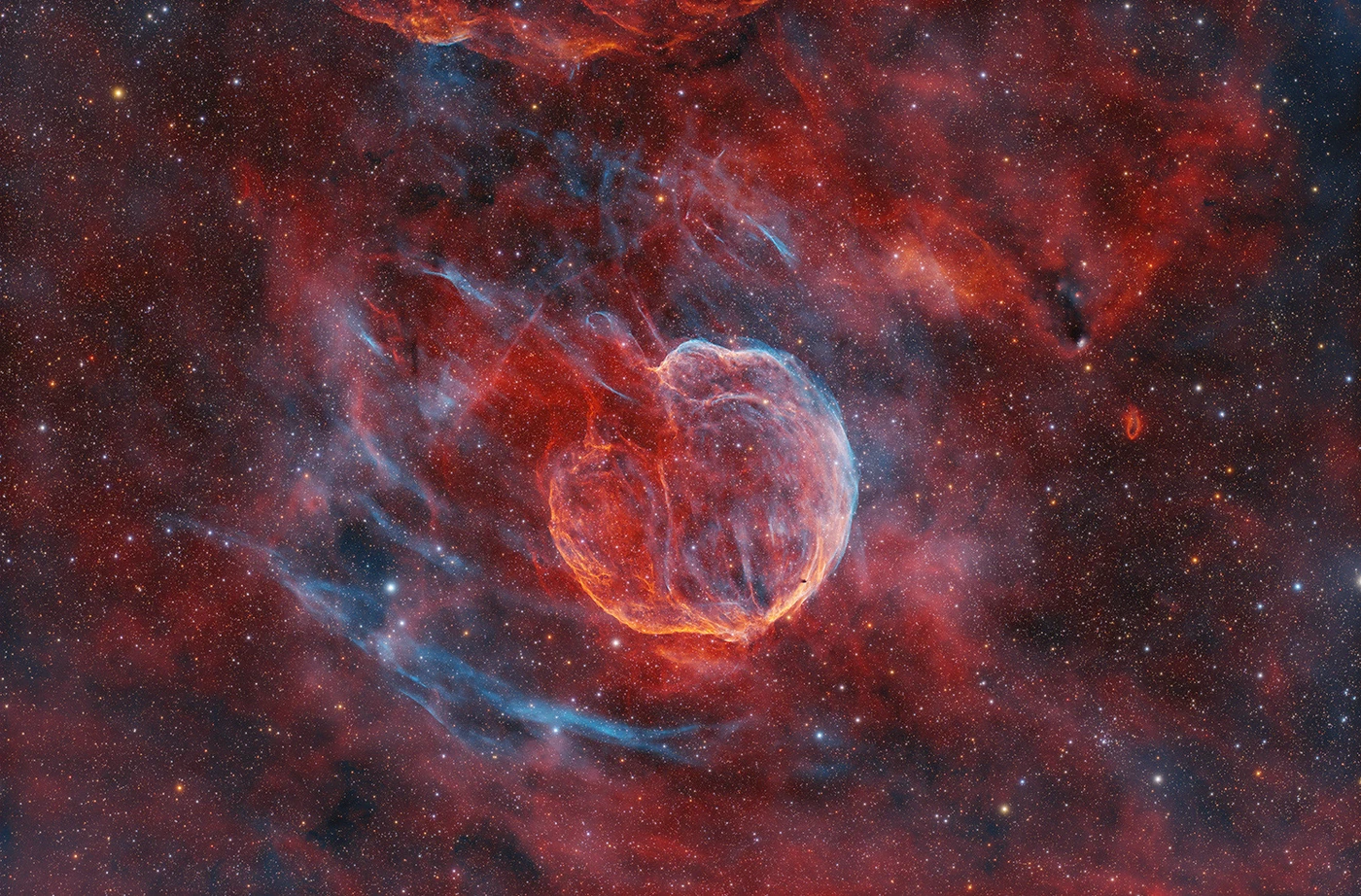
We are looking at a supernova remnant in the constellation Cassiopeia. The star that hurled this material into space is thought to have exploded around ten thousand years ago. Its remains lie some 9,780 light-years away and span an estimated 98 light-years.
Those numbers are almost impossible to grasp. In the photograph, that unimaginable scale takes shape: a broken shell, fragile in appearance, born of a violent event.
Humbert gathered 88 hours of exposure to reveal this extremely faint structure. There is something curious about the result of collecting light for so long. An explosion from the distant past appears here as something calm, almost weightless. The image was highly commended in Stars & Nebulae.
A little church beneath a crown of light
After the depths of the nebulae, The Crown brings us back to the ground. A dark wooden church stands in an open Icelandic landscape. A white door, a few windows, a simple cross on the roof. Around it lie grass, low hills and a sky filled with green.
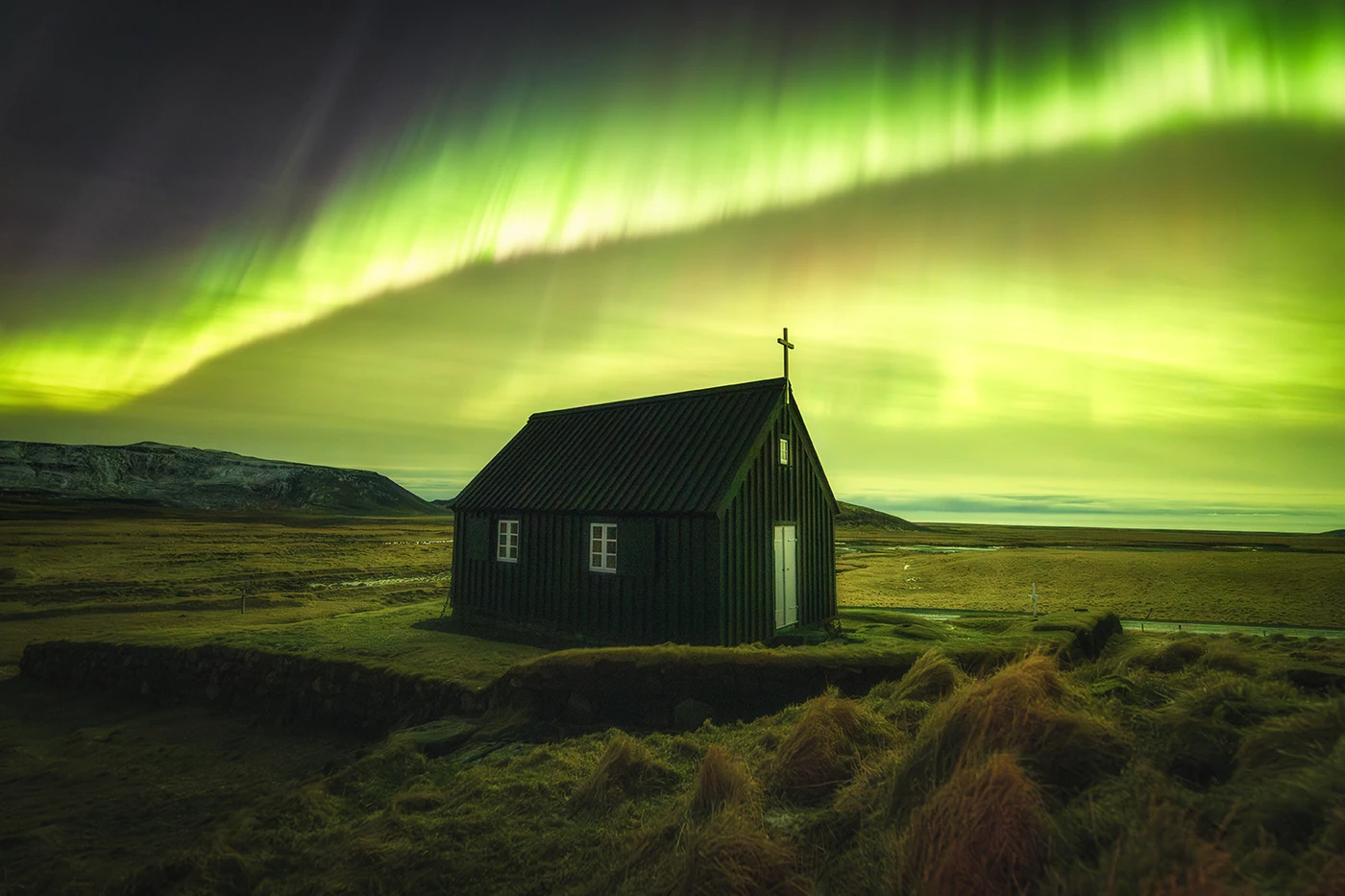
Radoslav Sviretsov took the photograph during a powerful geomagnetic storm on January 20, 2026. Broad bands of aurora sweep across the building. Fine vertical streaks give them the appearance of pleated fabric.
The church makes the space above it tangible. You have a sense of how large a door is, how high a roof. From that small, familiar building, the eye travels upward to a phenomenon that fills almost the entire frame.
The exposure lasted 2.5 seconds. While Humbert gathered light for dozens of hours, Sviretsov had to catch the changing sky in a brief moment. His photograph won the Aurorae category. Sviretsov used a Canon EOS R and a 15mm lens for the 2.5-second exposure.
The sky flows on through the water
Phil Halper also photographed the northern lights in Iceland. In Aurora Between Two Continents, the landscape plays a different role. A stream approaches us from the distance, carrying the colors of the sky.
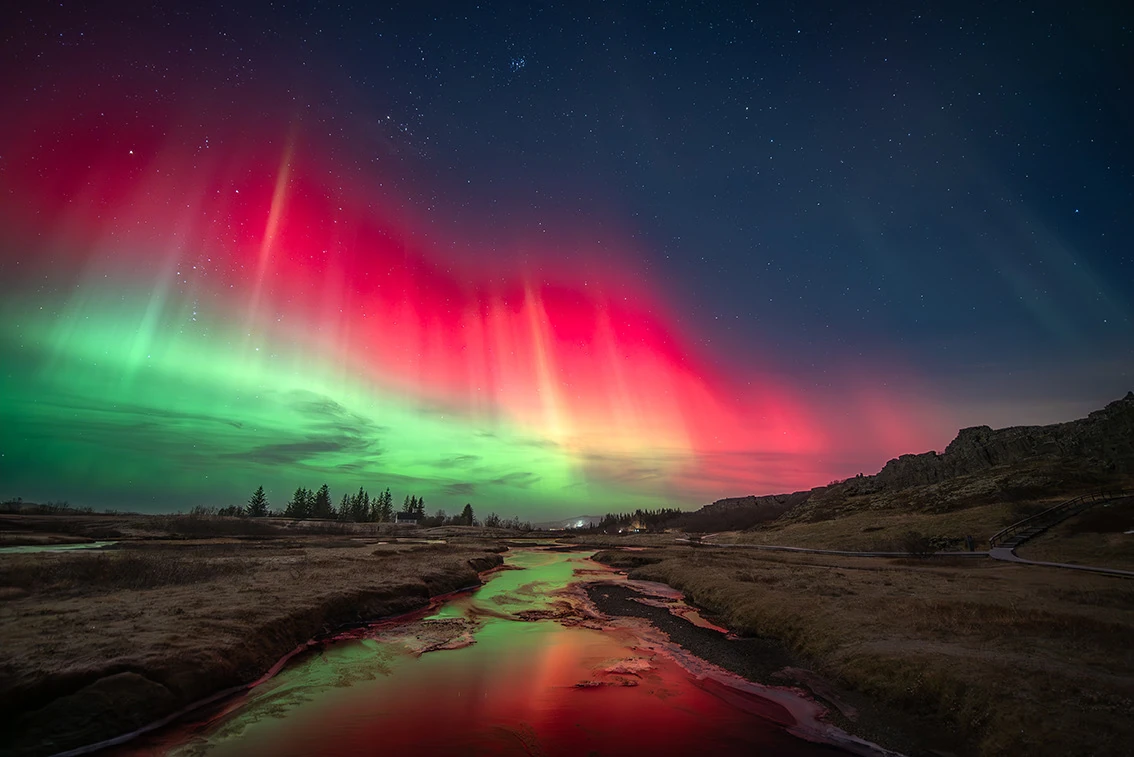
Green hangs low above the horizon. Above it, red and pink shafts of light rise into the deep blue. Those colors return in the water, between banks of dark grass. The sky seems to flow all the way to the bottom of the photograph.
Halper took the image on November 12, 2025, in Þingvellir. Powerful eruptions on the Sun had triggered severe geomagnetic storms. In his account, the colors were remarkably vivid to the naked eye. The intense red came from oxygen emitting light high in the atmosphere.
The title refers to the location between the North American and Eurasian tectonic plates. Yet the photograph works without that knowledge: your eye follows the water, finds the horizon and naturally continues upward. Halper was runner-up in Aurorae. He used a Sony A7S III and a 15mm lens at f/2, ISO 3200, with a 2.5-second exposure.
A pearl slowly disappearing
The quietest composition in this selection takes place in daylight. In Petr Horalek’s Venusian Pearl on the Moon, a sequence of pale lunar crescents appears against a blue sky. A bright white point sits beside the Moon’s edge. From left to right, it grows smaller until it disappears.
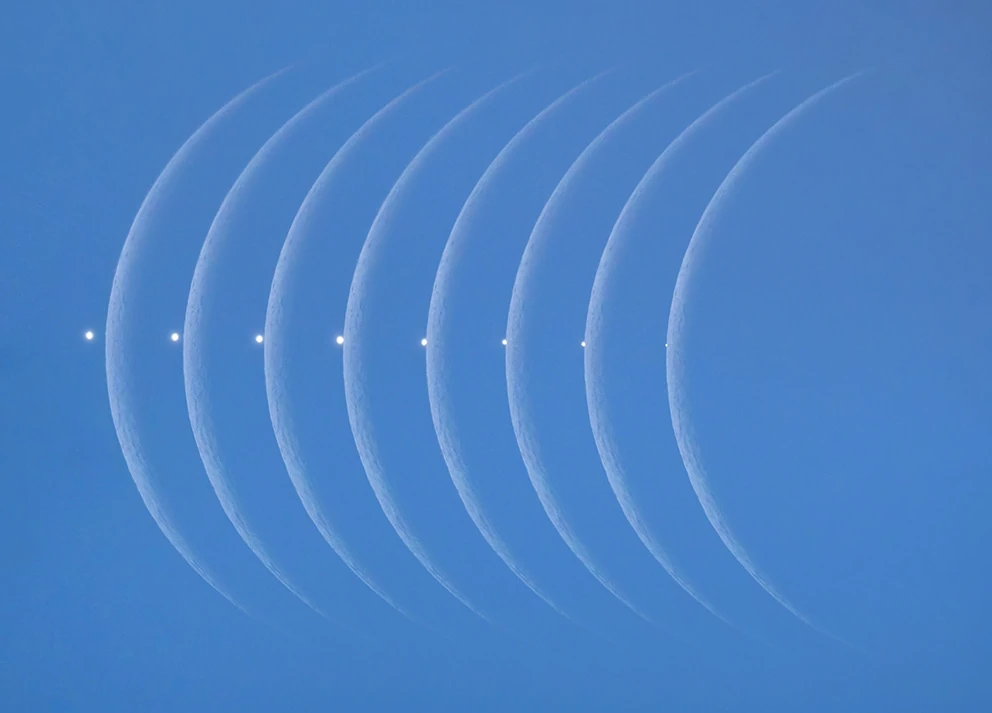
That point is Venus. On September 19, 2025, the Moon passed in front of the planet as seen from the photographer’s location in Czechia. The sequence brings together different moments of that occultation.
Horalek used a Nikon Z6 III on a Sky-Watcher 10-inch FlexTube Dobsonian telescope. The sequence combines multiple exposures of 1/8000 second at f/5 and ISO 250.
The image needs very little. Blue, a slender arc, a point of light. Repetition makes the movement visible while giving the composition a gentle rhythm. You follow the planet until its last sliver of light disappears behind the Moon’s edge.
Horalek won the Our Moon category with this image. After the abundance of dust clouds and auroras, it is this small disappearance that lingers. Even an almost empty sky can hold a complete story.
Looking further in Greenwich
The award-winning images are on display at the National Maritime Museum in London from September 18, 2026. Alobaidly receives £10,000 for the overall prize. The young competition winner is fifteen-year-old Nikolaos Strimpoulis from Greece, with Mineral Moon.
These five photographs offer five different reasons to look up. Sometimes an image calls for nights of gathering light, sometimes for precisely those few seconds. And sometimes it begins simply with recognizing something in the dark and wanting to know what is really there.
Among the Ocean Photographer of the Year 2026 winners, too, light, timing and composition shape our view of a largely hidden world.
The images are also collected in Astronomy Photographer of the Year, Collection 15.