The Sony NEX-3 and NEX-5 have only just been released and are already in high demand, whereas the Olympus Pen had a much slower start. Expectations for Sony are apparently high. Let’s see whether they are justified.
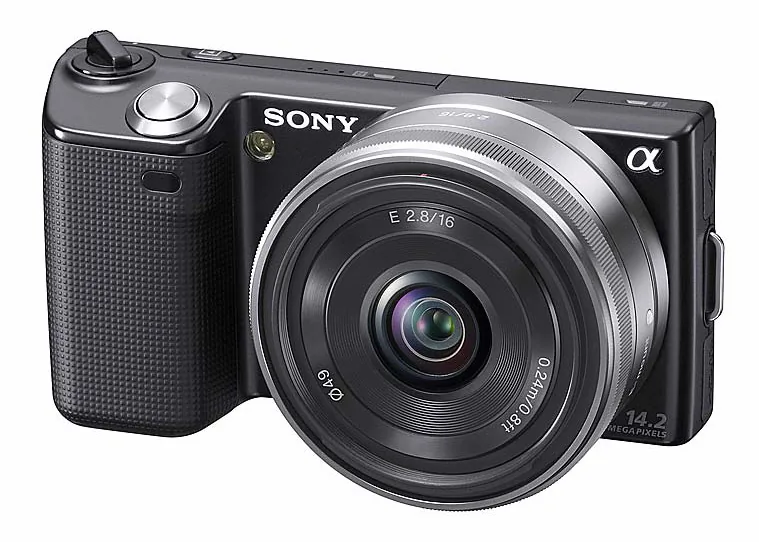
Sony is the first of the big three manufacturers to bring its mirrorless compact cameras to market. The premise is compact-camera convenience with DSLR quality. Sony certainly achieved the compact part: the NEX-5 body is about the same size as a Sony compact with a substantial zoom range.
Add a lens, however, and the camera approaches the size of a bridge camera with a 20x or greater zoom. The NEX cameras instead have a 3x zoom: 18-55 mm.
The announced 18-200 mm is not yet available, but with that lens you would mainly be holding a lens with a small piece of camera attached. It would still be more compact than a DSLR with a comparable lens, but some of the charm of its compact size would be lost.
Flip-Out Screen: Fantastic!
With the 18-55 mm lens attached, the result is a balanced, lightweight, compact combination that handles pleasantly. Despite the slim camera body, Sony managed to include an articulating LCD screen. The large, bright display tilts up and down for shooting from high or low angles.
It's nice that Sony has created a fold-out LCD screen despite the flat camera body
Shooting feels very comfortable with the camera held in front of your chest or waist. It is less tiring than holding it high in front of you, and without a camera covering your face, people are less likely to notice that you are taking photographs.

The only drawback of the low shooting position is that you have to bend your right wrist slightly. Sony once made cameras whose grip moved together with the screen, which was more comfortable.
Appearance
The lens mount on the NEX-5 protrudes slightly above and below the body. It looks a little odd, but emphasizes the compact size of the camera. If the 18-55 mm had the same appearance as the version supplied for Sony DSLRs, the result would look extremely cheap and plasticky—hardly inviting at Sony’s current price.
You could quickly conclude that the 5 holds better than the 3
The NEX lenses, however, look and feel luxurious and durable. Their outer rings are metal and the bayonet mount is stainless steel. The controls feel solid, with no play.
Optics
If you want to carry the NEX in a jacket pocket, the 2.8/16 mm pancake lens is the best choice. Kits containing both the 18-55 and 2.8/16 mm lenses are currently available, with only a modest premium for the latter. It is definitely worthwhile if your budget allows.
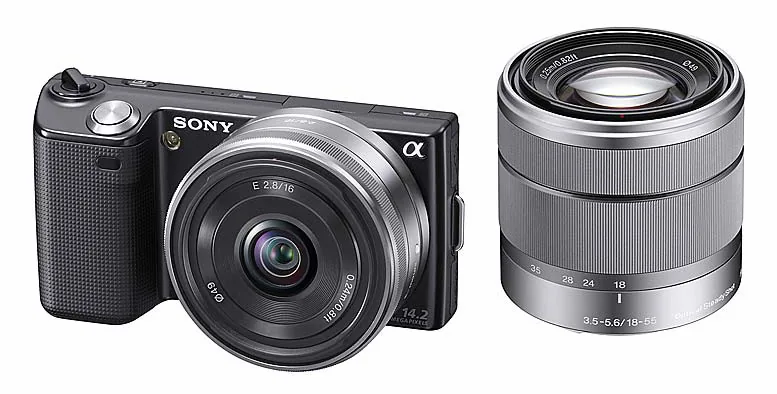
Sony’s choice of 16 mm is debatable. Its full-frame equivalent is a 24 mm ultra-wide-angle lens, with a field of view of about 84 degrees. That is very useful for city scenes and broad landscapes, but requires care when photographing people: at close distances, perspective becomes exaggerated. A 20 mm lens would have been more versatile without needing to be thicker.
The performance is comparable to the excellently rated 14 MP sensor of the Alpha 550
The 18-55 mm standard zoom delivers excellent optical performance and is an important link in the NEX-3 and NEX-5 image-quality chain. It does show considerable distortion at the extremes of its zoom range. Some photographs may need computer correction to make straight lines—such as a horizon high in the frame—truly straight.
3 or 5?
The NEX-3 is slightly longer and taller than the NEX-5. You might quickly conclude that the 5 feels better in the hand than the 3. The latter has a larger but smoother grip, so try both in a store.
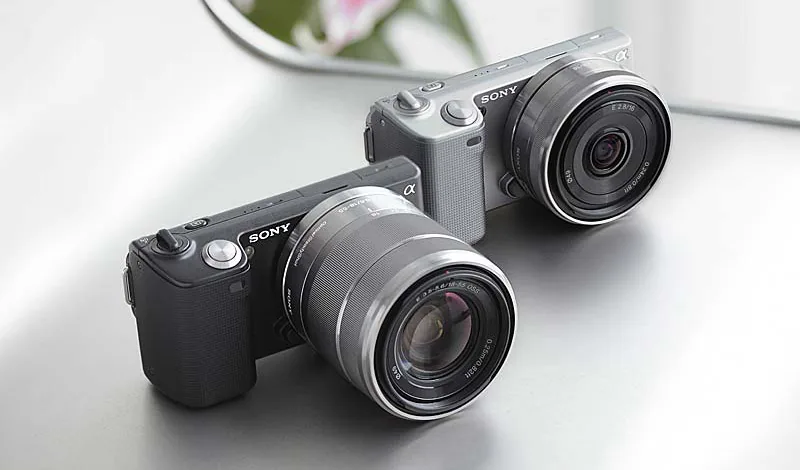
The 5 also has a firmer-feeling magnesium body, while the 3 is plastic but does not feel cheap. The NEX-5 has the stronger video features: Full HD at 1080i AVCHD versus HD on the NEX-3 at 720p MP4. Finally, the NEX-5 is the only model that supports a wireless infrared remote control.
Few buttons, and therefore many menus
14 MP
The heart of the system is, of course, the large APS-C sensor, the same format used by most DSLRs. Its performance is comparable to the highly regarded 14 MP sensor in the Alpha 550.

This provides strong performance across a wide ISO range. The camera reaches an impressive ISO 12,800, although results there are coarse and muddy enough for emergency use only. ISO 6400 is not much better, but ISO 3200 already looks quite good.
That is very usable, making the NEX-5 and NEX-3 effective in low light. It is therefore baffling that iAuto mode does not provide access to the high ISO settings.
It is also frustrating that automatic ISO does not display the ISO value selected by the camera.
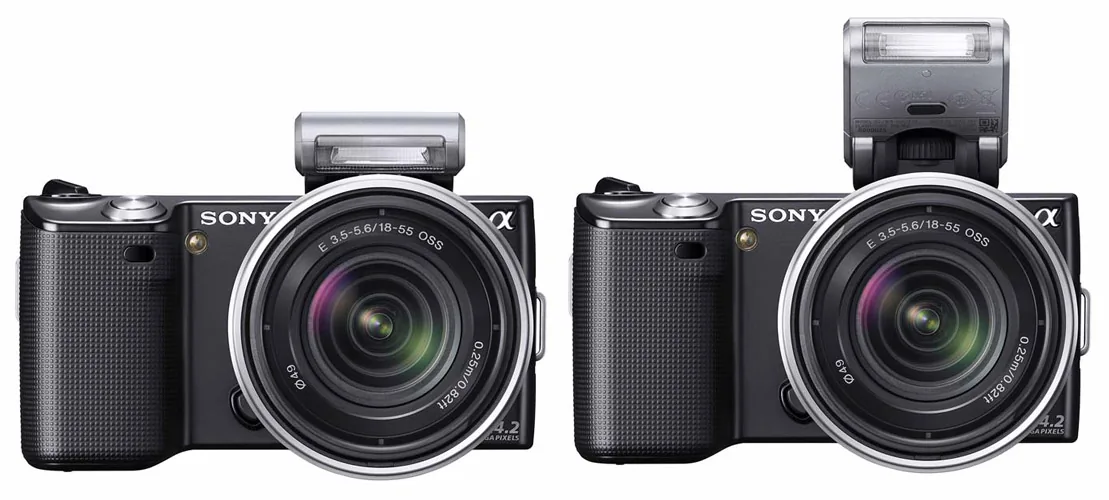
Good low-light performance is particularly useful because the cameras have no built-in flash. A tiny external flash is included and draws power from the camera. It is a little awkward to screw onto the body, but is secure once attached.
The flash is so flat that it can safely remain attached without getting in the way. Flip it up with your left index finger and it is ready; push it back down to deactivate it.
If you suddenly decide to try a little fill flash, it is immediately available. Well done—this works nicely!
Vivid
Once again, Sony’s translation work earns no praise. Some menu terms are so strange that you may need to consult the English version to understand them. For example, live depth-of-field control offers a setting that ranges between blurry and “vivid,” though it simply means sharp to blurry. The English term shown for vivid is “crispy,” so perhaps the English-to-Japanese translation was imperfect as well. That is surprising from such a global brand.
What you see is what you get
Controls
Photographers accustomed to a DSLR will need time to adjust to the NEX cameras. Almost every setting is accessed through menus; there is no quick way to change ISO, for example. Sony tried hard to avoid an intimidating sense of complexity, so the controls resemble those of a compact camera: few buttons and many menus. Motion rendering and background blur—meaning shutter speed and depth of field—are controlled intuitively, without juggling numbers: what you see is what you get.
Fast?
The autofocus is very fast for a contrast-detection system and comparable to Panasonic’s performance, making it slightly faster than the more hesitant Olympus Pen models. A burst rate of 7 frames per second is also impressive, but moving subjects may not remain sharply focused during that burst.
Normal continuous shooting tops out at 2.3 frames per second. Although 7 frames per second looks good in the specifications, manufacturers never state how long the camera takes to become ready for the next shot. A DSLR recovers very quickly and, more importantly, immediately restores the live view after the exposure.

On the NEX cameras (a current Sony APS-C alternative is the Sony a6700) the display briefly goes black and you really have to wait before taking the next photo. Capturing three precisely timed single shots of a child blowing out birthday candles is impossible, while even the simplest entry-level DSLR handles it without difficulty.
Start-up is genuinely slow. After switching on the camera, you may spend several seconds wondering whether the battery is empty before the NEX finally comes to life. The delay feels old-fashioned. Cameras that use live view full-time also consume a great deal of power, so a spare battery is essential for the NEX cameras.
Extras
Sony adds appealing extras to the NEX cameras, such as Auto HDR, which can let the camera determine the required dynamic-range compensation or allow you to adjust it yourself.
At its strongest setting, it can produce exaggerated HDR effects—think of the atmosphere in Carel Willink’s paintings.
Sensor Size
Sony retained the same sensor format used in its DSLRs, which has clear advantages: an APS-C sensor readily delivers high quality. But it creates an odd situation. Removing the mirror mechanism allowed the camera bodies to shrink, but not the lenses.
If you want extensive telephoto reach, the lenses remain large. Without an eye-level viewfinder to brace against your head, shooting is less stable. These NEX cameras are most enjoyable with relatively small lenses—which means relatively little zoom. Take it or leave it.
Successful, but...
With the NEX-3 and NEX-5, Sony essentially distilled the fun factor of the Alpha series into the most compact possible mirrorless camera. Live view, fast autofocus, and an articulating screen are the defining ingredients. These are genuinely enjoyable cameras capable of very high image quality.
Photo experts and photographers who love direct controls should stay away unless they can accept results-oriented shooting with little direct control. Otherwise, they can wait; a NEX-7—or -9, or something else—is bound to follow. In any case, this is Fun with a capital F and Quality with a capital Q.
One final piece of advice for anyone moving up from a compact camera: keep a cool head. If you need the camera to be ready immediately after each shot, want autofocus tracking for action, or prefer powerful zoom lenses, choose a DSLR.