This article covers the Sony A500 (2009 model).
Older camera reviews remain available online as a reference resource for photographers.
The Sony Alpha 500 is Sony's budget model among midrange DSLRs. It differs only slightly from the A550, which raises the question: what do you miss if you buy the Sony A500?
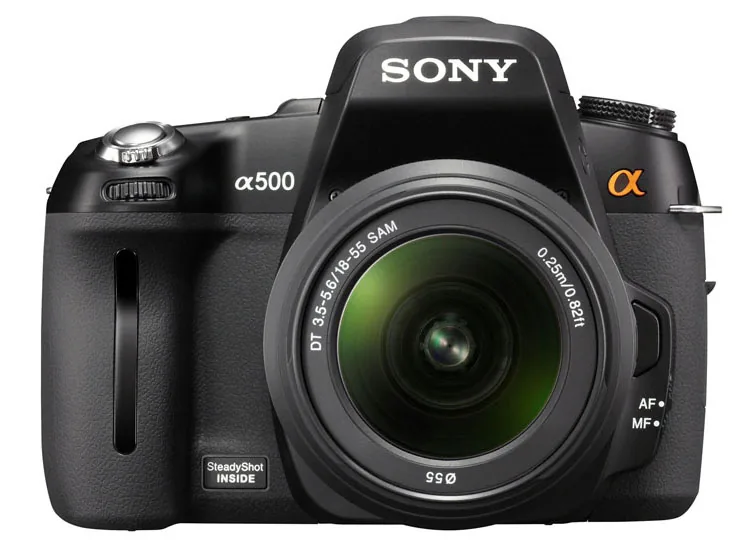
The differences are small and clear. The Sony A500 has a 12-megapixel sensor, 2 million fewer than the A550. It also lacks the High Speed Priority option, which allows a rate of 7 frames per second with focus and exposure locked. Still, the A500 reaches a respectable 5 fps, or 4 fps in live view—exceptional figures in this class.
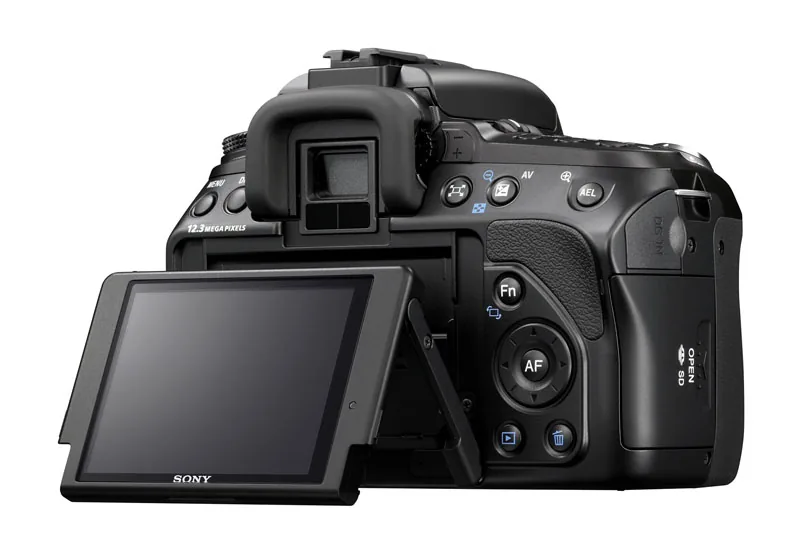
One thing quickly becomes apparent when you place the two cameras side by side: the A550's LCD screen is sharper and brighter. That does not immediately disqualify the A500's screen, however.
Without the A550 beside it, the LCD screen simply looks pleasantly bright. The A550's LCD is the 920,000-pixel screen found in many midrange and high-end cameras.
Sony represents the new way of shooting with a DSLR
Live View with Fast AF
Features shared by Sony's A550 and A500 include live view with fast AF, a tilting screen, built-in image stabilization, automatic dust removal, built-in help functions, and an accessible user interface that even beginners can understand immediately.
Other notable features include wireless TTL-controlled flash, with the built-in flash acting as the controller, automatic HDR, and generous automatic tone-curve adjustment.
Sony represents the new way of shooting with a DSLR: a large, bright live-view screen combined with DSLR-fast focusing. With conventional live-view systems, the camera effectively starts behaving like a slow compact camera again.
Quality
The A550's 14 MP sensor has proved to be a leader in this class; the A500's scores slightly lower. That seems odd because you might think fewer pixels mean larger pixels and therefore less noise. Yet the A500 produces slightly more noise at higher ISO settings.
The difference is small and appears only from ISO 1600 onward. The pattern is regular, and color noise remains reasonably controlled. ISO 12,800, the highest setting, is strictly for emergencies; ISO 6400 has limited uses, while ISO 3200 is quite usable. The camera's JPEGs are attractive and the Exmor processor does a good job, so there is no need to shoot RAW for sharpness, noise, or detail.
Not an abundance of fine-tuning options, but useful, practical features
For matters such as white balance, contrast, color saturation, and so on, it is naturally helpful to retain the best possible correction options through RAW for optimal correction flexibility. Automatic white balance is occasionally off. Often, simply selecting the shade setting yourself when necessary is enough to help the camera.
Thanks to their strong performance at high ISO settings, the A550/A500 are ideal for DSLR photographers seeking a few extra capabilities. The cameras are well suited to indoor photography without flash, as well as sports photography both indoors and outdoors. At the same time, they follow Sony's credo that customers should not face more complexity than necessary. So there is no abundance of fine-tuning options, but there are useful, practical features. Sony's contribution to the DSLR market is genuinely valuable.
That leaves you with a nice amount of money to buy some extras right away
Final Verdict: Sony DSLR-A500
Comparing the performance of the A500 and A550 shows that the A550 gives you more pixels, somewhat greater detail, and less noise. That makes the A550 more suitable for especially large prints. It also makes the digital teleconverter on these cameras (1.4x or 2x, selectable) somewhat more useful on the A550. It is a convenient feature, incidentally, although it does exactly the same thing as cropping later on your computer.
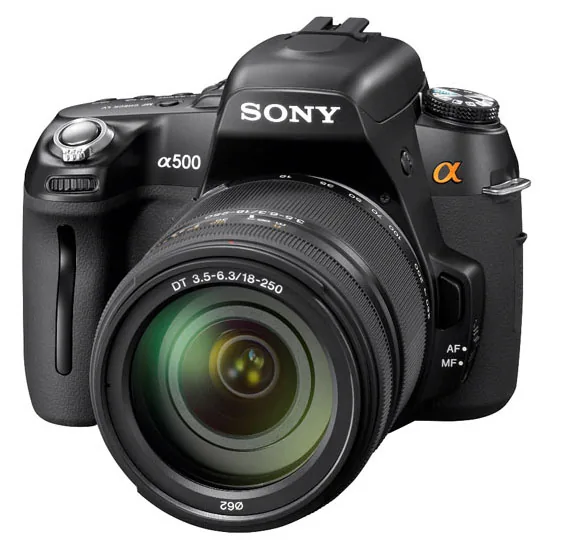
Many buyers face a dilemma: you can start with one lens, such as the 18-250 mm shown here, with a large zoom range so you never need to change lenses, but then a relatively heavy lens is always attached to the camera. Or you can choose the lightweight, compact 18-55 mm and 55-200 mm lenses. The camera then remains lighter to carry, but you occasionally have to change lenses.
At around 150 euros less, the Sony DSLR-A500 still holds its own. That leaves you with a nice amount of money to buy some extras right away—an external flash, for example, or the compact 1.8/50 mm lens, which is ideal for atmospheric portraits.