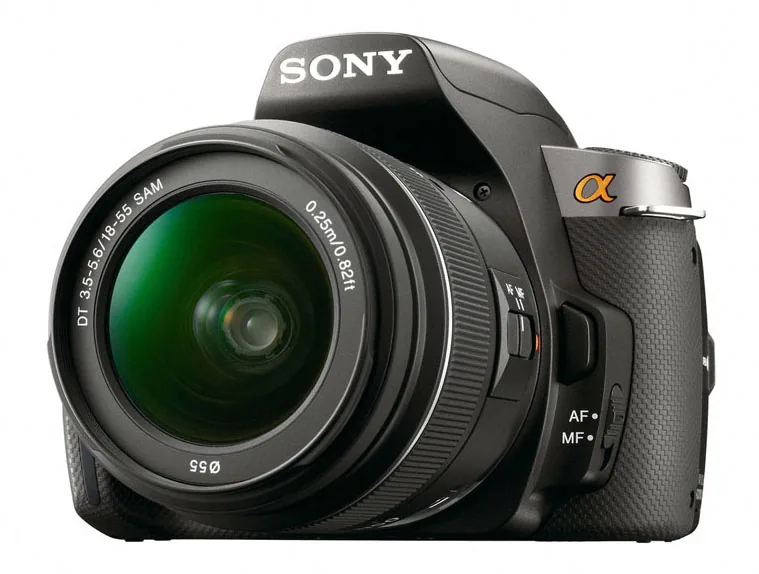
Sony has refreshed its entire entry-level DSLR lineup at once. We assess the results by looking at the Sony Alpha 330, the middle of the three new DSLRs. What is new, what is better, and what is worse?
In moving from the A200, A300, and A350 to the Sony Alpha 230, Sony Alpha 330, and Sony Alpha 380, Sony uses the same clear lineup. The A230 and A330 have 10 million pixels; the A380 has 14 million.
The A330 and A380 offer live view, a tilting LCD screen, and a digital teleconverter function (1.4x and 2x). The rest of the technology is identical, which makes choosing easy.
First time SLR user
That same emphasis on simplicity is evident in the cameras themselves. Sony says these cameras were designed above all for the ‘first-time SLR user.’ That means anything that seemed to make photography needlessly difficult was cut. Sony was already firmly committed to that approach, but it could be taken even further.
For example, you can no longer shift the program in P mode to select a different shutter-speed/aperture combination. The previous models allowed this, as do all other DSLRs on the market. For a DSLR beginner, removing it makes sense. If you want to control shutter speed or aperture, S or A mode is available; program shift only makes things more complicated.
Sony has likewise chosen to make most menu options and other functions unavailable in the scene modes. The ISO setting, for example, cannot be changed there. It is controlled automatically, with the selection partly based on the chosen scene. That does indeed keep things simple.
The unique selling point of these cameras is, of course, the fast autofocus available when using live view
Otherwise, everything you would expect is included, such as image styles for various types of subjects. You can also adjust them to taste for color saturation, sharpening, and contrast. Full white-balance options are available, including a custom white-balance setting and adjustment in Kelvin.
No Flash Button
This is one area where Sony’s cuts went too far. There is no longer a flash button that pops up the flash. Instead, you must use one of the four-way controller buttons marked with the flash icon, then choose the desired function from the flash menu, such as ‘Fill-flash’ or ‘Autoflash.’ A simple button that raises the flash is genuinely better, less cumbersome, and clearer.
Live View with Fast AF

The unique selling point of these cameras is, of course, the fast autofocus available when using live view. The standard AF system continues to operate because Sony’s live view uses an additional sensor inserted into the viewfinder system. Excellent! Once you have used this live-view method, you will not want anything else.
You can now even capture action using the LCD screen. The live-view screen tilts up and down, allowing you to shoot from the most unusual angles. This can genuinely spark your creativity. The optical viewfinder remains small, however, and eyeglass wearers may have trouble seeing the entire frame.
Resolution
The three models retain the same resolutions. This A330 proves that a 10 MP CCD can deliver excellent image quality. Detail and noise levels are better than on the A200 and A300. Images look noise-free through ISO 400, nearly clean at ISO 800, still surprisingly usable at ISO 1600, and not too bad even at 3200.
It is rather odd that Sony kept Auto ISO fixed at a range of 100-400. Including 800 would have been reasonable. It is a real shame that users have no control over this. Overall image quality is attractive, with well-rendered tonal gradations and advanced, switchable dynamic-range optimization adding a subtle finishing touch.
The new cameras do look much more attractive. They feature a beautiful two-tone finish with carbon-look details.
Interface
A very important improvement is how the camera communicates with the user. It explains many functions and also displays sample photographs for settings. It can show two graphs as well, one for shutter speed and one for aperture, illustrating how the settings affect motion rendering and depth of field. This is very well done.

Poor Localization
One thing Sony gets genuinely wrong is localization: the translation of menu terms, help text, and the instruction manual. Sony appears to have lost control of the process. The manual contains absurd translations—for example, an instruction meaning ‘set the depth of field’ where it should say ‘focus.’ Some of the in-camera help text is also incomprehensible, and it even contains spelling errors. In this area, Sony is by far the worst of all camera brands.
Looks
The exterior changes are substantial. The bodies are smaller, so they fill your right hand less completely. They are still manageable, certainly, but the substantial grip of the previous generation was better. The new cameras do look much more attractive, with a beautiful two-tone finish and carbon-look details. First-time users will undoubtedly find this appealing.
The LCD screen is less versatile in its range of movement than those on other cameras. It also cannot be folded inward for protection, although the mechanism itself is very sturdy.
The CompactFlash slot has disappeared, with Sony rightly choosing SD cards for storage. There is also a slot for Sony Memory Sticks to reward brand loyalty. This is clever when you consider that cards and sticks are increasingly used for video storage: someone with a Sony camcorder that uses a Memory Stick may be more likely to choose one of the new Alpha DSLRs, or vice versa.
This 330 is the most appealing of the three. The 10 MP sensor delivers attractive quality; you do not need more
It is also very smart that the new, more compact battery has already been used in Sony’s video range. Given that one of these easily costs around seventy euros, that is a significant advantage.
Optics
The camera will often be sold as a twin-zoom kit with the new 3.5-5.6/18-55 mm and 4-5.6/55-200 mm lenses. Their design matches the camera beautifully, although the ridged covering on the zoom ring quickly fills with dust and grit. The lenses have their own focus motors, making operation smoother and faster than with lenses driven by the camera body.
A 55-200 mm lens can now be made very compact, as Sony also demonstrates. The new lenses have their own focus motors, but the drive shaft for lenses without built-in motors remains visible at the lower right of the lens mount.
Fortunately, the new cameras still have an AF motor. Alongside the camera, Sony introduced a 1.8/50 mm lens for about 150 euros and a very slim 2.8/30 mm macro. The latter is a useful general-purpose lens when you want to carry the camera as compactly as possible, and it is inexpensive too, at just over 200 euros.
An SLR for Everyone
Anyone intimidated by the maze of DSLR functions and options will be well served by the new Sony models. They are thoroughly approachable cameras. It is a shame Sony did not include a set of creative filters, since beginners particularly enjoy those.
This 330 is the most appealing of the three. The 10 MP sensor delivers attractive quality—you do not need more—and live view with fast AF adds substantial value over the A230.