Many DSLR buyers barely consider Pentax. That is undeserved: these are interesting cameras. Will the K-x finally bring the brand the success it deserves?
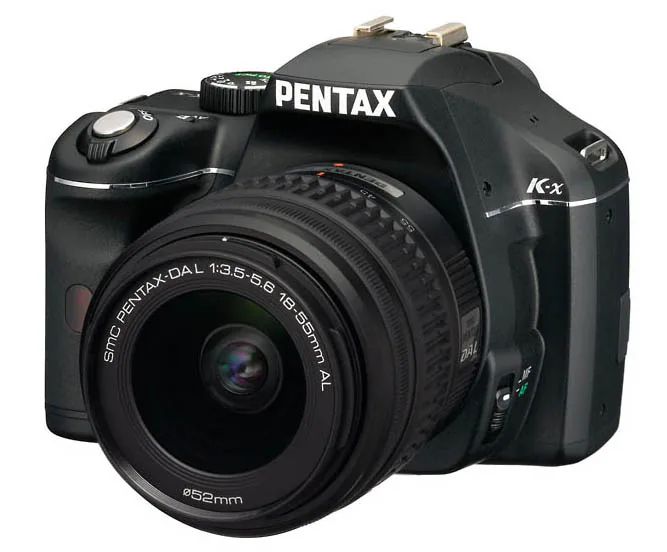
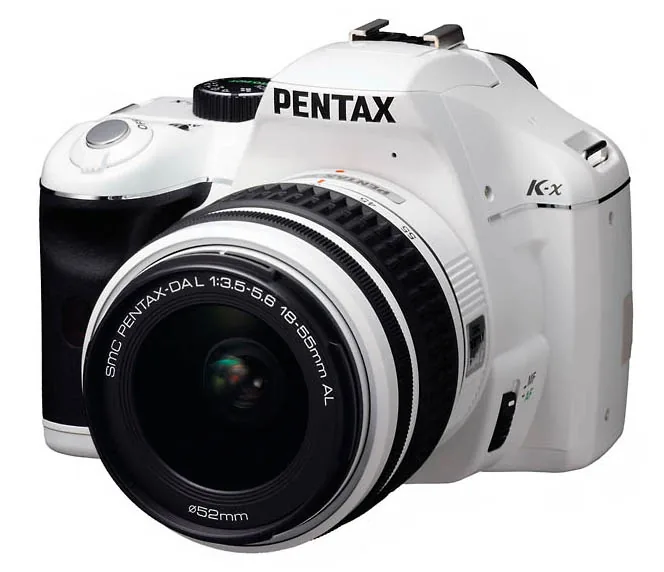
The Pentax K-x is one of the smallest DSLRs on the market. It is also one of the most complete in its class—probably the most complete. It may be small, but its grip is large enough to make this compact DSLR comfortable even for big hands.
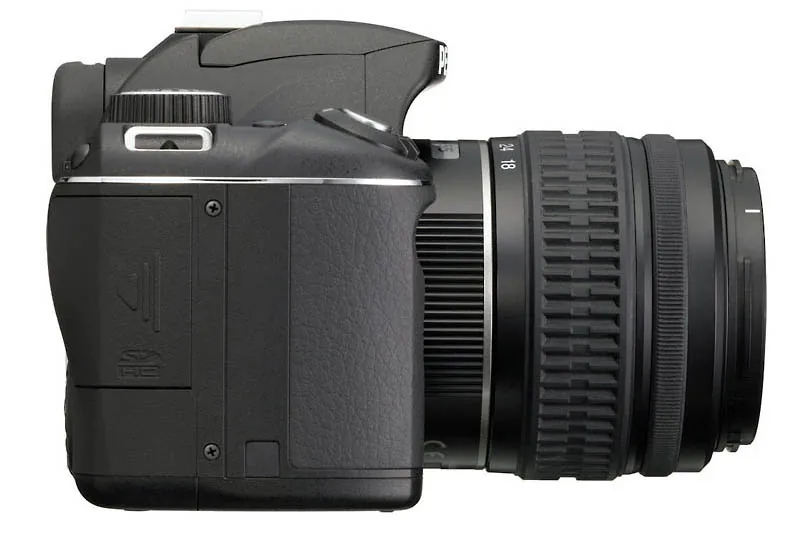
The size of the grip comes from the camera's power source: four AA batteries. With Energizer's expensive, non-rechargeable lithium AAs, Pentax claims you can take 1900 photos before they run out.
The real-world figure will be lower because of image playback and flash use, but you can travel without a battery charger. Rechargeable NiMH batteries still deliver a respectable 640 shots. Alkaline batteries, perhaps useful as an emergency set, provide up to 200.
AA batteries as a power source for a DSLR: only Pentax does it. And there is something to be said for the idea.
Excellent Preview
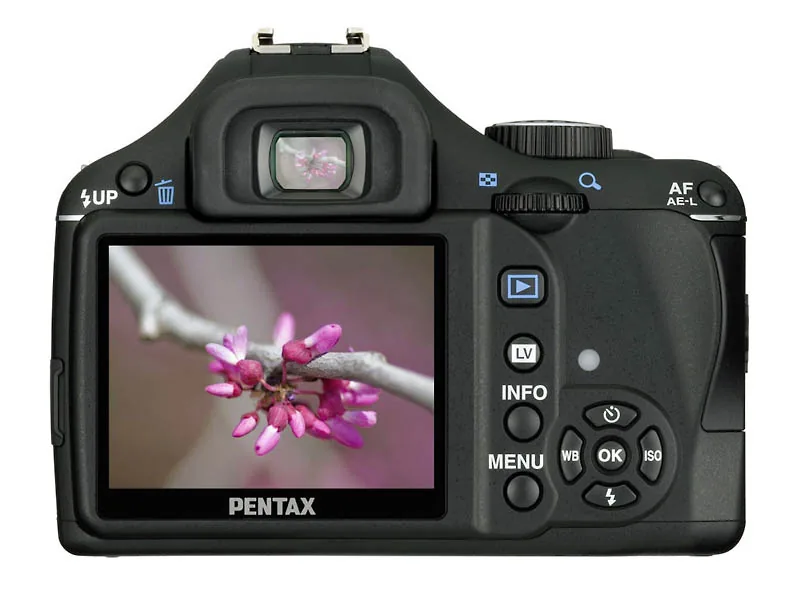
The Pentax K-x stands out in other ways too. Consider its preview function: you can test many settings using a preview image. This lets you immediately see what the white-balance settings will do to your intended photo, for example, as well as the effects of color saturation or contrast.
Every white-balance setting can also be fine-tuned completely. Once the settings are right, you can save the corrected or uncorrected preview immediately as the final image.
If you choose black and white, you gain access to the full range of contrast filters (such as the red filter for extra dramatic cloudscapes) and can once again see exactly how the result will look. The preview function is very useful to beginners and demanding experienced photographers alike. It gives you maximum control, and you learn from it.
Built-In RAW
The preview function is also ideal for the K-x's many special effects. Most can be adjusted for strength and execution, so you can see what you will get.
If you prefer to perfect your photos later, you can shoot in RAW. The K-x can process them in-camera and convert them to JPEGs. You can create as many versions as you like and apply all the available variations, including the effect filters. Processing RAW files on a computer does offer quality advantages.
A tremendous amount of thought went into this little camera
There is still some room for improvement in sharpness and detail, although the K-x already produces very good results in both respects. Making corrections on a good monitor is naturally more comfortable as well.
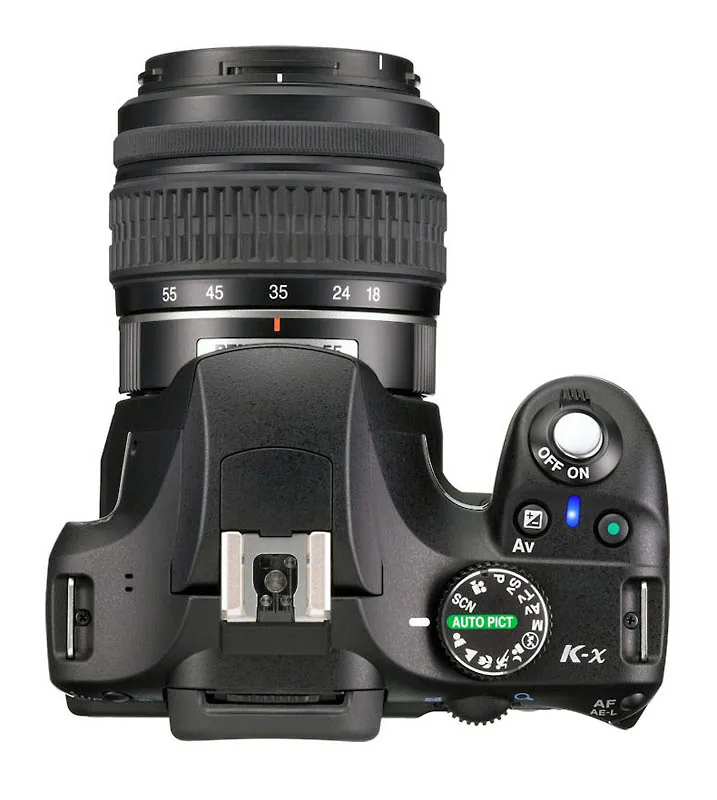
There is no longer a dedicated button for switching the camera to RAW capture. You now select RAW through the menu or a convenient overview screen, or you can program the large green button on top of the camera for RAW. The button can be assigned various functions, including visual depth-of-field preview or image preview.
The Auto HDR function, in which the camera rapidly takes three photos after one press of the shutter
A Compliment
The Auto Picture mode is useful for beginners or lazy photographers: based on the settings and shooting conditions, the camera selects the most suitable subject program. It also shows you what it selected, both on the LCD and in the viewfinder. In addition to the usual subject modes, there is a menu of scene modes for situations such as beach/snow, stage photography, and museums. The camera goes quite far in making these choices, and that is a good thing.
Communication between camera and user is exceptionally complete. The viewfinder provides extensive information, including the ISO value when Auto ISO is active, and the rear LCD is excellent for quickly accessing specific settings.
The ISO controls deserve high praise. Press the ISO button on the back of the camera and the ISO screen appears, where you can make every ISO adjustment: setting the ISO value yourself, enabling Auto ISO, and defining the Auto ISO limit.
Sounds logical? It is, but other brands and cameras always make you visit several menus or screens to do this.
As you keep shooting, you increasingly realize how much thought went into this little camera. The Pentax project manager responsible for developing the K-x simply must be an enthusiastic amateur photographer—there is no other explanation!
Fortunately, this Pentax again includes sensitivity-priority mode, essentially a Program mode in which you can vary the ISO value directly with the control dial.
Fast
At 4.7 frames per second, the K-x is fast. That is useful not only for rapid bursts but also for exposure-bracketing sequences. It also benefits the Auto HDR function, in which the camera rapidly takes three photos after one press of the shutter—one underexposed, one normally exposed, and one overexposed—and then automatically combines them into a single image with an enormous brightness range.
The K-x performs at the level of the Nikon D5000
Using a tripod is recommended, however, or the three images may not align properly. The camera does not automatically compensate for shifts. In addition to Auto HDR, you can choose several settings that improve dynamic range in a single image by preserving detail in highlights, shadows, or both, at various strengths.
Automatic distortion correction is available, as is chromatic-aberration correction. These corrections do delay the image's appearance on the screen slightly. Still, the functions are there and can be enabled or disabled as desired. They underscore just how versatile the Pentax K-x is.
AF
There is some sluggishness too. Focusing in live view takes a long time. When using live view, it is better to leave the regular AF system active. The display briefly blacks out, but you have more confidence that your photos will be sharp.
The K-x focuses using up to 11 AF points; 5 or 1 can be selected as well. Frames in the viewfinder indicate the area in which focus is acquired, but the individual sensor points do not light up. Compared with the competition, that is certainly a drawback. It matters most when all 11 points are active and you let the camera make the selection.
If you use only the center sensor—usually the most reliable approach—it makes little difference. An AF confirmation indicator is shown below the viewfinder. The viewfinder image itself is quite good and reasonably large for this class.
With the standard zoom, whose maximum aperture is 3.5-5.6, the focusing screen is fairly dark and its matte texture is clearly visible. The advantage is that it provides good visual focus checking; brighter focusing screens are decidedly less effective in that respect.
Pentax builds image stabilization into the body. That is an advantage, because even if you mount an old lens from around 1980, you still have stabilization. Its range is not spectacular, with a maximum benefit of 1.5 to 2 stops.
Sensor
The K-x is one of the first DSLRs to use Sony's back-illuminated CMOS sensor (12.4 MP), which can use as much of its surface as possible to gather light. It is therefore effectively more sensitive than conventional CMOS sensors, and that is very noticeable: the K-x is an outstanding high-ISO performer. ISO 1600 is entirely usable, even ISO 6400 still produces very serviceable images, and we have seen worse results at ISO 12800.
Available in 100 color combinations: Chocolate, Olive, Purple, Light Orange, Red, and many more.
The K-x performs at the level of the Nikon D5000, with slightly better detail but somewhat coarser-looking noise when noise reduction is set to Normal. Noise reduction has three strength levels and can also be turned off.
It is great that you can choose the ISO value at which noise reduction begins operating. Excellent! Another compliment: you do not have to dig deep into the menus for the noise settings; you can activate them directly from the clear main settings screen.
Success
The K-x is exceptionally complete without being complicated, and its controls are highly logical. The only thing you may need to get used to is the somewhat noisy focusing motor. It is not a problem for small adjustments, but when focus has to travel a long distance, the camera makes its presence heard. Lenses with built-in quiet focusing motors are available, though they belong to a more expensive class.
The K-x can shoot video too, with 720p output and the option to choose the aperture yourself. It even offers autofocus, which works surprisingly well. You will hear focusing noises, however: there is only a built-in mono microphone and no external microphone jack. If you want more, you need the K7. Overall, though, this is a lot of camera for the money: plenty of quality, plenty of options, and above all, a lot of fun to shoot with.