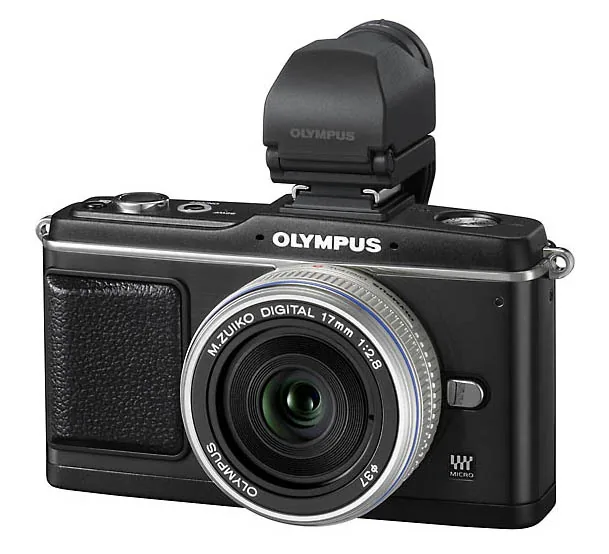
The main criticism of the Olympus Pen E-P1—the lack of a viewfinder—has been addressed immediately with the arrival of the E-P2. The camera also received a few more extras. So, on balance, has much changed?
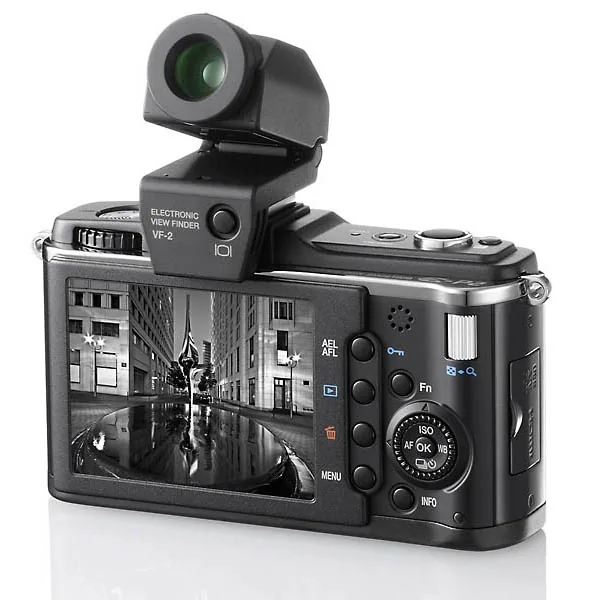
The VF-2 viewfinder instantly makes the Olympus Four Thirds concept much more complete and appealing. It does not compromise the requirement for compactness, because it is removable. You can decide each time whether you need it.
Why is that viewfinder so important? Well, the 3-inch LCD screen on the E-P1/2 is good, but it is hardly exceptionally bright. On a beautiful sunny day, you can barely see what your photo will look like.
Of course, many compact-camera users are accustomed to that, but it does not make it acceptable. As a photographer, you want to aim accurately and compose your image properly.
The E-P2's slide-on LCD viewfinder is therefore very welcome—provided it is good, of course.
Viewfinder Image
Put the E-P2 with its viewfinder to your eye and you are in for a surprise. Sharp, bright and large: what an excellent viewfinder image. This is far better than what you find on hybrid cameras—much better.
This is far better than what you find on hybrid cameras—much better
Beautiful: no banding or visible pixels. The image is larger, more detailed and brighter than that of the smaller Olympus DSLRs (E-450, E-520, E-620).
The small viewfinder towers above the body.
In low light, the image also retains normal brightness and is therefore many times brighter than an SLR or optical viewfinder. Noise is the trade-off, but overall you unquestionably retain better control of the image.
Another practical advantage of this viewfinder is its high position. It rises well above the camera, leaving your other eye with an unobstructed view of your surroundings. That also keeps you aware of what is happening outside the frame.
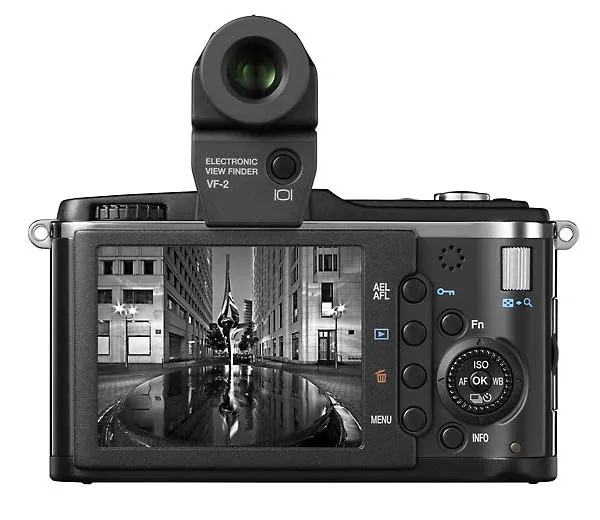
The entire viewfinder image is easy to see, even when wearing glasses. It shows hardly any lag. In this form, it poses serious competition to the optical SLR viewfinder, something I also observed with the Panasonic G1.
Immediately after taking a shot, you also see the captured photo in the viewfinder—something an SLR viewfinder cannot do at all. And when you photograph in black and white, the viewfinder image is also black and white.
But there is one area where a camera with an SLR viewfinder still always wins: speed. After taking a shot, the camera is immediately ready for the next one. With the Pen, it takes a moment for the live image to return before you can continue.
Not Fast
The slow refresh after taking a shot is actually a lead-in to the next drawback of this camera. Focusing has not improved compared with the E-P1.
That means autofocus always spends some time searching: the image briefly ‘breathes,’ and then focus is acquired. This makes technical sense, because the system searches for maximum contrast in the image coming from the sensor.
With an SLR camera, which uses a dedicated focus sensor during normal operation, the autofocus system usually knows immediately which direction to focus and how far it needs to move. That provides confidence. With live-view AF, which is what we are dealing with here, focusing is more like a sophisticated form of trial and error.
SLR quality in a compact camera—that is the basic idea
New compared with the E-P1 is tracking AF: focus can follow a subject across the frame and remain locked on it. It works well, as does face detection, which makes the camera focus on a face automatically.
Tilting Up
Back to the viewfinder for a moment. It tilts upward by 90 degrees, allowing you to choose the viewing angle you find most comfortable. No SLR viewfinder can offer that. You can often add an angle finder as an accessory, of course, but that seems clumsy compared with what you get here.
There is also cause for criticism. The viewfinder slides into the hot shoe and the accessory port beneath it, but it cannot be locked in place. It does not slide off very easily, but loss cannot be ruled out. It is strange that Olympus did not add a locking mechanism.
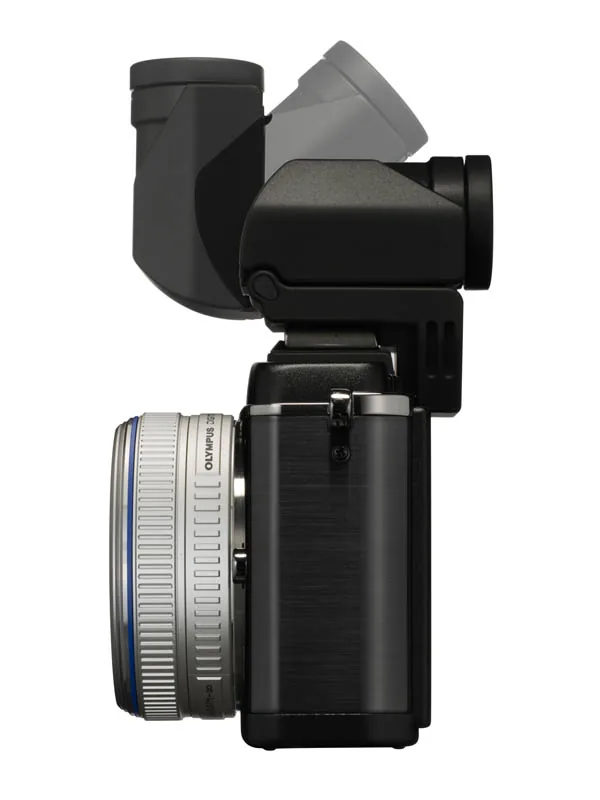
With the viewfinder tilted upward, the Pen E-P2 is very well suited to tripod work, such as product photography. You can program the camera to magnify the center of the image during manual focusing, allowing extremely precise focus. It works very well.
Unconventional Concept
The concept is unconventional through and through. SLR quality in a compact camera—that is the basic idea. Many people seeing the E-P1 and E-P2 for the first time find them larger than expected. Compact cameras are smaller, and SLR cameras are larger, although placing an Olympus E-450 alongside can be instructive.
Small, convenient, discreet, always with you, without flash
Forgoing a built-in flash is certainly unconventional too. If you want flash, you need to attach a separate unit; realistically, only the small FL-14 qualifies, and it provides little light. The next model up is the FL-36, and although it is relatively compact—it takes only two AA batteries—the combination becomes very top-heavy. But with the Pen concept, you really should not be thinking too much about flash in the first place.
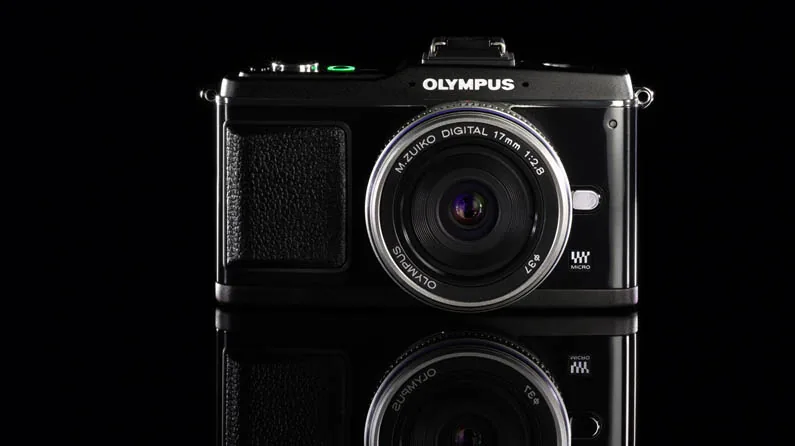
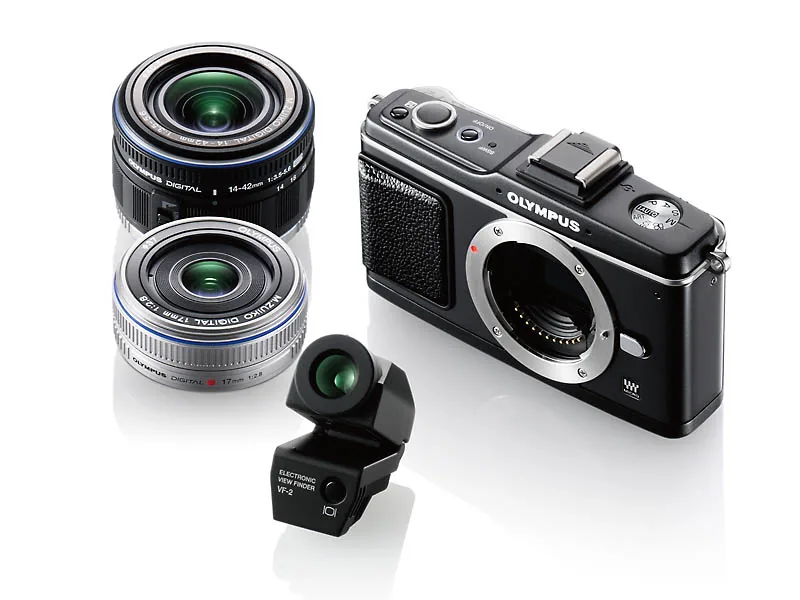
Small, convenient cameras like these should be used like a Leica rangefinder: small, easy to handle, discreet, always with you, and without flash. And in that case, you should not want to fit a 3.5–5.6/14–42 mm zoom either.
If you want to work without flash, you need a fast lens. The Olympus 2.8/17 mm is an appealing choice that also keeps the camera pleasantly slim. Or choose Panasonic's Leica 1.7/20 mm. It is slightly thicker, but a full stop and a half faster—and better too.
That makes the E-P1 and E-P2 meaningful low-light cameras
Olympus's 17 mm does not always receive favorable reviews, but browsing online galleries shows that it can produce very respectable photos. This again emphasizes that we should spend less time testing and more time taking pictures.
Do not forget that this lens is also highly practical. It keeps the camera extremely slim, so you always take it with you. Panasonic's 20 mm is an optical gem that also encourages you to use wide apertures and play with sharpness and blur.
To conclude this case for fast lenses, consider Olympus's ultimate advantage: in-body image stabilization. That makes the E-P1 and E-P2 meaningful low-light cameras.
Adapters
We have been discussing two prime lenses with moderate to high maximum apertures. But much more is possible, because adapters are available for all kinds of lens mounts—even for an old brand such as Exakta, for example.
So if you have a Canon FD 1.4/50 mm that has been lying around for 30 years, you can give it a pleasant retirement. Leica rangefinder lenses can find a home this way too, without requiring you to commit to an M9.
Especially at focal lengths of 50 mm and above, the E-P2's electronic viewfinder is invaluable, because you naturally have to focus manually. The built-in image stabilization is a welcome bonus then as well.
It turns your Pen into a music, meeting or interview recorder...
Sensor and Image Quality
For more information about image quality, see the Pen E-P1 test. Because of the somewhat smaller sensor, Micro Four Thirds noise levels are slightly higher than those of the better APS-C systems. But with a concept as distinctive as the Pen, usability and photographic enjoyment deserve substantial weight in the comparison.

The E-P2 adds more extensive movie functions, including more exposure options. The accessory port—used for the electronic viewfinder, among other things—also accepts an external stereo microphone. It is useful not only when recording movies; it turns your Pen into a music, meeting or interview recorder.
There are two new creative filters and the iAuto mode, which activates an automatic image-enhancement feature that optimizes—or, more accurately, boosts—elements such as color saturation and contrast.
Given this camera's already colorful rendering (see the E-P1 review), this is not a feature to covet. Fortunately, there are plenty of options for tailoring everything to your preferences, including color saturation, contrast and sharpening.
Conclusion
Working with the accessory electronic viewfinder is a pleasure. It unquestionably makes the Pen concept more complete and the camera much more enjoyable to use. It is curious, of course, that using this accessory viewfinder makes it impossible to mount a flash on the camera. Will we ever see the first accessory viewfinder with a built-in flash? And with a microphone jack too, naturally.
Despite the added viewfinder, the Pen E-P2 is not a full-fledged equivalent to an SLR camera. That is due to the slow image refresh and hesitant focusing. Even so, it is an excellent camera for travel and leisurely walks, capable of delivering images of very high quality. With that little viewfinder, it can be used anywhere, at any time, as a creative tool.
Incidentally, this E-P2 is available only in black, and in that finish—like the original black analog Pen—it is highly tempting!