Sports photographer Adam Pretty had already become a mainstay at Getty Images at a young age. In 2008, he spoke to Fotografie.nl about four Olympic images from Sydney and Athens—photos in which timing, risk, chance, and trust come together.
The series originally appeared in four parts around the Beijing Olympic Games. The four stories are collected below in a single article.
Ronnie Weller and the Value of a Sports Photograph
In the first image, Pretty looks back at German weightlifter Ronnie Weller during the 2000 Sydney Olympic Games.
"The reason I wanted to take this photo goes back to the 1996 Atlanta Olympic Games. I was at home watching TV when I saw German weightlifter Ronnie Weller win a silver medal. He went absolutely wild and fell backward onto his back in celebration.
When it became clear that I would be traveling to the Sydney Games as a photographer, I immediately checked whether Ronnie would be competing again—and sure enough, he was. So I asked for permission to photograph the weightlifting.

The competition took place in a kind of concert hall with an opening in the roof. I asked the organizers if I could place my remote-controlled camera there, and they agreed.
By then, Ronnie was locked in a fantastic battle with an Iranian for the gold medal. Then, on his very last attempt, Ronnie breaks the world record! Amazing. And I’m shouting, ‘Look up, look up!’ Which Ronnie does. I was briefly afraid I’d ‘chopped off’ Ronnie’s head, by the way, because he stepped back slightly.
The value of a sports photograph depends on the event
So then you think the contest has been decided—it’s all over. But the Iranian comes out for his final attempt and casually breaks the world record in turn. What’s more, the guy acts as if it’s perfectly normal for the record to be broken twice in a matter of minutes. He shows no emotion at all and simply walks off the platform.
‘Oh man, there goes my photo—why did he have to do that?’ I almost took it personally. After all, the public wants photos of winners, and that is one of the dangers of sports photography.
The value of a sports photograph depends on the event, on everything that led up to it, and less on the beauty of the photo itself. Thanks to the courage of the photo editor—who chose the photograph—this image was published after all. Rightly so, because the photo still holds up."
Pieter van den Hoogenband, Ian Thorpe, and Motion in Black and White
The second story centers on the freestyle final in Athens featuring Pieter van den Hoogenband and Ian Thorpe.
"The final was a showdown between Pieter van den Hoogenband—the only swimmer not wearing a full-body racing suit—and his rival Ian Thorpe, in the white swim cap below him. Thorpe does indeed appear to get off to a slow start. Yet he manages to win; Van den Hoogenband ultimately finishes second.
I took a major risk with this photo by using a slow shutter speed. It creates a beautiful sense of motion, but there is also a high risk of blur. I had already attended about twenty other swimming events and tried the same technique, but only a small percentage of those shots had turned out well.
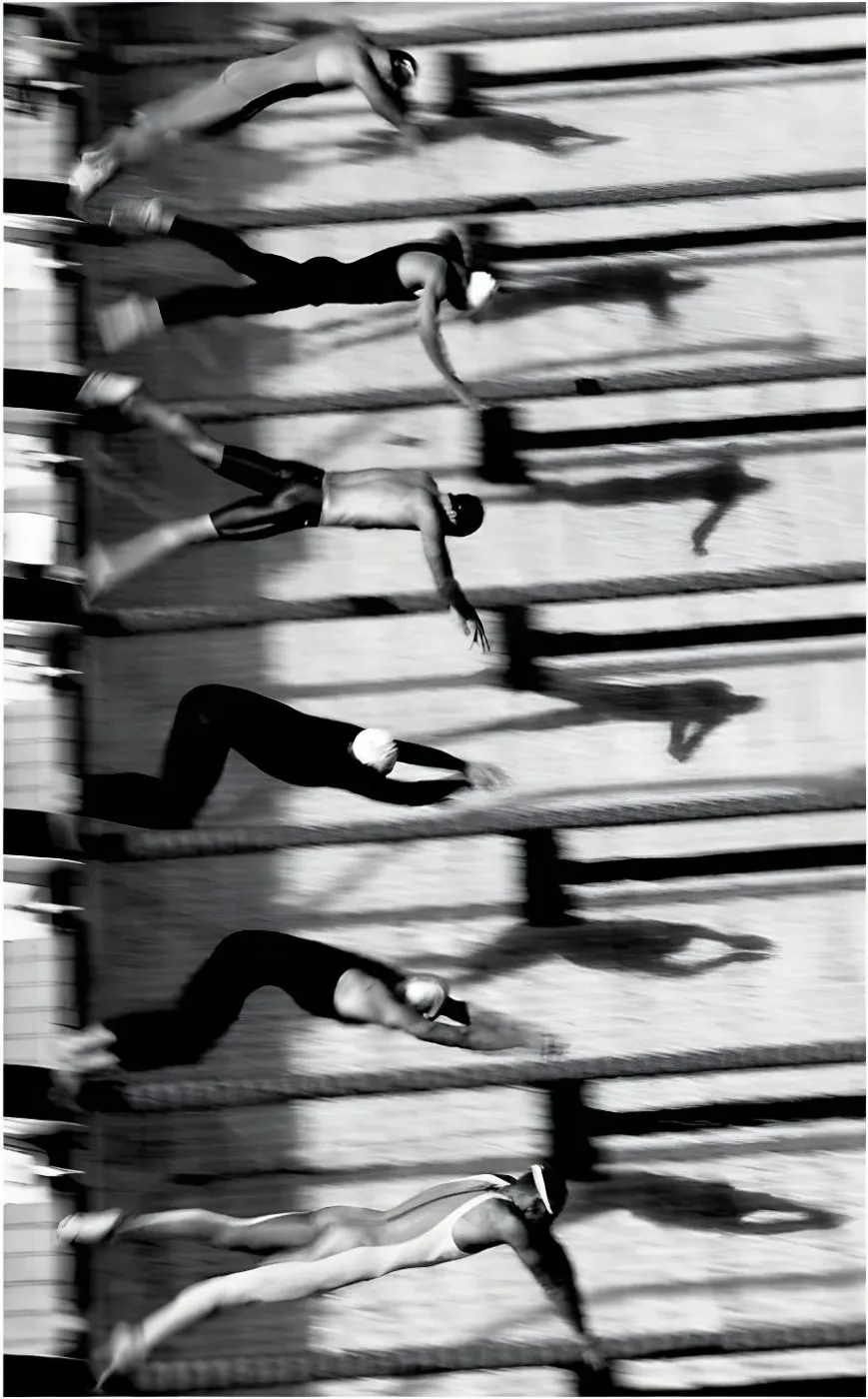
So I was very nervous before this fairly important sporting moment—I obviously couldn’t come back empty-handed, although I knew that several colleagues would also be taking photos.
And because it is black and white, you also pay more attention to the graphic forms
The decision to use black and white was made because the colors were too distracting—all those swimsuits and swim caps, the pool, blue water, lane lines… It would have been far too busy visually, and I wanted to emphasize only the shadows of the starting blocks and bodies. And because it is black and white, you also pay more attention to the graphic forms.
To avoid visual clutter in the photo, I also decided to leave two swimmers—one above and one below—and therefore the edges of the pool, outside the frame.
I won a World Press Photo award with this image in 2005, which came as a surprise to me. I had submitted ten photos to the competition, including some into which I had put much more energy—and as a photographer, you quickly assume those photos must be better. Apparently not."
Rulon Gardner and the Moment After the Match
In the third installment, Pretty talks about wrestler Rulon Gardner, who ended his Olympic career in Athens.
"This is Rulon Gardner, an American heavyweight wrestler. What makes the photo powerful is that it raises questions. Is he happy or disappointed? And what are those strange shoes doing there? You don’t immediately know what is going on.
The story behind it is that at the previous Games, in Sydney in 2000, Gardner won gold by defeating Russian three-time defending Olympic champion Aleksandr Karelin. It was a remarkable achievement, one that Americans in particular were immensely proud of. At the Athens Games four years later, Gardner failed to reach the final and had to settle for bronze.
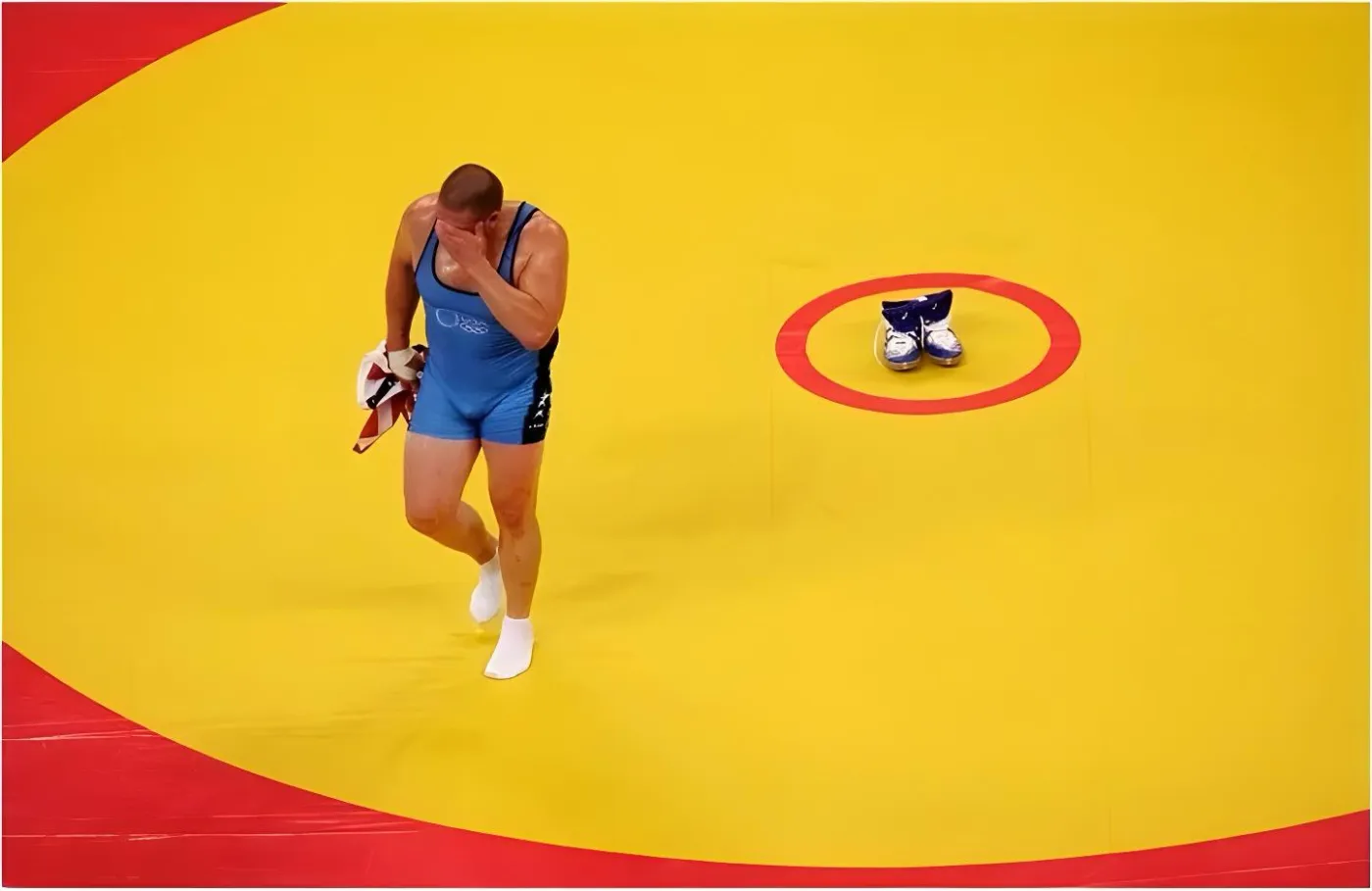
Originally, I wasn’t going to cover this match at all, but another photographer had dropped out. It was also one of the final days, so after working 20-hour days I was starting to feel exhausted. And no, I didn’t fully understand the situation at that moment. But I saw Gardner take off his shoes after winning a match, become emotional, and slowly slip away from the mat, so I took the photo.
If an ordinary person got caught between them, they’d be dead
The next day, the American delegation was ecstatic about a particular photo of mine, while I had no idea which photo they meant—but it turned out to be this one. Gardner was a major American sports hero, and this had been his final match, his farewell.
I really love wrestling photos. It’s a sport in which you experience defeat physically as well; your opponent has actually hurt you. I also love the positions the men sometimes maneuver each other into, like a ballet.
And then there’s the violence of a wrestling match, especially between heavyweights weighing 120 kilograms. If an ordinary person got caught between them, they’d be dead.”
The New Zealand Track Cycling Team in the Morning Light
The fourth image shows the New Zealand team during the team pursuit at the Olympic Velodrome in Athens.
"This photo, of the New Zealand team during the team pursuit at the Olympic Velodrome in Athens, also makes you curious. You have to look three times… It’s early in the morning, around 10:00, I think, and the light is ‘bad,’ just beginning to spill over the edge of the roof. Yes, a race really is in progress; at the top, you can also see the shadows of four spectators.
It wasn’t until I was in this position that I realized just how unique the image was. Fortunately, the light lasted only a moment; it moved across the track very quickly and was gone after about three minutes.
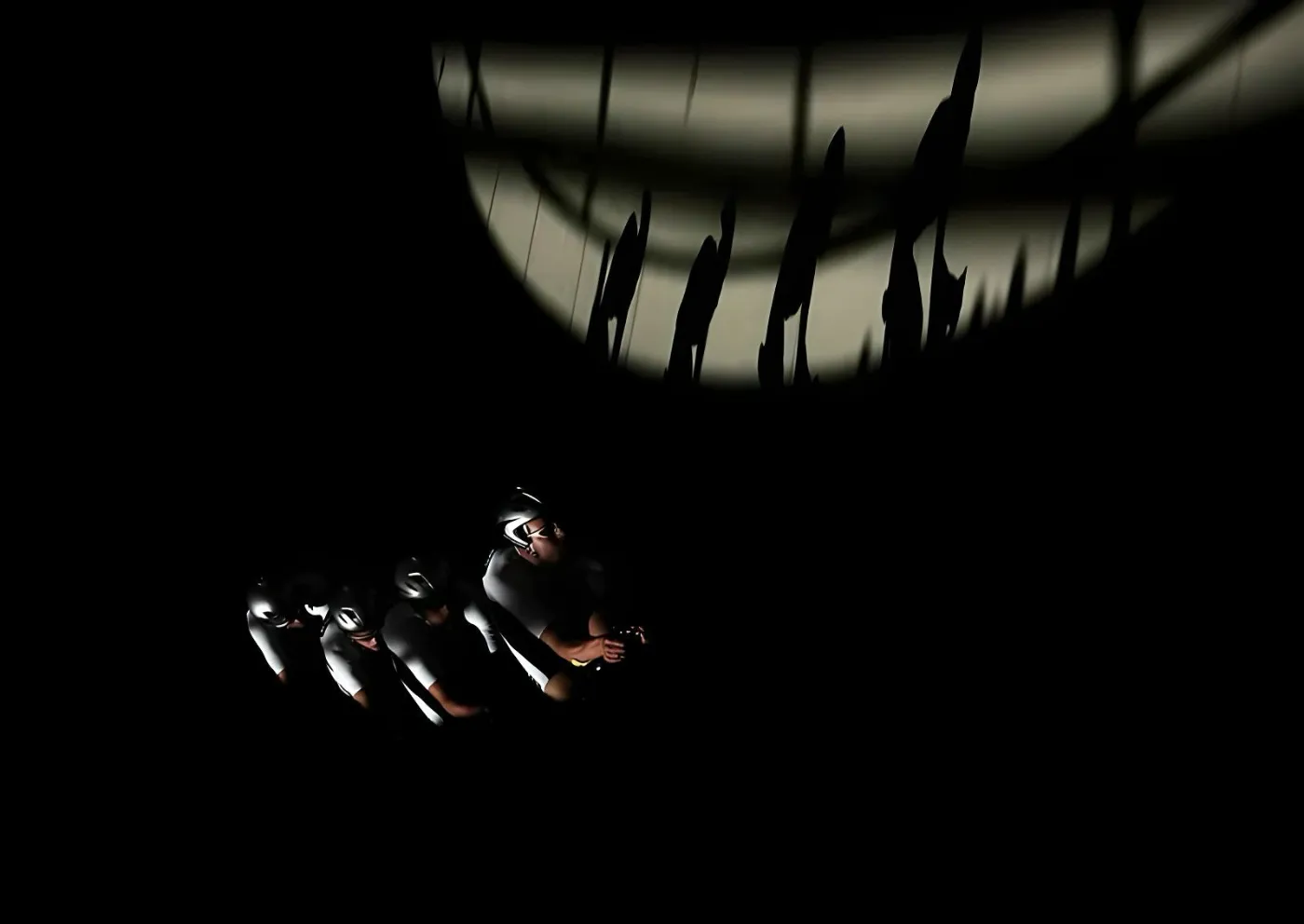
Fortunately, because other photographers see you sitting there and immediately wonder what you’re doing: ‘Why is he over there? I want to sit there too.’ It’s not just the athletes who are competitive; the sports photographers are too.
Freedom works well for me because I also want to take risks
Remember, you’re there with a thousand other photographers, all of whom are also looking for that special photo. Shortly after I took this picture, five other photographers were already looking over my shoulder.
Although I have to follow a certain schedule and am responsible for several events, Getty Images gave me a great deal of freedom during the Games. They knew I would come back with good photos, that I had ten years of experience, and therefore felt comfortable giving me more freedom.
But I need it too. Freedom works well for me because I also want to take risks. And sometimes I even want to make mistakes so I can learn from them. Of course, the Olympic Games aren’t the time to make mistakes—you naturally want to avoid them then—but still.”
The World of Getty Images
At the time, photo agency Getty Images—headquartered in Seattle, United States—was the world’s largest image provider, thanks in part to the Time & Life Pictures and Stone collections. In that capacity, it sold images to countless newspapers and magazines, as well as film and advertising agencies. To supply the daily stream of photos, Getty Images represented approximately 140 professional news photographers and worked with around another 2,000 freelance photographers—including Australian Adam Pretty.