Nikon has made its entry-level DSLR more sophisticated. The new Nikon D3100 is aimed at young families, but could it also appeal to creative hobby photographers who prefer a small, lightweight camera?

Nikon D3100
If you enjoy driving, you do not automatically choose a big, heavy, expensive beast of a car—you may have more fun in a small, stiff-sprung Japanese pocket rocket. The same can be true of cameras.
Enjoying photography and taking lots of carefully considered photos does not automatically mean you need the most pixels, the highest speed, and the greatest number of buttons.
A good photo requires two things: a good lens and a good sensor paired with good image-processing electronics.
Entry Level
The fact that you can also take good photos with an entry-level DSLR is clear from a Flickr search for images shot with Nikon's D40, the now-distant predecessor of the D3100, which had a 6-megapixel image sensor. Put a good piece of glass in front of it and the results can be beautiful. The D40x, D60, and D3000—all with 10 MP CCDs—were slightly better, but not by much. The main limitation of these image sensors was their performance at higher ISO settings.
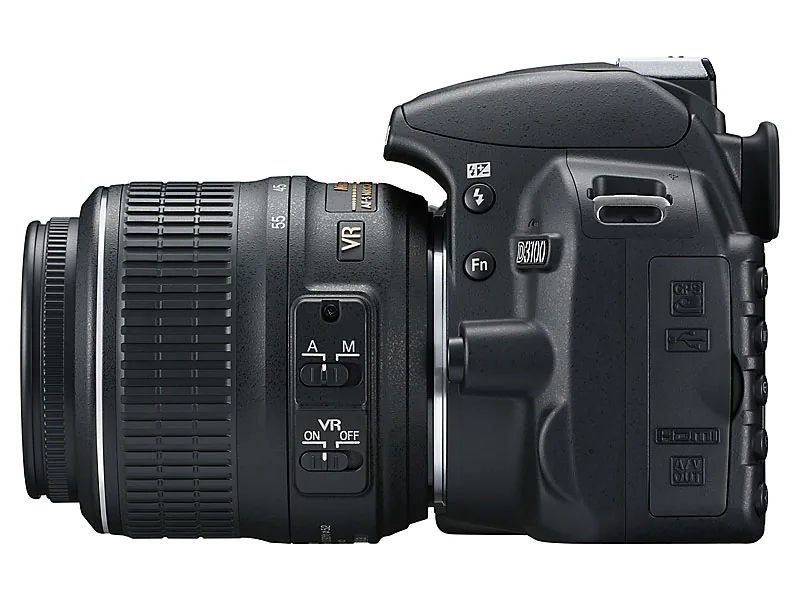
The Nikon D3100 is one of the most compact DSLRs currently available
Now comes a major step forward: a brand-new 14 MP CMOS sensor in the D3100. Its main advantage is in low light. In practice, you begin to notice the difference at ISO 800, and the advantage grows as the ISO setting rises.
Good
The new sensor produces sharp, detailed, virtually noise-free images through ISO 3200 (where it is still better than the Nikon D3000 at 800!). What an excellent little sensor! Even the two highest settings, equivalent to ISO 6400 and 12800, remain quite usable. This sensor can do justice to even Nikon's most expensive lenses!
The D3100 offers balanced color reproduction and tonal gradation, helped in part by its effective D-Lighting. Automatic white balance—the setting that still gets things wrong most often, even on the latest DSLRs—performs better than average.
Because performance is good throughout the ISO range, the D3100's Auto ISO setting is genuinely useful. It is also highly configurable: choose a preferred setting (400 or 800 is a good choice), an upper limit (for example, ISO 3200; higher values must be selected manually), and the slowest shutter speed (for example, 1/30 s with a stabilized lens).
This excellent Auto ISO function works particularly well with A mode (aperture priority). You retain control while needing to adjust very little.
This sensor can do justice to even Nikon's most expensive lenses!
Fast, but...
The 11-point autofocus system can operate very quickly and accurately. That speed is less apparent with the 18-55 mm lens because its focus drive is fairly slow. The 11 sensor positions appear as small black dots on the focusing screen. They are not always easy to see, except when they light up to confirm focus.
Most importantly, the AF sensor is highly accurate, even in low light. Atmospheric portraits by lamplight are easy, with pinpoint focus on the eyes if desired—even with the AF-assist light switched off. This is a major strength of this small Nikon.
Naturally, you can let the camera choose the AF point or select it yourself, focus with the central AF point, or use tracking AF, which follows a subject as it moves through the frame.
Like its predecessors, the D3100 has no built-in autofocus motor. This is only a problem with older lenses, which require manual focusing on this camera. It is particularly unfortunate if you want an f/1.8 50 mm lens: an inexpensive, fast portrait lens. It is high time Nikon produced a version with its own focus motor.
Guide
The feature that made the D3000 unique continues in the D3100 with its Guide mode, which uses menus to help the user choose particular settings. It is easy to use and understand.
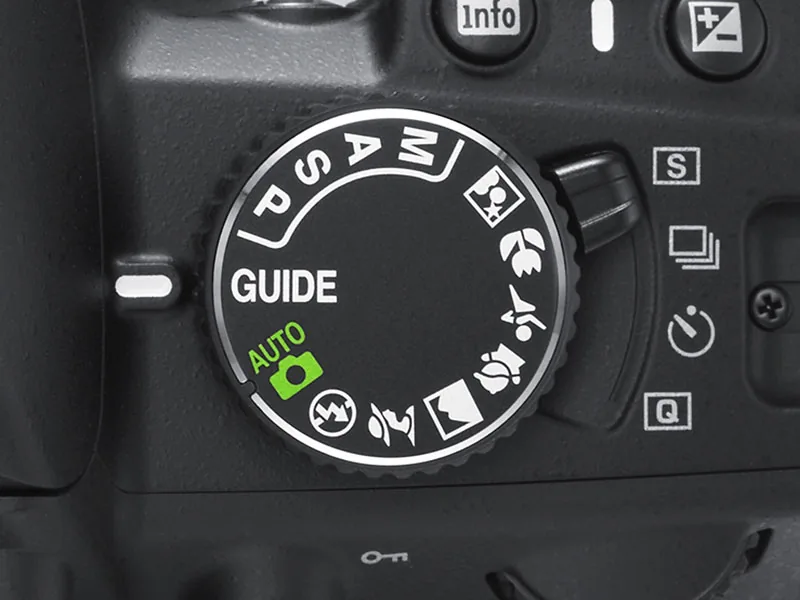
Guide mode quickly and simply leads you to an appropriate setting. It is especially useful for beginners. Once you photograph regularly, you will soon know the settings and select them directly.
In fact, the mode encourages experimentation with the camera's settings. You do not need to take a course or keep consulting the manual; you simply use the options in the Guide menu.
This system has been refined further since the D3000. Sample images show exactly what each available setting will do. When you change the aperture, for example, the sample images demonstrate how background sharpness increases or decreases. Guide mode makes the D3100 an ideal beginner's camera.

Nikon also uses sample images outside Guide mode to clarify settings. Each ISO setting, for example, comes with a practical example.
Tip: For truly attractive images with pleasing transitions between sharp and blurred areas, Nikon's new and extremely affordable f/1.8 35 mm makes an excellent additional lens.
Live view
Live view is an important addition over the D3000. It uses contrast-detection focusing, while the normal autofocus system remains inactive. Focusing is therefore slower, but the loss of speed is modest on the D3100.
Face detection can be enabled so that the camera focuses on a face automatically. It works well and is often fast enough—ideal for casual portraits at home, for example. Combine this with excellent high-ISO performance and you have a fine camera for indoor photography without flash.
The f/1.8 35 mm offers a field of view between wide-angle and telephoto. Its high image quality makes it very suitable for indoor photography without flash.
Film
The live-view image can be recorded as a movie. The large image sensor delivers very good video quality, although there are limitations. Recording always takes place at maximum aperture. That is useful for creative control over sharp and blurred areas, but it prevents you from increasing depth of field and can cause overexposure in bright sunlight. A 4x neutral-density filter is therefore useful. Nikon uses the widest aperture to make contrast-detection focusing easier.
The D3100 is designed first and foremost as an approachable DSLR for people without a background in photographic technique
Autofocus remains active during recording, but with a considerable delay. This helps prevent distracting shifts in the image, although it can also be inconvenient. A tap on the shutter-release button briefly reactivates focusing while recording. The D3100 often adjusts focus without hunting, but not always, so this is not intended for professional use. Focus noise is audible in the recorded mono sound, and there is no external microphone socket.
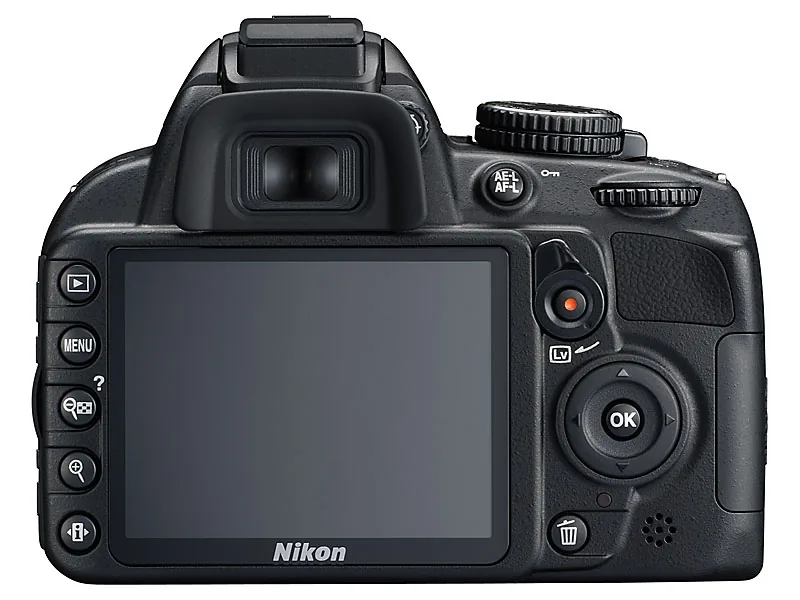
You can choose between a classic information display and a modern graphical view of the settings. The boxes at the right and bottom can be activated to change settings.
A Class Act
This sensor really calls for an excellent lens. Nikon's 18-55 is a respectable kit lens, but the clearly superior—and much more expensive—16-85 mm makes the images even sharper and more vivid. Most buyers will not make that choice. The D3100 is intended primarily as an approachable DSLR for people without a background in photographic technique, and it succeeds completely. Anyone can use it. It will usually be sold with the 18-55 mm VR or 18-105 mm VR.

The image quality of this small DSLR is so good that its relatively low price may leave room for a better or more versatile lens: Nikon's 18-200 or 16-85 mm, for example; Sigma's 17-70 mm; or one of the roughly f/2.8 17-50 mm lenses offered by several manufacturers.
Of course, the D3100 lacks features found on higher-end models, most notably auto bracketing. You must also accept a fairly small viewfinder. If you can live with those two shortcomings, the D3100 is a pleasant, very quiet camera—even outside its special Quiet mode—and fully capable of producing high-quality images.