Nikon recently introduced a new 200-400 mm lens. Fotografie.nl asked Dré de Man—a Nikon expert and veteran lens reviewer—for his impressions of it.
Nikon’s new 200-400/4 is officially called the Nikon AF-S Nikkor 200-400mm f/4 G ED VRII. The VRII designation indicates two things: first, this is a new version of the lens.
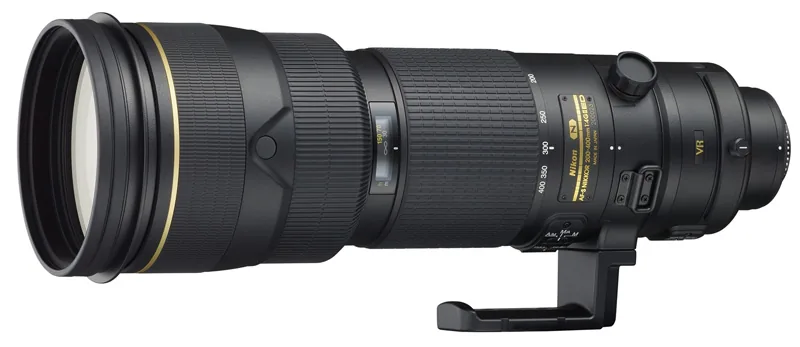
Second, VRII refers to the second, improved version of Nikon’s own image stabilization, VR. The optical design has not changed, although Nikon has added Nano Crystal Coating to several elements.
Starting with that last point: photographs of the setting sun showed that the lens is exceptionally resistant to internal reflections—quite an achievement for a design with 24 elements. Light transmission has also improved over the previous version, which was already extremely sharp.
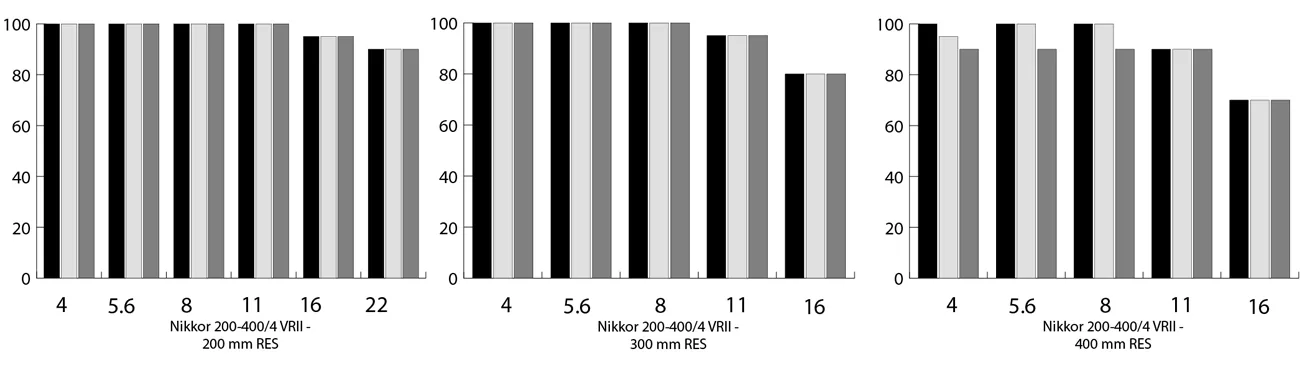
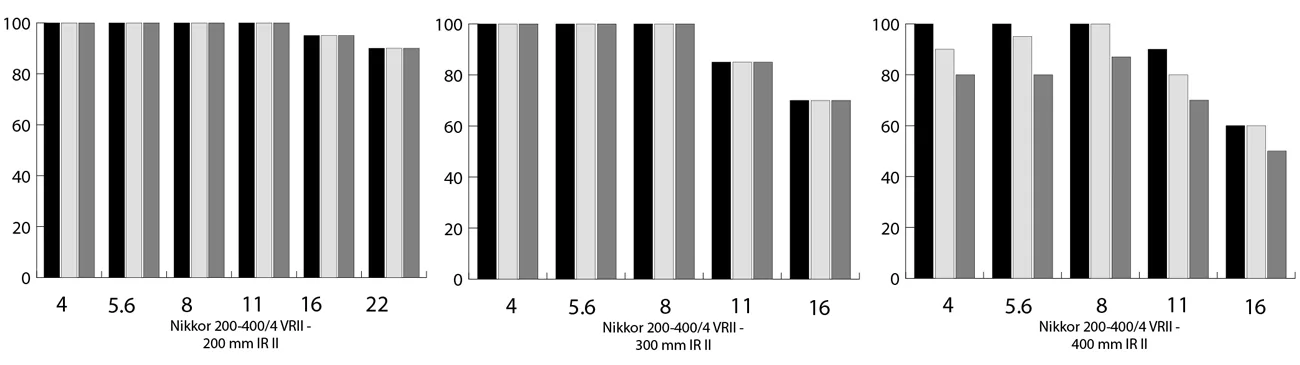
The test results confirm this: the lens scores exceptionally highly in every area. In many situations, it delivers 100% of the achievable quality. Performance is marginally lower at 400 mm, but the differences are so small that they would be barely perceptible even in highly critical landscape photographs made with the D3x. Put differently, even at 400 mm this lens is in another class from lenses such as the Nikkor AF 80-400/4.5-5.6.
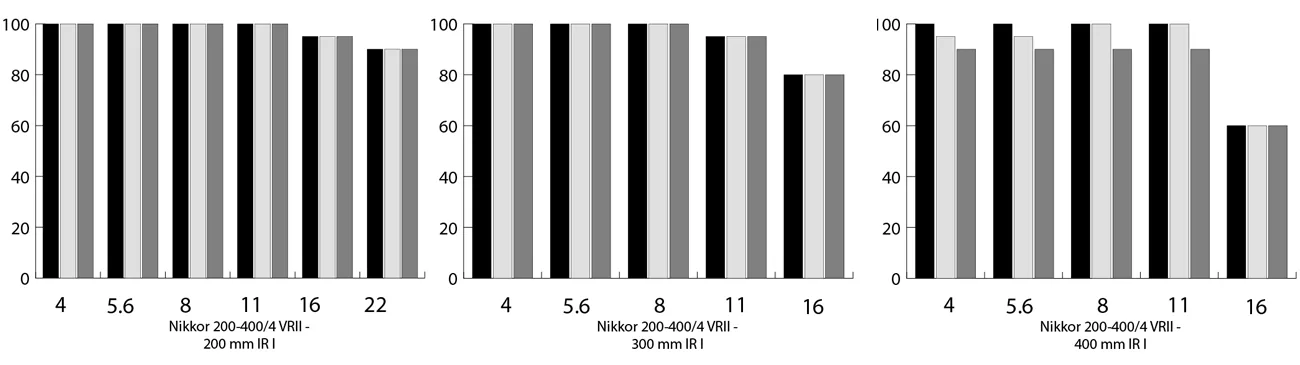
A curious result appears when the lens is stopped down: it still delivers excellent sharpness at f/16 and f/22. Contrast is somewhat lower—enough to appear in the graphs. If you need a photograph with slightly less shallow depth of field, however, it is good to know that these apertures remain usable in practice.
The lens’s only real competition comes from Nikon prime lenses, with or without a 1.4 x converter. The 200-400/4 is so good optically that you can make the choice on practical grounds.

The lens is supplied in a separate case and with its own carrying strap to reduce strain on the lens mount. A very thick, virtually indestructible, and well-coated protective element—effectively a UV filter—is fitted as standard. In the rare event that it causes reflections, it can be removed and a protective cover is included. The lens also has a 52 mm drop-in filter holder.
The lens is mechanically exemplary. It weighs 3200 grams, focuses as close as 2.3 m, and is 365 mm long. The suggested retail price, including VAT, is €7,469.
The 100-400 is slightly less expensive.