One of the best-known images of the twentieth century is the photograph Neil Armstrong took on July 20, 1969—we see Edwin E. ‘Buzz’ Aldrin taking his first unsteady steps on the Moon, as if learning to walk again.
The beauty of this historically important image—taken with a specially designed Hasselblad camera and complete with crosshairs—lies above all in the detailed reflections in Aldrin’s helmet visor. They show the illuminated figure of the photographer, the lunar landscape unfolding behind him, the Eagle lunar module, and Aldrin’s elongated shadow.
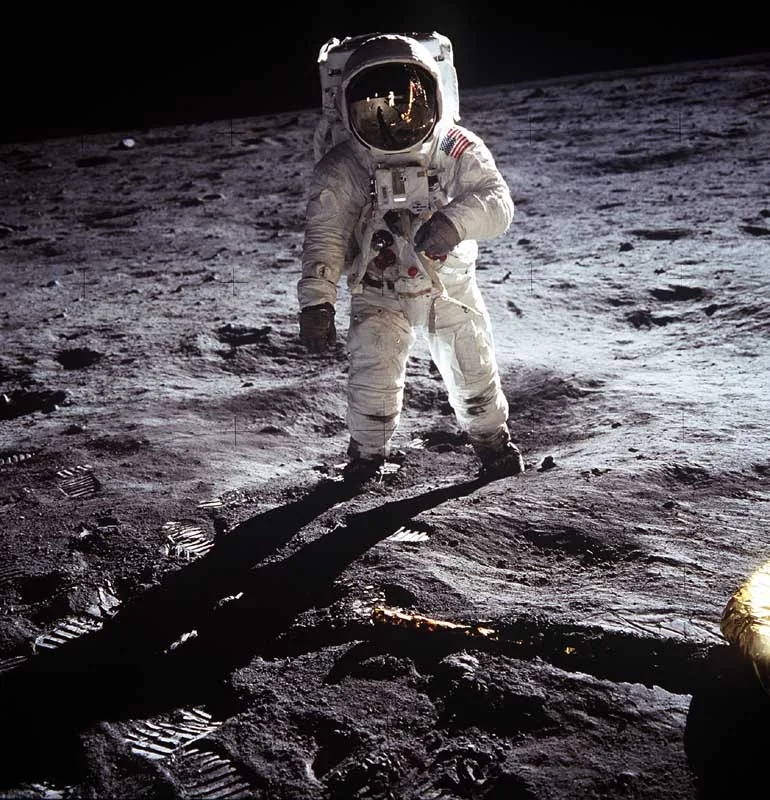
What stands out is the unique play of light, so striking that critics seized on the photograph to support the conspiracy theory that the Moon landing never took place. They claimed that the Americans had staged the photograph (as well as other Moon-landing photographs) in Hollywood fashion to win the prestige race to the Moon against the Russians.
Taken with a specially designed Hasselblad camera and complete with crosshairs
The Sun shines over Aldrin’s left shoulder, yet his right side, although entirely in shadow, contains too much detail. Moreover, the Moon has no atmosphere to diffuse the light; the photograph should therefore have been much brighter, and the landscape behind Aldrin could never have faded so slowly yet distinctly into darkness.
Finally, skeptics say that the shadows of the lunar module and Armstrong contradict one another. These are, of course, implausible arguments that do not reflect a modern mindset, but they do cast this classic photograph in a remarkable light.