Leica is not just about quality; it is also a concept. That philosophy is reflected in the X1 compact camera. Is this truly a direct descendant of the original 1913 Leica, without the marketing hype? It very well could be.
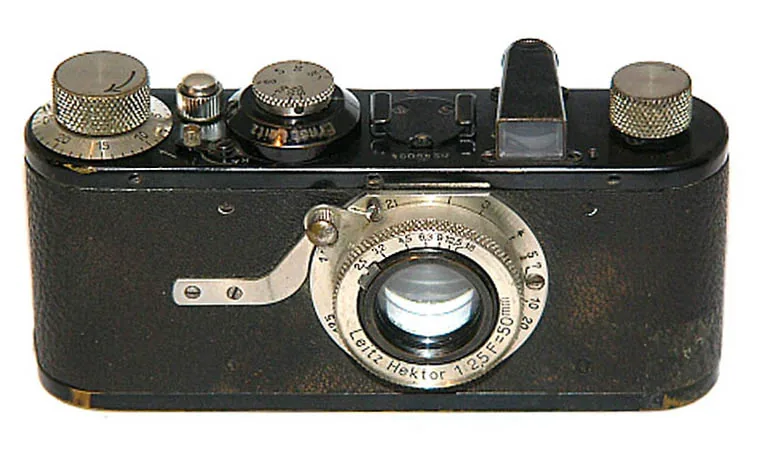
The original Leica. Early in the last century, engineer Oscar Barnack discovered that 35 mm-wide film, originally intended for motion-picture applications, was well suited to producing sharp, detailed photographs.
This required a lens capable of rendering fine detail, something microscope manufacturer Leica, where Barnack worked, was able to produce.
This led to the very first Leica: a small, flat, film-loaded box with a good lens, created in 1913. It was ideal for Barnack, whose asthma made him reluctant to carry heavy cameras but who still wanted high quality.
Leica negatives measured 24 x 36 mm and always required an enlarger to make prints. The film was so fine-grained and sharp, however, that more than enough quality remained.
A top-class image sensor and a top-class lens
It was the striking sharpness of Leica photographs that proved so convincing, thanks to the combination of a high-quality lens and a perfectly matched recording medium.
APS-C
The Leica X1 follows a similar formula: a top-class image sensor—the same as in the Nikon D90/D300s—and a top-class lens. A box with a lens attached.
No reflex system, battery pack, zoom, or interchangeable-lens system. Just everything needed to take excellent photographs while walking around, like Oscar Barnack.
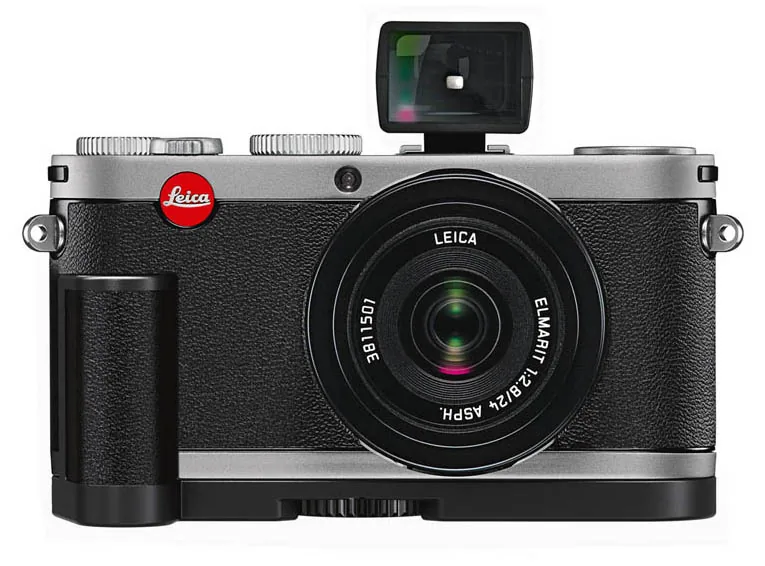
The Leica X1—whose current compact alternative is the Leica D-Lux 8—does not use the 24 x 36 mm image format but the smaller APS-C format, which can reasonably be regarded as the successor to the small-format standard because of its favorable balance between camera size and quality.
Exceptional Sharpness
The lens is a Leica Elmarit 1:2.8/24 Asph. It functions like a 2.8/36 mm lens, a pleasantly neutral wide angle for general use. It is an optical gem, with high sharpness across the entire frame. At its widest apertures, the lens is still somewhat soft, especially in the corners. That is nothing unusual; it is normal. At f/5.6 and f/8, however, it is exceptionally sharp.
When Leica is the subject, tradition is always part of the story
Chromatic aberration sometimes occurs and is easy to correct. The X1 removes it automatically in JPEGs. The lens is fairly prone to flare, which is hardly surprising given its front-row position for catching stray light. It is a shame Leica does not include an elegant retractable lens hood. The front ring of the lens can be unscrewed, so accessories will undoubtedly follow.
Simplicity
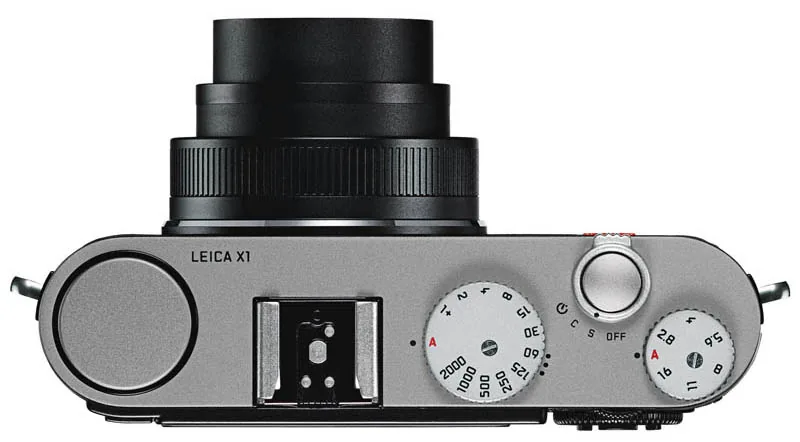
Now to using the X1. Its outward appearance of simplicity carries over into operation. There are two dials on top: one for shutter speed and one for aperture. To let the camera set either automatically, turn the relevant dial to A.
To let the camera control both, set both dials to A. It is extremely simple and is also a long-standing Leica operating method, dating back to the R4 SLR (1980), which in turn inherited it from the 1977 Minolta XD7. Yes, when Leica is the subject, tradition is always part of the story.
The two exposure-control dials. There is no need to select P, A, S, or M; everything is self-explanatory.
Automatic exposure works very well and is easy to correct, either with plus/minus compensation or with exposure lock, which activates automatically when the shutter button is pressed halfway.
A large round button sits on the left side of the camera; press it and the flash pops up. Despite its guide number of 5, the small flash is powerful enough for average indoor use.
The flash benefits from the lens's wide maximum aperture and, of course, from the excellent image sensor, which continues to deliver attractive quality at high ISO settings.
Sluggishness
Now the praise must be tempered, because the X1 is slow in several respects. When reviewing photos, for example, it takes more than a second for the image to appear. Moving to the next image is faster, but still noticeably slower than on an average midrange compact camera. Hopefully Leica will improve this. Our test camera was a preproduction model running firmware version 0.72i.
Focusing is very accurate, but feels somewhat like live-view autofocus on an SLR
Autofocus is slow as well. Focusing is highly accurate, but feels somewhat like live-view autofocus on an SLR—which makes sense, because that is essentially how it works here. Yet many much cheaper compact cameras are faster. The Panasonic GF1 and Olympus Pen cameras also focus more quickly. Even the similarly sluggish Sigma DP2 beats the Leica.
With a camera like this, you often do not need autofocus at all when shooting in cities or the countryside. Select f/11 and a medium focus distance, and everything from 1 m to infinity will be sharp thanks to the depth of field. In good weather, your shutter speed will then be approximately 1 divided by the ISO setting, making it easy to choose safe shutter speeds.
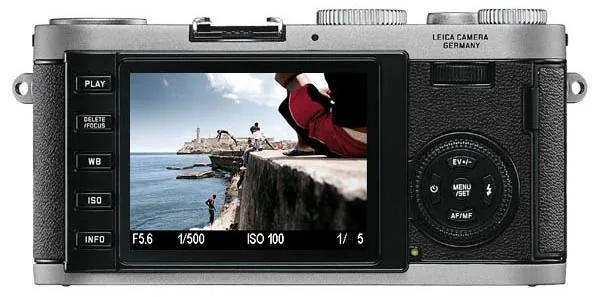
When will a manufacturer finally build this into a camera? It would be an ideal Leica feature. During manual focusing, a distance scale appears, allowing you to set the distance in meters. Above it, the center of the image appears enlarged on the screen, so you can also focus precisely on the image itself.
The camera takes two shots in rapid succession for this stabilization technique
DPReview reported that manual focusing was unusable because focusing occurred through the stopped-down aperture. That must have been a bug; everything worked as it should here.
Image Stabilization
Auto ISO, which works only with automatic exposure, is adjustable: you can set the highest permitted value—3200 is the maximum ISO—and the slowest permitted shutter speed: 1/8, 1/15, or 1/30 s. A 1/60 s option would certainly have been welcome. Image stabilization is useful at these slower speeds, but the X1's implementation has major limitations. It is electronic stabilization and works only at shutter speeds from ¼ to 1/30 second.
The X1 has two dials for settings. One is beneath the factory lettering—yes, made in Germany—and the other surrounds the five-button control pad.
For this stabilization technique, the camera takes two shots in rapid succession: a normal exposure and an underexposed image at a much faster shutter speed. The second records important lines and contours that are used as the basis for processing intended to produce a sharp image.
Because this relies on processing, stabilization works only when JPEG files are selected. That processing can sacrifice a great deal of fine detail, which does the beautiful lens no favors. It is better to switch stabilization off and use a higher ISO setting to obtain a shutter speed that reduces the risk of camera shake.
DNG
For RAW processing, the X1 produces Adobe DNG files, which are regarded as a more or less universal RAW standard. In Adobe Camera Raw, the files delivered excellent quality: fresh, clear, crisp, and sharp. The JPEGs did not initially look bad, but compared with the DNGs they are rather dull and muddy. Selecting the Vivid picture style is not a solution; it exaggerates the image without coming close to the freshness of the DNG files. It is worth remembering that the camera did not yet have final firmware.
If you are considering the X1, budget for the viewfinder right away
The JPEGs do handle high-ISO noise reduction well, though it is not adjustable. It provides a good balance between noise suppression and detail retention, especially if sharpening is set slightly below the midpoint.
Optical Viewfinder
If the X1 were smaller, it would not handle as comfortably. Its size is just right. But it only truly feels like photography once the accessory viewfinder is attached. It provides a large, bright image with a frame line and shows fairly accurately what the photograph will include. If you are considering the X1, budget for the viewfinder right away.
Value?
No, the X1 is not perfect. But if you want top quality from a small camera, it deserves serious consideration. Still, 1,600 euros, plus almost 300 more for the viewfinder? For much less, you can buy a Panasonic GF1 with a 1.7/20 mm lens or an Olympus Pen with a 2.8/17.5 mm lens. Their performance is somewhat lower, however, because their smaller sensors score slightly worse for noise and detail.
Optically, Olympus's 17.5 mm is clearly inferior, while Panasonic's 20 mm comes close to the Leica. Another camera is even closer in concept: the unconventional Sigma DP2, also with a fixed lens and costing less than half as much. But it is mainly attractive if you limit yourself to lower ISO settings.
Also remember that Leica includes a full version of Lightroom with the X1, although many prospective buyers may already own it. Still tempted? Compare it with a Nikon D90 and a 2.8/24 mm lens. Consider the cost, weight, and size, and then look at the Leica again. It has been a winning concept for a very long time.
Read this article in Dutch: Leica X1 Review.