The Limburgs Museum recently acquired eight remarkable photographs from a specialized gallery in the western Netherlands. They are probably the earliest photographs ever taken in Venlo.
The photographs document the construction of the bridge over the Meuse. Work began in September 1864, and the bridge opened on May 25, 1865. The images were made by Julius Perger (1840–1924), a German photographic pioneer who had settled in The Hague.
The original prints were scheduled to be displayed at the Limburgs Museum from Saturday, June 11, through Sunday, September 4. Because they are light-sensitive, they are exhibited in a specially designed cabinet.

When Julius Perger arrived in Venlo in April or May 1865, the bridge was nearing completion. Work continued on the approach and the first bridge section on the Blerick side, where scaffolding was still in place. The photographer performed his assignment with care, documenting the project meticulously. Yet these are also beautiful photographs: the interplay of the beams creates a strong symmetry.
The first photos of Venlo
The bridge is a monumental structure, an impressive creation by skilled engineers and builders. Perger had people pose at carefully chosen points to convey the bridge's scale. They stand motionless, looking directly into the camera or turning their gaze away.
The posed figures unintentionally reveal another distinction: the divide between gentlemen and laborers. The gentlemen wear immaculate suits and top hats, while the laborers wear work clothes and caps.
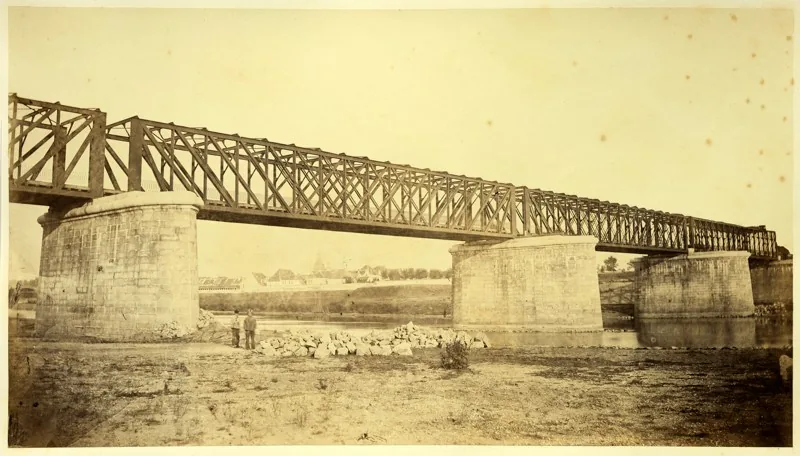
Perger was one of the photographers who documented the rapidly changing landscape of the second half of the nineteenth century. He and his colleagues photographed bridges, hydraulic works, and new railway lines. These specialists worked on commission for engineering firms, contractors, and government bodies.
The prints differ in size from today's standard formats. Perger's photographs are approximately forty centimeters wide and twenty centimeters high. They are albumen prints, made on paper coated with egg white dissolved in water and mixed with salt and a silver nitrate solution.
On November 25, 1886, everyone in Venlo turned out to witness a spectacle: the old bridge was shifted slightly in a southerly direction. This freed up space on the pier for a second bridge. A short time later it could be put into use.

The bridge photographed by Julius Perger remains etched in the memories of many Venlo and Blerick residents over the age of 75. On Friday, May 10, 1940, they awoke to an enormous blast. Shortly after four that morning, the Dutch army blew up the bridges. Not long after the invasion, both the road and railway bridges could again be used on a provisional basis.
In the fall of 1944, the river crossings became the focus of a major tragedy. Allied aircraft attacked them thirteen times, but each attempt failed. The bombs fell on Venlo and Blerick, killing or injuring hundreds of residents.
On November 25, 1944, German forces blew up the bridges. The Meuse became the front line and remained so until Venlo's liberation on March 1, 1945. In the following weeks, many people unknowingly followed in Julius Perger's footsteps. They went to the river to photograph the twisted remains. The bridges became an icon of devastated Venlo.
Learn more about the bridges at www.limburgsmuseum.nl.