Photographer Tom van der Leij travels the world. All kinds of things pass before his lens. That is how he ended up in Irian Jaya, the Indonesian part of New Guinea.
After stopovers in Kuala Lumpur, Bali, Jakarta and Jayapura, I arrive in Mulia following two days of travel. Here, in the interior of Irian Jaya, doctors from Doctors of the World run an AIDS prevention project. They also organize activities to improve access to basic healthcare and prevent infectious diseases.
I had been asked to document the project through photography for an exhibition.

Among the Dani, the Indigenous inhabitants of the region, HIV/AIDS is a growing problem. Polygamy and casual sex are considered perfectly normal here, while contraceptives are not used. It is all highly photogenic, but the diseases also make it deeply affecting.
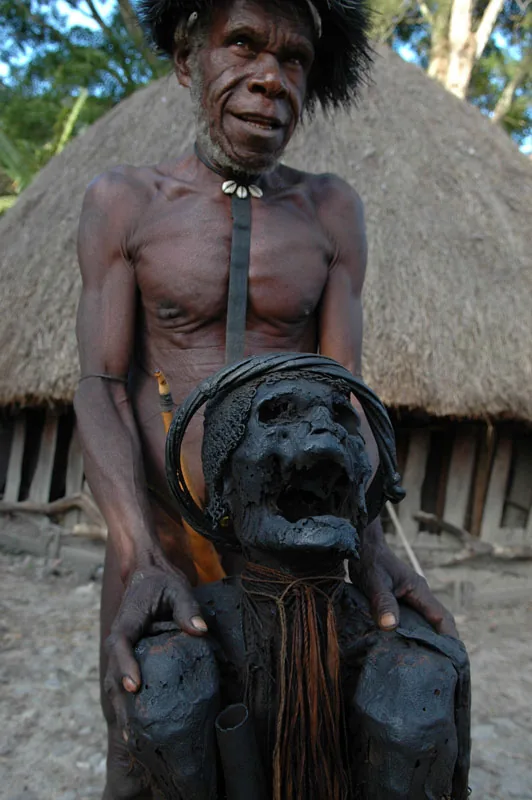
An old man retrieves one of his great-great-grandfathers from his thatched hut: a mummy as much as 350 years old
After a week, my work is done and I continue to Wamena aboard a small mission plane. It is high time to discover the remarkable people and unique flora and fauna I have heard so much about.
Just three years earlier, dozens of new animal species were discovered on this enormous island. They ranged from frogs and butterflies to the nearly extinct tree kangaroo and a new species of honeyeater, a bird.
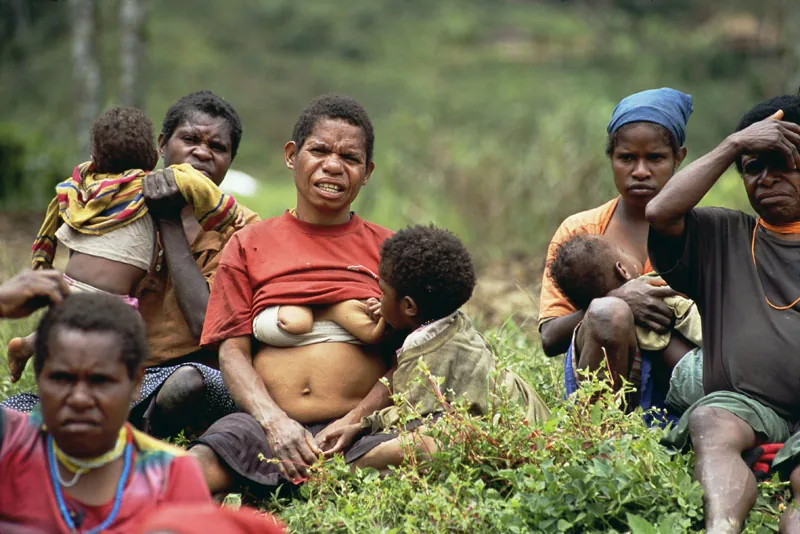
Irian Jaya forms the western part of the island of New Guinea. After Greenland, it is the largest island in the world! It was formerly a Dutch colony and was occupied by Indonesia in 1963. At the time, approximately 2.6 million people lived there, including 1.6 million Indigenous Papuans. The rest of the population consists of “outsiders” from Indonesia’s other islands, including Java, Sumatra and Sulawesi.
And if the rumors are to be believed, cannibalism was still common in the last century
Papua’s Indigenous peoples are extremely diverse. Their appearance varies by region, which makes them particularly interesting to photographers. The island separated from Australia some 60,000 years ago. Some tribes share many physical characteristics with Aboriginal Australians.
I have heard that the island’s inaccessibility means many tribes live in extreme isolation. This is one reason the Papuan tribes were among the last peoples in the world to be discovered. Each has its own language and culture, and more than 230 languages are spoken in Papua—one-fifth of all the languages in the world! And if the rumors are to be believed, cannibalism was still common in the last century. I have been warned!
Wamena lies in the Beliem Valley. This is Papua’s premier tourist attraction, but there is no mass tourism here. The valley, eighty kilometers long and twenty kilometers wide, was not discovered by Westerners until 1938. They found a highly developed society there.
Together with a guide, a porter and a cook, I head into the bush for nearly a week. We go up and down hills and cross raging rivers. After walking for two days, I feel as though I am completely in the middle of nowhere. I have not discovered any strange animal species yet, but the children sometimes look at me as though they have seen a ghost.
They have never seen a white person before, I realize! Then I hear sounds approaching. A group of people. Not just any group, but a group of tourists. And sure enough, I can clearly make out Dutch. I have mixed feelings, but I also find it very funny. Of all places, this is where I encounter a group of Dutch people.
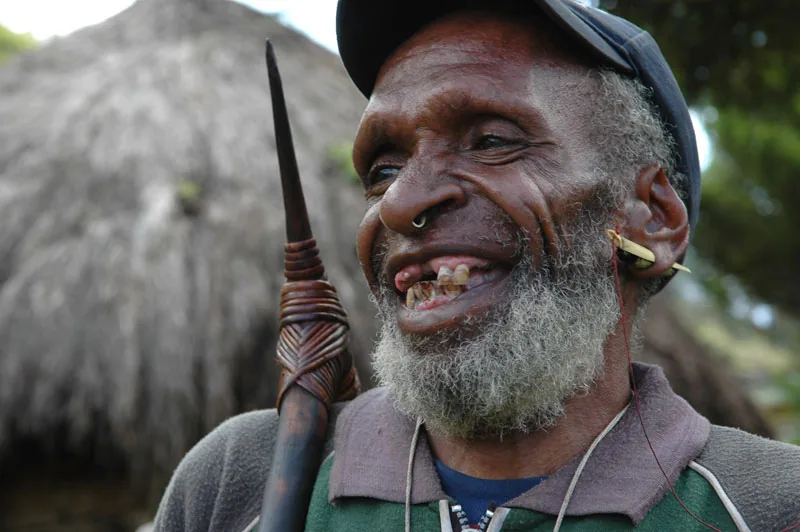
The next day, I meet several men from the Dani tribe wearing their kotekas, the well-known penis sheaths. While the koteka has been replaced by Western clothing in the cities and among young people, men in rural areas still wear it with pride.
The animal is slaughtered in front of me and thrown into a pit containing red-hot stones
Their size varies by region, depending on the materials available to make them, from gourds to bamboo.
It is time to put my plan into action, and I explain to my guide what I have in mind. I do not like staging photographs, but this one has to be staged. My idea for the exhibition flyer is a koteka with a condom over it; that seems to sum it up: AIDS prevention in Papua.
Because I keep showing them the photographs on the camera’s screen, they are perfectly fine with what I am doing. They laugh themselves silly, make jokes about me and I keep clicking away.
On the final day, I cross the unforgiving Beliem River. The new suspension bridge was built beside the old bridge, from which a Japanese tourist fell a few years earlier and was never found. This is also the endpoint of the hike.
We drive straight on to Sumpaima, a small village in the north of the Beliem Valley. I now realize that a piglet is included in the price of the hike. The animal is slaughtered in front of me, thrown into a pit containing red-hot stones, covered with leaves and steamed until done.
Before the feast begins, the men and boys of the village reenact a battle. It is a little touristy, admittedly, but it looks impressive and makes for a great photograph.
On the way back, my guide has another surprise for me. An old man retrieves one of his great-great-grandfathers from his thatched hut: a mummy as much as 350 years old. This also falls under the heading of a tourist attraction, but it nevertheless makes a profound impression on me.
For the umpteenth time, I pick up my camera, take a few shots and put it away again. I decide that I have taken enough photographs on this trip, and during the final farewell ritual I deliberately leave my camera in my bag. Every detail reaches me in a completely different way. Well, perhaps just that one last photograph.
The Positiv Papua People exhibition has been shown at Paradiso, Hotel Arena in Amsterdam and Museum Volkenkunde in Leiden.
Want to learn more about this author and photographer? Visit the Tom van der Leij page.