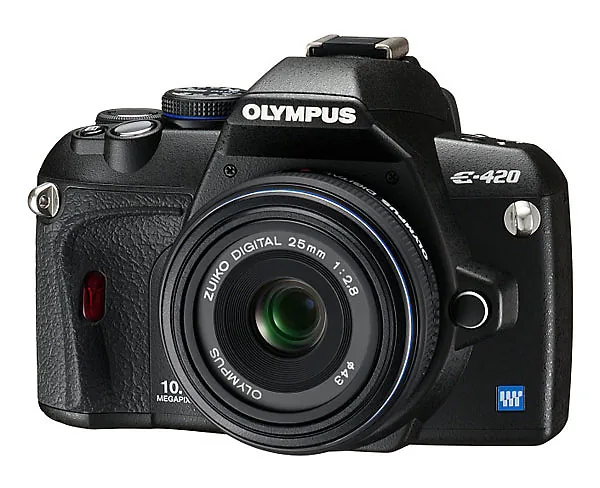
The smallest DSLR. The best way to emphasize just how small it is is to fit it with a tiny lens. Olympus gets that right. But does it deliver photographically?
Long, long ago, zoom lenses were poor and expensive. Hardly anyone took them seriously. Photographers carried large bags full of lenses and had to switch them often. And they did a lot of walking to get the framing right.
Henry Ford
Today, many DSLR buyers do not even realize that some lenses cannot zoom. In other words, there are lenses you do not have to twist before taking a picture. The only thing you can turn on such a lens is the focus ring, but you hardly ever use it because the camera focuses automatically. A prime lens like this has a fixed angle of view.
If you want your subject to appear larger or smaller in the frame, you have to walk forward or backward. It is photography's Henry Ford principle: you could buy a car in any color, as long as it was black.
Prime or zoom
Why choose a prime when you can zoom? To achieve the highest possible quality, for example: because a zoom must deliver optimum quality at different focal lengths, the manufacturer often has to make certain compromises. Or to achieve a fast maximum aperture (large maximum aperture), for example.
It is easier and less expensive to build a fast prime lens than a fast zoom. A fast zoom also becomes larger, heavier, and usually more expensive. Consider the 1.8/50 mm that several manufacturers offer at a bargain price: fast, compact, and light. It is one of the finest lenses in the lineup, at an unbelievably low price!
25 mm
Those 50 mm lenses are inexpensive in part because they use mature optical designs that have been around for a long time and no longer present many construction challenges.
They were the inexpensive standard lenses in the days before zooms became popular. They were intended to be versatile because their angle of view falls between telephoto and wide-angle.
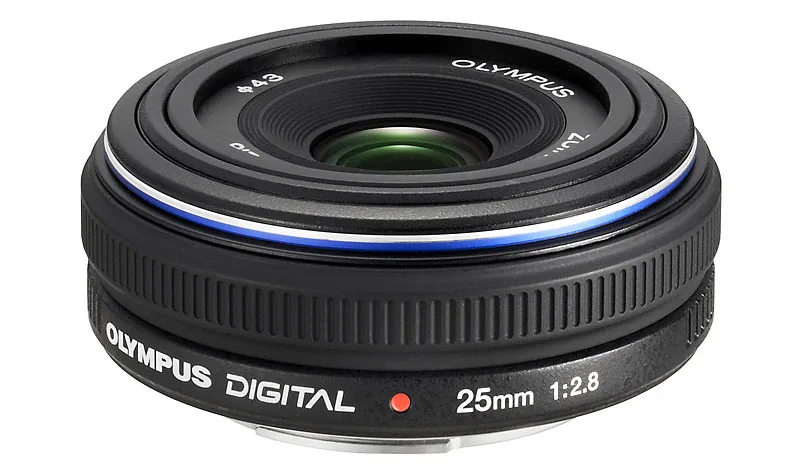
Olympus, a trendsetter in small, compact cameras for more than forty years, wanted to release an ultra-slim lens for the E-420 so that the camera could truly be called pocketable.
A zoom would be too large, so Olympus chose a prime: a 25 mm lens that, with the 2x crop factor, was comparable to the old 50 mm lens on the traditional film format. To keep it especially light and slim, its maximum aperture was set at 2.8.
Bright
You notice it immediately through the viewfinder: that 2.8 produces a brighter viewfinder image than the standard zoom's 4.0. It is very pleasant to look through and immediately gives an extra sense of quality. That is a good start.
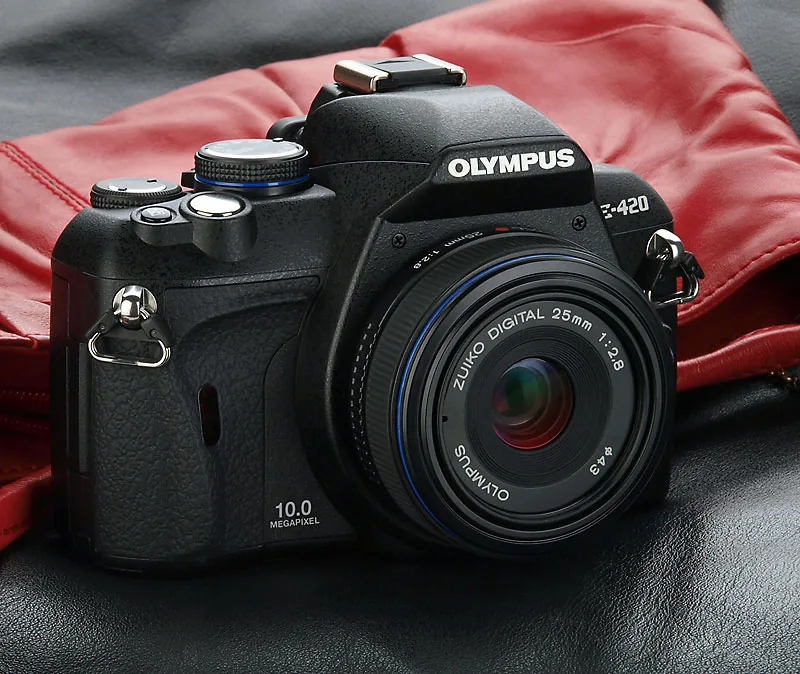
From the side, the little lens looks like a thick lens cap. Fortunately, there was still room for a proper focus ring with enough grip. It controls the focusing motor—provided the camera is set to MF (manual focus) or AF + MF. In the latter mode, you can manually override autofocus at any time.
A nice touch is that you can program the direction of rotation for manual focus. If you are used to Canon, for example, you turn counterclockwise from far to near (viewed from behind the camera); with Nikon, it is exactly the opposite. At the time, all Olympus DSLRs offered this feature.
Versatile
It is an example of the E-420's exceptionally comprehensive feature set: you can customize a great many functions, genuinely at a professional level. It also has a fully automatic mode and a large number of scene modes. A real crowd-pleaser, then.
The body is pleasantly small. It lacks the grip of the E-510/520 and therefore also has a smaller, lighter battery. Where those cameras have a grip, this one has a ridge that gives your right hand excellent purchase. Different from the 510/520, but certainly no worse! And here you benefit from an especially small, light body.
The viewfinder is small too. The squarer format makes it seem slightly larger (4:3 instead of 3:2), but this was by far the smallest viewfinder on the DSLR market at the time. Compactness exacts a steep price here.
Live view
In live view, autofocus normally uses the camera's dedicated AF system, so the mirror briefly flips back and focusing takes a long time. The image also blacks out for a moment. It is not pleasant to use at all. It is not so bad only for macro and tripod work. The 420 has a second focusing system for live view: contrast detection. It was also found on the E-3 and Panasonic L10. With this system, the camera focuses like a compact camera.
There is also a third mode, hybrid mode: when the shutter button is pressed halfway, the camera sets focus approximately; after the shutter button is pressed fully, fine focusing follows via the normal AF sensor. Hybrid AF and contrast-detection AF work only with compatible lenses, or with lenses made compatible through a firmware update.
Impressive. What does it achieve? Well, contrast-detection AF has the advantage that you can see what the focusing system is doing, which is very helpful. But the combination of live view and AF remains slow. At the time, anyone wanting live view and fast AF had only the Sony A300 and A350 to choose from.
50 mm macro
The 25 mm lens delivers excellent optical quality. It clearly outperforms the far from poor 14-42 mm standard zoom in contrast and detail. But what if, after a while, you tire of using nothing but 25 mm?

What do you add then? A zoom? Or another prime lens, to maintain that top-tier quality? The 2.0/50 mm macro is a very attractive option. It is light, compact, and a full stop faster than the 25 mm. It reaches a reproduction ratio of 1:2 (half life-size). To reach 1:1 (life-size), the lens would have to be larger and heavier, while not everyone needs that.
To reach 1:1 (life-size), the lens would have to be larger and heavier, while not everyone needs that. Olympus solves this with an extension tube available as an accessory.
This 50 mm is more than a macro lens, incidentally. It is a very fast short telephoto lens, ideally suited to portraits and reportage photography, even in low light. This lens is also of high quality: sharp and brilliant, with beautifully soft out-of-focus rendering. A dream of a lens and excellent value for money. And if the E-420 with the 25 is in one jacket pocket, this one will easily fit in the other.
A classic kit?
That gets you very close to the classic reportage kit of the fifties and sixties. There is one caveat: it would have been better if Olympus had not chosen 25 mm, but 18 or 20 mm. That would have given you a more wide-angle standard lens, which is more useful in our increasingly crowded world. The 25 mm is neither telephoto enough nor wide-angle enough.

Not suitable for portraits, and not suitable for broad views either. In my opinion. But I admit I may not be entirely right. A 50 mm equivalent is generally used to produce a natural perspective. You photograph the scene as you saw it with the naked eye—an honest image. There is something to be said for that too. The great French photographer Henri Cartier-Bresson made most of his photographs with a 50 mm lens.
So let me say that the Olympus 2.8/25 mm presents a challenge to your photographer's eye. Just like the Leica Summilux 1.4/25 mm, which also fits this Olympus (but is 4x as fast and 5x as heavy). And the Sigma 1.8/24 mm. There was plenty of choice.
As for the E-420's image quality: at ISO 400 there is no distracting noise, ISO 800 is still quite acceptable, and RAW processing can yield further useful improvements. Color reproduction is generally very good, although white balance under artificial and fluorescent light may sometimes need a little help.
A pity
Unfortunately, choosing the extra-light, extra-compact E-420 means sacrificing image stabilization. The consolation is that you need it less if you do indeed use fast lenses. Wide open, the 2.0/50 gives you a full three stops over the 14-42 mm standard zoom at its telephoto setting (f/5.6). That is roughly the advantage Olympus's image stabilization delivers under favorable conditions.
Of course, adding anti-shake would make the difference from the E-510/520 very small, but in that case Olympus might as well make it more resistant to rain and dust too, creating something special for rugged travel photography.
At the time, we were waiting to see, while respecting Olympus's efforts to remain a distinctively unconventional camera brand.