He had it all: a job as an American Airlines pilot, a villa in Dallas, a wife, and two young daughters. Then a life-threatening illness stripped away his certainties. After brain surgery and rehabilitation, Arno Knapen, now 50, is getting back on his feet. His anchor is a camera.
Ask Arno Knapen about his favorite place to spend time and he answers without hesitation: River Legacy Park, five square kilometers of fields, woods, trails, and water. Here, in this green space in Arlington, Texas, he found light during the darkest days of his life.
In late summer 2008, doctors discovered a benign tumor in Knapen's brain and decided to operate. But what should have been a period of recovery became a maelstrom of confusion and frustration. He could no longer remember even the simplest things, such as his own home address.
"It was frightening," recalls Knapen, who was born in Vlaardingen and moved to the United States in 1985. "I truly did not know what was going to happen to me."
The advice of a neuropsychiatrist...
A neuropsychiatrist advised that Knapen's brain needed exercise and stimulation. Because a camera has something in common with a cockpit—in that both require complex choices involving such things as aperture, shutter speed, and ISO settings—Knapen bought a complete kit with all the bells and whistles (specifically, a Sony A300, 18-70mm, 70-300mm, and HVL F42AM) and headed into his beloved River Legacy Park.
“At first I could not figure out how the thing worked,” he says of the camera, “but after spending hours experimenting in and around the park, I began to understand how best to capture a subject.”
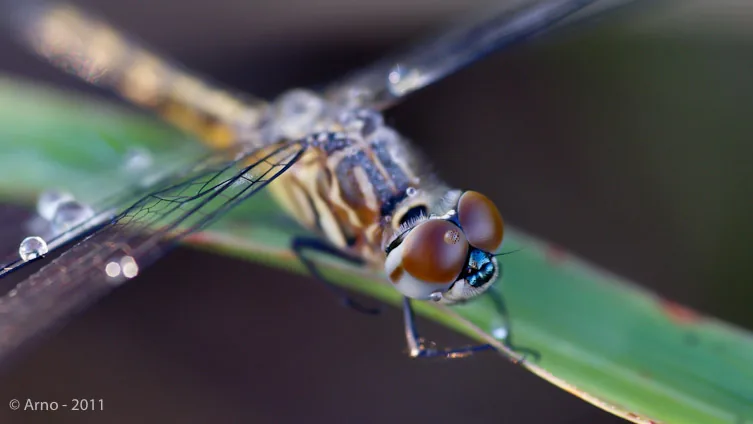
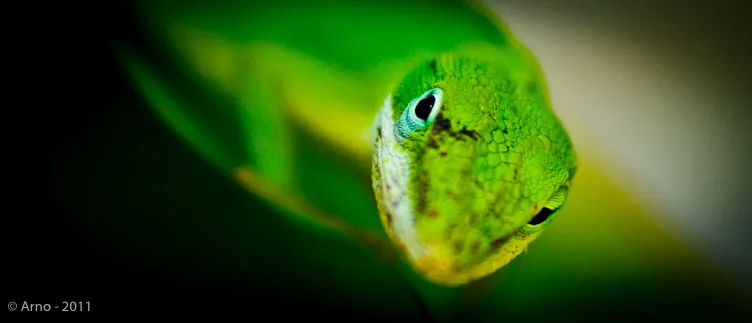
He takes the camera from his bag, gets up, tinkers with the settings, and photographs a beetle. By now, he has made tens of thousands of images. He favors experimental macro photography: close-ups of insects, animals, flowers, and plants.
It is his way of giving something back to the park that—if you will pardon the drama—saved his life
“I am drawn to shallow-DOF macro photographs: that razor-thin, millimeter-scale depth of field that reveals part of an insect at precisely the right point. I am not really interested in the standard approach to macro photography—a right angle, a flash setup, and F22 for maximum depth of field. I am looking for something different, something that bears more of my own signature.”
His work did not go unnoticed: the American Airlines pilot's strikingly colorful photographs appeared in a brochure for the River Legacy Foundation, an organization dedicated to preserving the park that holds an annual fundraiser for that purpose.
Knapen’s photographs will also be shown in an exhibition connected with the fundraiser. It is his way of giving something back to the park that—if you will pardon the drama—saved his life.
How Is He Doing Now?
Eighteen months after the operation and a series of extensive tests, he is on the way up again—literally as well as figuratively. He has returned to the air as a copilot on a Boeing 767, flying international routes.
Wherever he lands, he always takes his camera, although his focus has shifted to street photography, producing crisp black-and-white images.
His second-favorite place to spend time? Plaza de Armas, a square in Santiago, Chile, where residents gather to play chess in summer.
“Street photography—photographing people—is an intermediate step as I continue to challenge myself. I am trying to discover how I most like to portray people and to master off-camera flash techniques. With the knowledge I gain during this phase, I want to do something in portrait and fashion photography. My life has revolved around working with machines, and I am not very good with people. It is time I learned.”