You have thought it through carefully and believe you can carve out a place for yourself in the profession. Ideally, you have training and the necessary practical experience. But how do you go about working for yourself? What should you avoid? What should you definitely do? And how do you find clients? This third and final installment explains.
The basics
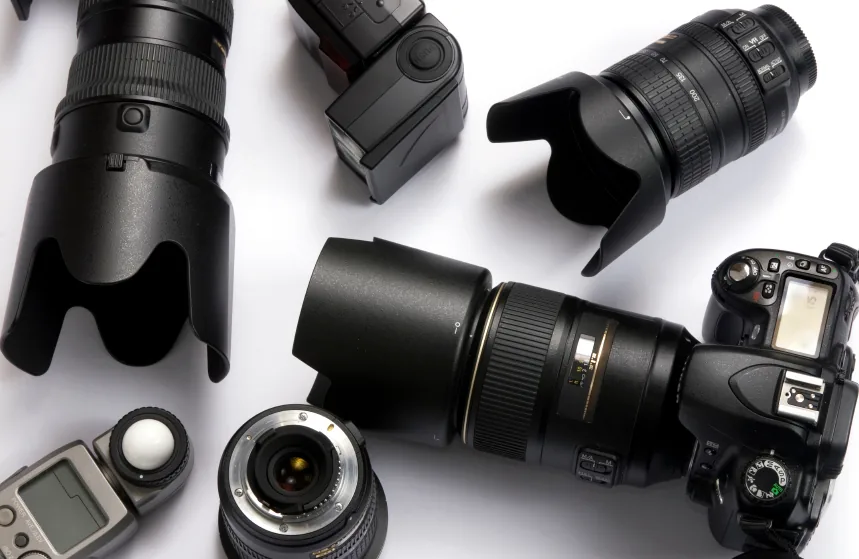
At the time this article was written, aspiring professional photographers in the Netherlands were advised to register with the Dutch Chamber of Commerce and notify the Dutch Tax and Customs Administration when starting a business. Anyone could establish themselves as a photographer without having to meet formal requirements. Depending on the specialty, some equipment was necessary; a decent semi-professional or professional digital SLR with several good lenses was considered a solid foundation.
A photographer’s basic starter kit
Until you have an impressive client list, banks are unlikely to be lining up to lend you money. Do not hesitate, however, to rent additional equipment from a specialist supplier when an assignment requires it. If you specialize in studio work, maintain a good list of rental studios until you can afford a space of your own.
Remember that clients will judge you partly by your workspace: you are less likely to be taken seriously in a run-down studio. Lighting equipment can be rented, but buy your own basic set as soon as possible. Familiar equipment lets you work more safely and cost-effectively.
Together or alone?
Many newcomers are inclined to start a business together, usually because going it alone feels daunting. First ask whether you genuinely have more to offer together than individually. Are your specialties really that different? You will need twice as many clients and must earn twice as much to take home the same amount.
In fact, there is only one sound reason to start together: sharing a studio and/or equipment. In any case, put every agreement in writing beforehand. If things do not work out later, you will at least avoid immediately becoming entangled in a difficult division of assets. To be safe, assume that a business partnership may be even more likely to fail than a marriage.
Specialization is the best way to distinguish yourself to prospective clients
Specialization and presentation
Where do your strengths lie? Photographers who can do everything are few and far between. If you are one of them, you probably do not have time to read this. Your quality will improve enormously when you focus exclusively on the work you excel at. Specialization is also the best way to distinguish yourself to prospective clients: they are more likely to remember your name when they can associate it with a particular type of work.
Make sure your specialty is clearly visible in your portfolio and present it to the best possible advantage. You need a clear story and an immediately convincing answer when asked why someone should work with you. Naturally, everything must look polished: a messy portfolio—or even dirty fingernails—will undermine the impression of quality.
Finding clients
How do you find clients? This is the thorny issue that many established photographers continue to struggle with. You never seem to gain clients quickly enough, and they are often difficult to approach. Research suggests that client acquisition is a seriously undervalued part of running a photography business. Sitting at home waiting will certainly achieve nothing. You can, of course, send mailings, but the pool of potential clients is limited, especially in advertising and publishing.
Research suggests that client acquisition is a seriously undervalued part of running a photography business.
It is therefore quite feasible to approach those prospects personally. That is more confrontational than sending a mailing, of course, but if you cannot face it, you may be in the wrong profession. Nothing beats personal contact: clients need to trust you before they will award you an assignment, and a mailing cannot build that trust. Fortunately, you have one advantage: you are new to the profession. Advertising agencies and publishers in particular will often be curious about what you have to offer because they, too, constantly need something new. This is where your opportunities lie. Be careful not to waste them—you may not get a second chance. You may find it a little easier to get through the door than established photographers, but you can also lose a prospective client’s interest more quickly.
What is your specialty?
During the first phone call, an agency will often ask for your website. They will take an initial look, and if they are interested enough, a meeting may follow. Make sure you present yourself well online, but do not show too much or there will be no reason for you to visit in person. You need to spark enough curiosity to earn an invitation; relationships develop only through personal contact.
Think of a presentation format that shows your work to its best advantage. If they invite you to present your portfolio, their interest will quickly fade if you have nothing new to show. If they are interested, remember that above all you need the opportunity to prove yourself. That matters more than making money immediately.
Many renowned photographers also did their first small assignment for free, although they may be reluctant to admit it. One option is to work on a results-only basis. Leave a digital version of your portfolio in attractive, original packaging so they can show your work to others internally and, with a little luck, your name will continue circulating around the agency for months. After a successful visit in which promises were made, stay in touch regularly. The aim is to keep your work in their minds for as long as possible.
Finding clients in corporate photography calls for a pragmatic approach. Directly approaching companies can work well here too; sometimes it is simply a matter of calling at the right moment. Be specific from the outset, give them a rough idea of your rates, and email a link to your website. Be flexible and perhaps suggest doing a trial assignment.
Equipment, studio, specialization, presentation, client acquisition, perseverance, creativity ...
At the time this article was written, a mailing was also considered a viable option, though not one from which to expect too much. Email addresses could be obtained from sources including the Dutch Chamber of Commerce. Unless you wanted to damage your reputation before it was properly established, indiscriminate mass emailing was best avoided. Few things were more irritating than spam, and it was illegal then as well.
Do not regard any of this as a guaranteed path to success; no such path exists. Perseverance is the guiding principle. Much of the advice above was learned through trial and error and may certainly prove valuable. Good luck!