In Part One, I explored the possibilities of making photography your profession. In this installment, I survey the various specializations and take a look at professional practice. I also explain how to gain the knowledge you need. The information below reflects the professional and educational landscape at the time of publication.
Advertising Photography
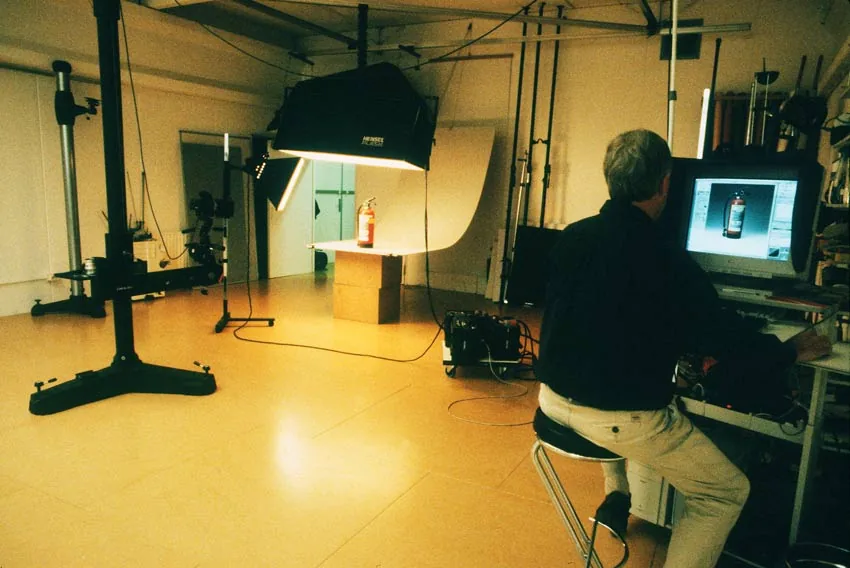
A diverse and relatively well-paid field. Ninety percent of your clients are advertising agencies. Art directors know the tricks of the trade. They are not looking for merely competent pictures; they can buy those cheaply from image banks or stock-photo agencies. More than ever, they expect something new from a photographer. Above all, you need to surprise them with an original vision.
You also need enough professional knowledge and experience to visualize your images to a high standard. Of course, once you have established a relationship, you will also be expected to deliver straightforward professional work without pretensions. But that is not what wins the client in the first place. Are you obsessed with creating images, driven to make things, and do you often look at advertising photographs and feel you could do better? Then you may be on the right track. Setting up in Amsterdam is the obvious choice. It is still the center of the advertising world in the Netherlands.
Industrial and Corporate Photography
This field is related to advertising, but as the name suggests, your clients are mainly companies. You produce corporate reports and photograph products and installations—in effect, all photography commissioned without the involvement of an advertising agency. In general, the quality standards are lower than in advertising.
That is because most clients do not have a clear idea of the best that can be achieved. Do not underestimate them, however. They still demand value for money: every photograph has to pay for itself. It is a highly varied field, but fees generally lag somewhat behind those in advertising photography.
Fashion and Lifestyle Photography
To succeed here, you need good taste, an original mind, and a strong sense of trends and fashion. You often work on location as well as in the studio, usually as part of a team with stylists and models. You therefore need to work well with people and be able to explain clearly what you want from them.
This too is a relatively well-paid branch of photography, although fees are arranged somewhat differently. Many publishers set the photographer's fee rather than the other way around. Your work appears in magazines, which is an advantage because publication often leads to new assignments.
Photojournalism
First and foremost, you are a journalist. Innate curiosity, an analytical mind, healthy skepticism, and a sense of adventure are indispensable. Regular working hours do not exist; news happens 24 hours a day. Newspapers and magazines employ only a limited number of staff photographers. You usually work freelance, or at best under a limited contract. The ability to handle stress is an advantage, while pay ranges from mediocre to poor—unless, of course, you happen to capture that unique photograph. But a photo opportunity like Willem-Alexander urinating in public does not come along every day. No matter: gutter journalism was not where you wanted to end up anyway.
Consumer and Event Photography
Think primarily of wedding photography, portraits, and school photography, or green screen photography at corporate events. Some photographers also organize photo sessions as entertainment at large gatherings, making an arrangement with the organizer. In general, you need good business instincts. Before people use your services, they will carefully compare you with the competition. There is little awareness of quality in the consumer market, so it is difficult to persuade clients on that basis. As a result, you often have to work at competitive prices.
There is also such a thing as fine-art photography. This is the umbrella term for work in which earning money comes last. If you see yourself as a true artist, this may be where you belong. I would not call it a separate specialization. If this is your path, you had better keep your current job for the time being.
There is also such a thing as fine-art photography. This is the umbrella term for work in which earning money comes last.
Education
Now that you have some idea of what is possible, let us look at how to gain the necessary knowledge. Publicly funded academies offering full-time photography programs can be found throughout the Netherlands. The best known are:
- the Royal Academy in The Hague
- the Rietveld Academy in Amsterdam
- St. Joost Academy in Breda
There are also programs in Utrecht, Enschede, and Rotterdam. All of these institutions offer evening programs as well.
In addition, there are privately funded institutions such as the Fotoacademie and the Fotovakschool. The latter is the oldest privately funded photography school, and fifty percent of self-employed photographers with a professional diploma earned it there. You can study there part-time or by correspondence.
To be admitted to a publicly funded institution, you need a convincing story. Demand generally far exceeds the number of available places. In my experience as a teacher at the School of Photography, now part of the Royal Academy, admissions committees pay close attention to motivation. When asked what you will do if you are rejected, 'go to driving school in Driebergen' is the worst possible answer. What they want to hear is, 'Then I will try again next year.' You also need to assemble a varied portfolio that gives a clear picture of your abilities. Originality and quality are the key words. Once admitted, you will receive further guidance. The integrated internship provides a good view of professional practice, so after completing such a program you will be reasonably well prepared for the profession.
Or Jump Straight In?
Not everyone is in a position to follow this route; your circumstances may not allow it. If you have enough talent, however, there are still possibilities. Simply call photographers and ask whether they have room for an intern. Above all, do not be discouraged. If the timing is inconvenient, call back later. You need to catch them at just the right moment; sometimes something has just gone wrong with a previous intern, creating an opening.
Even if they do not have a place for you, it is valuable if you can visit and show your work. Opportunities often emerge unexpectedly. Paid work as an assistant is usually unlikely, but even occasionally helping out in a photo studio gives you a major advantage over someone who has never seen one from the inside. If you are allowed to organize the archive or help with digitization, seize the opportunity with both hands. Many photographers still struggle with the digital workflow.
If you happen to be highly skilled in Photoshop, that may provide a way in. Remember that the photographer needs a good reason to let you look through work for their clients. If you say you want to start your own business as quickly as possible, I would give you little chance. Make yourself useful while keeping your eyes and ears open. 'No task is beneath me' is roughly the right attitude. Sometimes a photographer is willing to guide you by acting more or less as a mentor. In return, you can occasionally help as a freelance assistant. Meanwhile, keep working on your portfolio.
Suppose all of this works out: how do you then start your own business, what do you need, and how do you find clients? To keep using photographic terms, I will shed light on that in the next installment.