The Canon EOS 50D raises the bar. The EOS 450D had 12 megapixels, while the EOS 40D had 10. Major competitors also offered at least 12. That is why Canon gave the 50D 15 megapixels, putting an end to all the debate in one fell swoop! But... how well did that work?
At the time of publication, the EOS 40D had been extraordinarily successful. It was a large, solid camera with remarkably few shortcomings. Fast AF, high-speed continuous shooting, a magnesium body, weather sealing, live view, and automatic sensor cleaning. And all at an extremely competitive price.
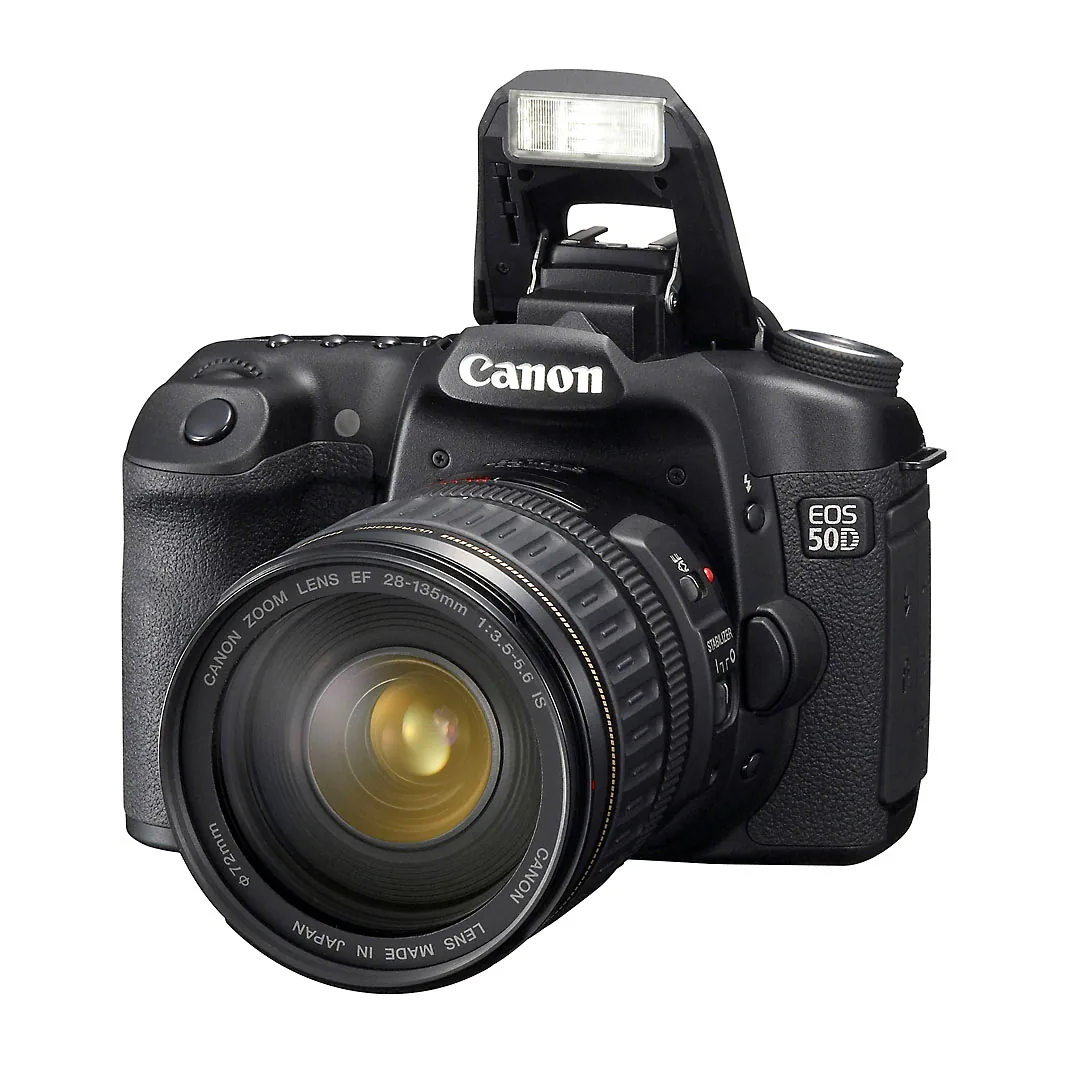
Many prospective Canon buyers are torn between the lightweight, compact 450D and the semi-professional 40D. That is because the 40D is actually too inexpensive for what it offers, especially compared with the competition. So should you stop reading and just buy it?
Not necessarily—at the time, the 50D was also finding buyers, despite being considerably more expensive than the 40D.
Added value
The new sensor has a microlens array. These lenses concentrate the light so that all of it reaches the sensor’s photosites. Nothing is lost, which should have a positive effect on noise levels.
Canon uses a new processor, DIGIC 4. It is so fast that the continuous shooting rate drops only from 6.5 fps to 6.3 fps, even though the pixel count has increased by 50%.
On the back is a stunning LCD screen with 930,000 pixels, clearly superior to the one on the 40D. The 40D’s live view offered only phase-detection autofocus, which meant the live image briefly disappeared while the camera focused. The 50D also introduced contrast-detection autofocus, which did not interrupt the live image.
The 50D’s weather sealing has been improved further, and its seams are also narrower.
The 50D recognizes which Canon lens you are using and knows exactly how much to brighten the corners of the image at each setting.
Focusing this way requires patience. It is slow and tends to hunt. The first method is faster; the second is more pleasant because the live image remains visible. You can also select face detection: the camera recognizes the shape of a face and keeps it in focus wherever it appears in the frame. It is essentially a consumer feature borrowed from compact cameras.
It works surprisingly well, incidentally (although it is slow), and could be useful in bars, at Carnival, and so on—if you are willing to take your EOS 50D into those environments.
Automatic peripheral illumination correction is also new. The 50D recognizes which Canon lens you are using and knows exactly how much to brighten the corners of the image at each setting.
It is an excellent feature and a powerful weapon in the competition with lens manufacturers Sigma, Tamron, and Tokina. You can also configure back- and front-focus correction for up to 20 lenses.
High-ISO noise reduction has also improved. The 40D offered only On and Off; here you get Off plus three levels. The same applies to the Auto Lighting Optimizer.
As for file formats, Canon adds a second, extra-small RAW format. This is useful when photos do not need to be large but you still want the benefits of RAW. Naturally, it also produces smaller files. Another new feature is an HDMI port for HDTVs.
The maximum ISO setting has increased from 3200 to 12,800.
Controls
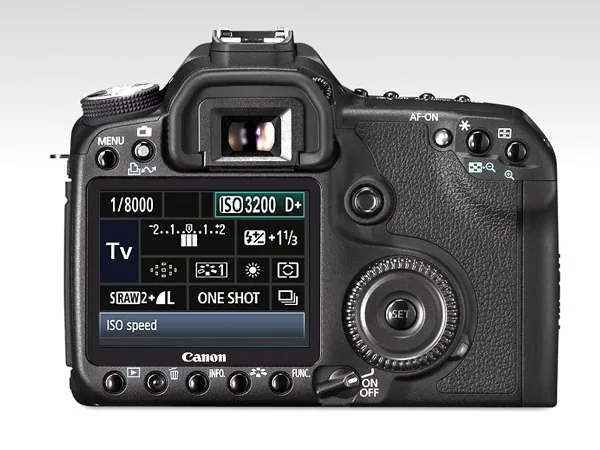
Canon has made two interesting usability improvements. The first concerns the information screen, which presented all the important functions in a very clear overview.
On the 40D, it was strictly informational: you could only view it. On the 50D, you can access this screen and change a setting directly, as on Olympus cameras. It works extremely well.
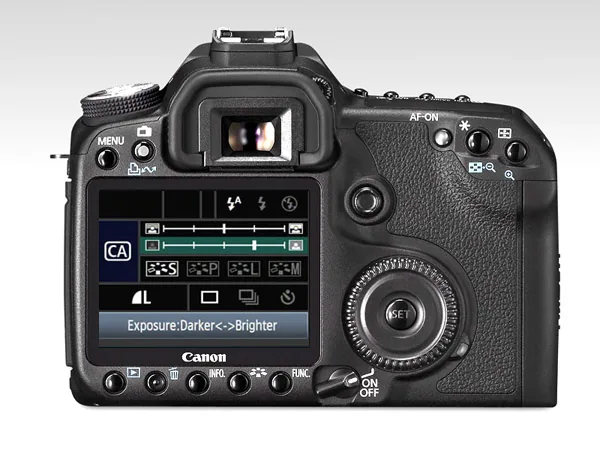
The second new feature is Creative Auto mode. The mode dial on top of the camera has a CA setting for it. This displays a screen on the back containing only the settings that the average amateur photographer needs.
Canon has also tried to present two important variables in a more intuitive way. For depth of field, you see a long scale running from a blurred background to a sharp background. This lets you choose greater or shallower depth of field.
Below it is a similar scale for exposure compensation, running from darker to brighter.
In terms of operation, the 50D is a typical Canon: businesslike, comprehensive, and free of gimmicks. Live view now has its own button, which it certainly deserves.
Fortunately, live view’s silent mode remains. In this mode, the shutter does not reset until you release the shutter button. The exposure itself is whisper-quiet (care for a contest, Leica?), while the shutter’s reset is slightly louder and can be delayed until a moment when it will not be disruptive—for example, during applause.
The camera is fast in every respect. The shooting cycle is so quick that viewfinder blackout as the mirror flips up is extremely brief. It feels very professional—and it is.
The built-in flash doubles as an AF-assist light. It fires a few brief pulses to help the camera focus in low light. This is rather conspicuous, but fortunately it can be disabled. The AF system usually performs perfectly well without this assistance.
Image quality
The big question, of course, is what those extra 5 megapixels actually deliver. Detail is slightly higher, but nowhere near proportionally so—in fact, not even close.
It is clear that the higher pixel count produces more noise, which must be smoothed away at the expense of sharpness and detail. The result is roughly on par with a good 12-megapixel camera. The remaining 3 megapixels are useful mainly to the marketing department, which will be only too happy to capitalize on them.
The highest sensitivity settings, equivalent to ISO 6400 and 12,800, produce a great deal of noise. At smaller reproduction sizes, however—a three- or four-column newspaper photo, for example—they remain quite usable. That makes these settings genuinely useful and an interesting improvement.
The result is roughly on par with a good 12-megapixel camera.
The Auto Lighting Optimizer is Canon’s counterpart to Nikon’s D-Lighting. A comparison with the Nikon D90 that happened to be on hand revealed major differences. Canon’s improvement is marginal, while the D90’s D-Lighting works minor miracles when adjusting tonal curves. The 50D often needs help from the photographer to achieve good white balance under artificial light; Nikon also performs better in this respect.
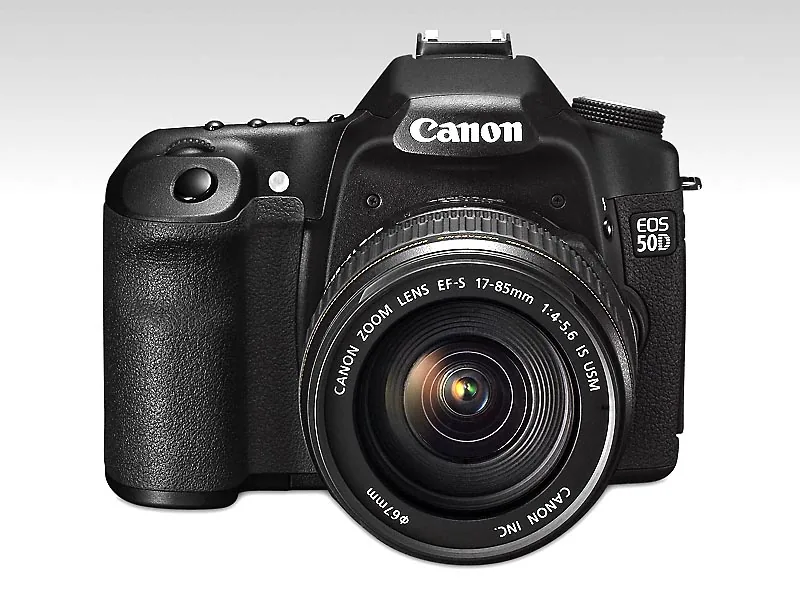
One final point about image quality: the 17-85mm lens, which Canon promotes as the standard zoom for the 40D and 50D, is not capable of doing justice to the quality of these cameras.
Canon had apparently set the bar fairly low for consumer lenses. The then-newly released, long-awaited 18-200mm IS was no standout either. Cameras of this caliber came alive with the f/4 17-40mm, the f/2.8 24-70mm, or the f/4 24-105mm IS.
Unintentionally, the 50D is a great advertisement for the 40D...
At the time of publication, Canon users were spoiled for choice in telephoto lenses, with no fewer than four 70-200mm models, ranging from the highly affordable f/4 version without image stabilization to the f/2.8 IS version. The review judged all four exceptionally good.
The pixel barrier
The Canon 50D therefore deserves some criticism, mainly because it is not much better than the 40D despite expectations that it would be. Marketing has run headlong into the pixel barrier here. Unintentionally, the 50D is a great advertisement for the 40D.
The bottom line, however, was that the 50D was an incredibly satisfying camera to use: thoroughly reliable, fast, and consistently accurate in focusing, with a usable maximum ISO of 12,800. It also offered some welcome usability improvements. At the time, it seemed well positioned to replace the 40D, after which its price could come down.