
At the time of this review, the Canon EOS 1000D was Canon’s entry-level DSLR. The differences from the 450D were not all that significant. Did that make it appealing, or not?
You could say: pay a little more and you can get the 450D. Or you could say: go ahead and buy the 1000D, and you’ll have money left for an extra battery, more memory, or extra ice cream on vacation. Which is the wiser choice?
Broadly speaking, the 1000D is a 400D with a few features from the 450D. Canon took everything that was good about its bestseller and added a few of the features that also made the 450D more appealing.
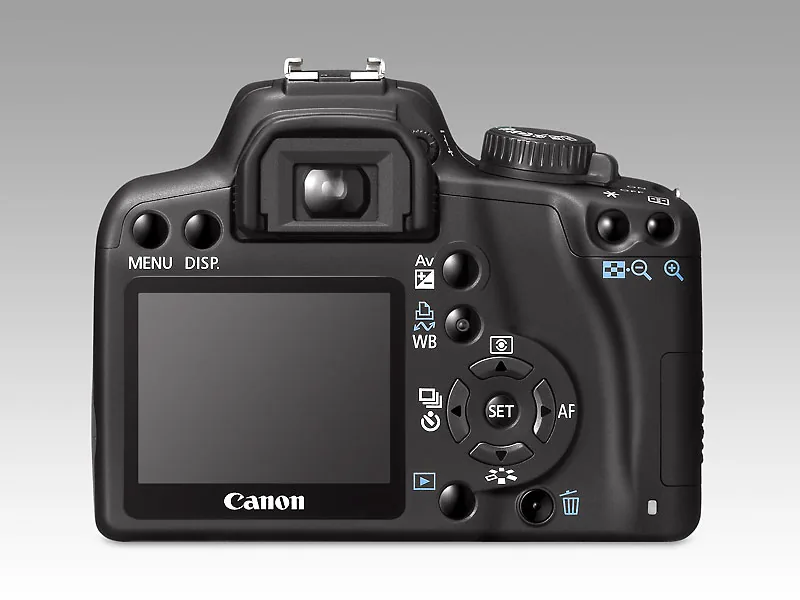
There’s the handy ISO button on top, which lets you change the ISO setting quickly and directly at any time. And the ISO display in the viewfinder, which is more than welcome when the camera is selecting ISO automatically.
Then there are the Picture Styles, which are easy to select and customize to your taste, with sharpness, color, contrast, and other settings tailored to specific subjects or preferences.
And, of course, live view. You could say Canon should have left that out to make the distinction from the 450D clearer. But Canon would probably argue that the intended audience is used to digital compact cameras and therefore wants to shoot with arms outstretched. At the time, that made this Canon’s least expensive DSLR with live view.
In practice
Any photographer with some experience will naturally confirm that the most stable way to hold a camera is with the camera against your head and your elbows tucked into your body. And although the 2.5-inch screen (450D: 3 inches) on the 1000D may be bright, it is of little use at an amusement park on a summer day.
The 1000D handles exposure extremely well, and its white balance requires relatively little intervention or adjustment.
The bright, clear optical viewfinder is one of this camera’s strengths, so use it! The 450D surprised us with the size of its viewfinder; this one is slightly smaller again, about the size of the 400D’s, but still pleasant to use.
The seven focus points the camera can use, whether selected automatically or manually, are clearly visible. The center point is a cross-type sensor. The 400D and 450D have 9 focus points; on the 450D, the center sensor has extra sensitivity, which matters with especially fast lenses.
At their widest apertures, particularly at shorter shooting distances, those lenses have so little depth of field that the added focusing precision is welcome.
If you plan to use macro lenses and fast telephoto lenses, or want to keep that option open, this is your reason to choose the 450D.
That said, the 1000D also focused quickly and accurately during the test (using an 18-55 kit lens and a 1.8/50 mm lens), at close range and at f/1.8.
Depth of field
While we’re on the subject of focus, Canon’s entry-level model also has a button for visual depth-of-field preview. Competitors have no qualms about leaving this out, assuming that new DSLR users will not care. Depth of field can be a somewhat difficult concept to explain, but mastering it is and remains essential if you want to progress beyond snapshots.
Fortunately, Canon retained it and provided two tools for it on the EOS 1000D: a depth-of-field preview button and Canon’s proprietary A-DEP function. The camera measures the distances at all 7 focus points and chooses an aperture and focus-distance setting that keeps everything sharp, where possible.
Noise and sharpness
In overall image quality, the 1000D performs much like the 400D. Color noise at high ISO settings is suppressed slightly better—very good for this class. The 450D’s newer CMOS sensor performs a little better in this respect. ISO 1600 can be used there with few reservations, while with this camera you will be more inclined to limit yourself to 800, although its 1600 setting is better than the competition’s.
The camera measures the distances at all 7 focus points and chooses an aperture and focus-distance setting that keeps everything sharp
The ISO 800 setting is very good. For maximum detail, you could even turn noise reduction off. By default, when high-ISO noise reduction is set to ‘Off,’ noise is already suppressed strongly without sacrificing detail. The automatic ISO system appropriately goes up to ISO 800; you must always select 1600 yourself.
The 1000D handles exposure extremely well, and its white balance requires relatively little intervention or adjustment. That is quite impressive. It means favorable conditions for worry-free photography.
The 1000D is light and small, making the move less intimidating for photographers coming from a compact camera. You can see just how compact it is by comparing its dimensions with the diameter of the lens mount.
A lot of camera
At the time of this review, the EOS 1000D was 80 to 100 euros cheaper than the EOS 450D. If you are an ambitious beginner, it may be better to spend the extra money: the 450D’s maximum image quality, more sensitive autofocus, and better viewfinder make that premium worthwhile.
That does not disqualify the 1000D: it simply offers a lot of camera for the money, and the savings compared with the 450D can go toward adding a telephoto zoom, such as Canon’s 55-250 mm IS.
At the time, the standard 18-55 lens was considered unexceptional, so you could instead choose a better standard lens: Canon’s 17-85 mm IS, or Sigma’s 17-70 mm, which was considered even better but lacked image stabilization.
If you choose the 18-55, be careful: the EOS 1000D was also sold with the regular 18-55 mm lens (without IS, and therefore without image stabilization), making it slightly less expensive than the version with the 18-55 mm IS.