The Limburgs Museum holds a collection of approximately 3,600 glass negatives dating from the nineteen thirties. Almost all were made by Jan de Jong, a photographer whose work appeared in publications including Panorama, Katholieke Illustratie and Libelle. De Jong worked in the southern Netherlands. In 2010, the Limburgs Museum and Mediagroep Limburg published the book Het glazen album van Limburg.
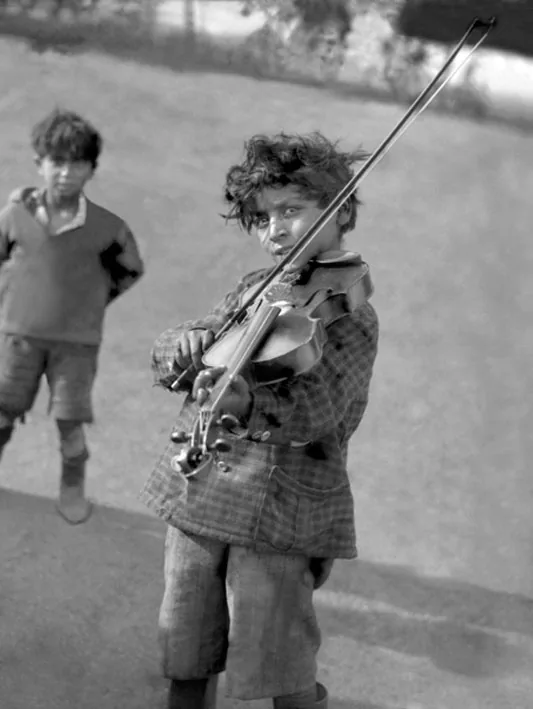
One of the photographs in the publication attracted the special attention of amateur historian Rob Hendrikx of Lanaken, Belgium, in early 2014. In the photograph—which Jan de Jong had titled Brunssum. At the caravan camp: the little violinist he immediately recognized Willy Steinbach, an older brother of Settela Steinbach.
Many people know the girl Settela from one of the most famous photographs of World War II—she looks out, confused and frightened, from a freight car whose door has not yet been fully closed.
Rob Hendrikx contacted the Limburgs Museum, which holds three other glass negatives that Jan de Jong made at the caravan camp in Brunssum in October 1935. These images show many members of the Steinbach family.
Settela, who would become world-famous, was ten months old at the time and was being held by her sister Elisabeth. Large-format prints from these unique and historically important negatives were displayed in a small presentation titled:
1944
The little violinist Celestinus ‘Willy’ Steinbach
Murdered at Auschwitz
2014
In the years before World War II, Heinrich (Moeselman) and Emelia (Toetela) Steinbach and their large family traveled among several places in southern Limburg, including Maastricht, Buchten, Brunssum and Susteren. From July 1943, the occupying authorities no longer allowed caravans to travel. The family ended up at the caravan camp in Tongelre, Eindhoven.
On May 16, 1944, acting on Nazi orders, Dutch police carried out the only large-scale roundup of Sinti and Roma in the Netherlands. The father, Moeselman, had already been interned at Camp Amersfoort. His wife and nine children were arrested in Eindhoven and deported via Westerbork to Auschwitz several days later. The four oldest children were sent from Auschwitz to labor camps, where they died from illness and deprivation.
Their mother, Toetela, and the five youngest children were placed in the special section for Sinti and Roma at Auschwitz-Birkenau and were murdered in the gas chambers two months later. Moeselman survived the war, but never recovered from the loss of his family and died in Maastricht on June 9, 1946.
The haunting footage of Settela Steinbach as the train departed Westerbork made the girl a symbol of the Holocaust. It was not until 1994 that a journalist discovered her identity and established that she was not a Jewish girl, but a Limburg Sinti girl.
Limburgs Museum
Keulsepoort 5
5911 BX Venlo
www.limburgsmuseum.nl