For many photographers, AI transparency sounds like a matter for lawyers and platforms. In practice, it comes down to a much simpler question: are you showing an image that looks real even though AI played a substantial role in writing or constructing it?
From August 2, 2026, the EU AI Act generally applies, including the transparency duties in Article 50. This is not a blanket rule requiring every photographer to label every AI-assisted edit. It does make it more important to consider one thing in advance: what exactly did you do to an image, and do you need to disclose that honestly?

For photographers, picture editors, and competition entries in particular, this is no longer a theoretical issue. Not because every edit is suspicious, but because the distinction between a photograph, an edited photograph, and a synthetically constructed image is becoming less self-evident.
The real question is not which tool you used
It is tempting to approach AI mainly as a technical matter. Did you use Generative Fill? A smart retouching tool? Replace a background? Generate a face? Ultimately, however, the result matters more than the button.
...the software list matters less than the possibility that someone may mistake your image for a moment that was actually captured.
Article 50 divides the duties by role. Providers of AI systems that generate synthetic image, audio, video or text must generally make outputs machine-readable and detectable as AI-generated or manipulated, except where the system only assists with standard editing or does not substantially alter the input or its meaning. Deployers who publish image, audio or video that constitutes a deepfake must disclose that it was artificially generated or manipulated. For clearly artistic, creative, satirical or fictional work, the disclosure may be made in a way that does not hamper the work. In other words, this is not a universal label duty for every photographer or every AI-assisted correction.
That also makes the issue more concrete for photographers. Cleaning up a sky or removing a speck of dust feels different from convincingly constructing an entire scene with elements that never existed. There is a gray area between those extremes, and that is precisely where it helps to ask yourself the same question each time: if I do not explain this, could a viewer be misled?

Not every use of AI needs the same label
This is also where much of the concern arises. No, every minor AI correction does not automatically trigger the same duty. Article 50 itself distinguishes synthetic or substantially altered output from systems that only assist with standard editing or do not substantially alter the input or its meaning.
Light color correction, removing a distracting spot, noise reduction, or limited cosmetic retouching will generally not carry the same weight as a nonexistent person, a fabricated event, or a convincingly manipulated news scene. That does not mean disclosure is always unnecessary. Standards may be stricter in a competition, an editorial context, or a documentary series than in independent artistic work.
There is also more leeway for work that is clearly artistic, fictional, or satirical. A surreal image that plainly does not claim to depict a literal real-life moment is different from a reportage-style portrait that appears to come directly from reality.
What photographers should record now
If you use AI tools frequently, it is wise to document your workflow a little more carefully than before. This does not require a thick dossier. A few simple habits are often enough:

• note what AI did in each image: clean up, extend, replace, generate, or combine;
• keep intermediate versions, especially for assignments, competitions, or editorial work;
• use clear language, such as 'image containing AI-generated elements' or 'image editing with generative AI';
• reassess each publication: a gallery, newspaper, competition, or stock platform may have its own rules;
• be especially transparent in journalism or documentary work, where trust matters more than clever cleanup.
The benefit is not only that your legal housekeeping is better. It also helps prevent practical disputes afterward. If a client, jury, or editor asks exactly what happened, you will not have to reconstruct the process.
Competitions and editors will pay closer attention
For photographers, that may be the biggest change: not that everyone will suddenly be fined, but that editors, platforms, and competition organizers are likely to make their forms and rules more specific.
The old question, 'Has this image been edited?' has become too vague. Almost every digital photograph is edited in some way. The more relevant question is whether generative AI was used and, if so, exactly where: for the background, an object, a face, or the entire scene?
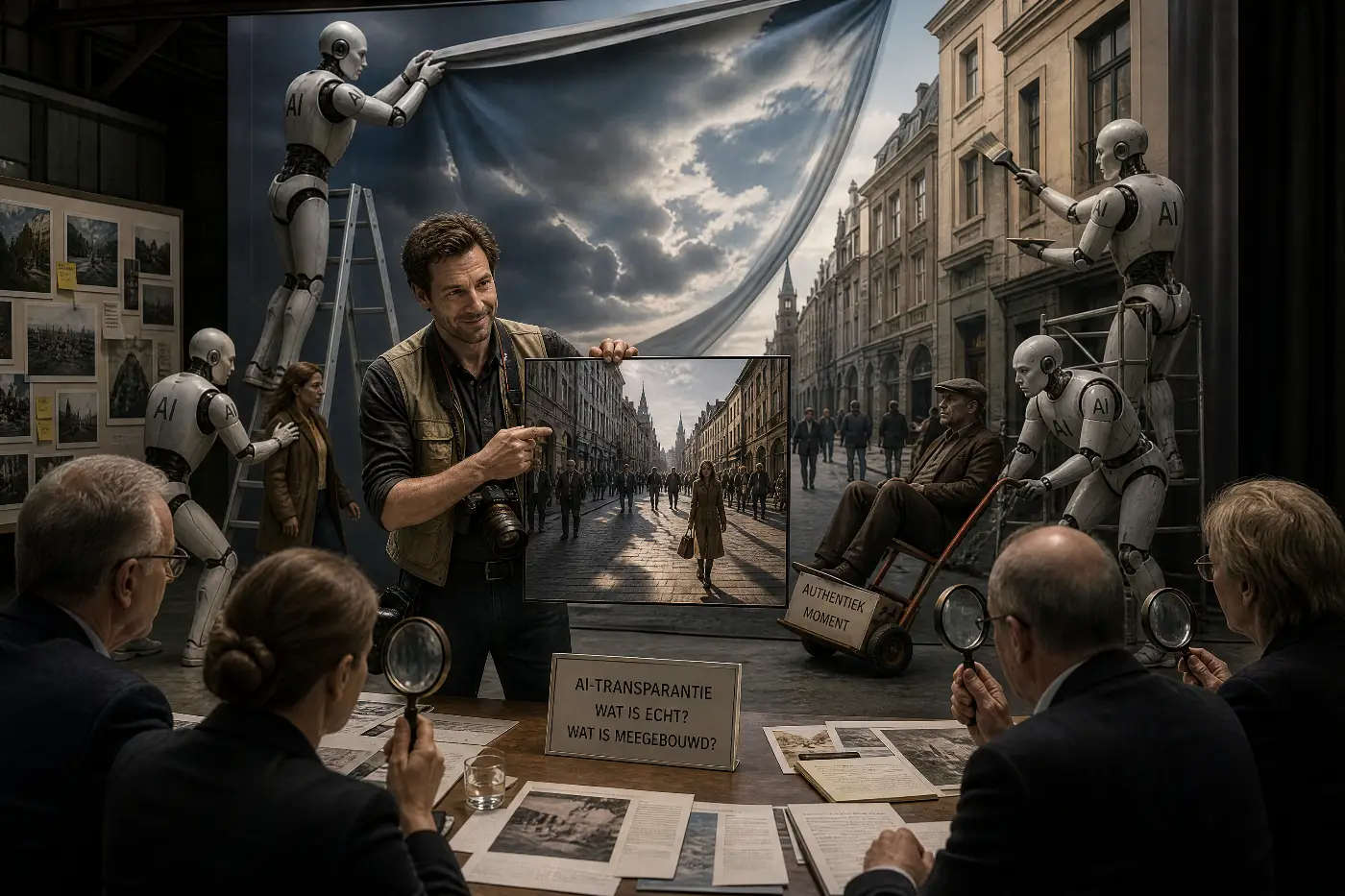
Communicating clearly about that now puts you ahead of the discussion. This also applies when you regard your own AI intervention as minor. What seems like a technical detail to you may be precisely the point on which a jury or editor wants more information.
Transparency will simply become part of the profession
The main change is probably not in the software, but in the way you talk about image editing. An honest label does not make work less creative, less beautiful, or less interesting. It mainly shows that you understand what the viewer believes they are seeing.
This is exactly where photography will face greater scrutiny in the coming period. Not because every maker should be distrusted, but because credible-looking images are easier to fabricate than ever. A calm, open approach protects not only the photographer but also the trust on which photography still depends.